BW Offshore Business Model Canvas

BW Offshore: Business Model Unveiled
Discover the strategic core of BW Offshore with our comprehensive Business Model Canvas. This detailed analysis unpacks how they deliver value through innovative offshore solutions and secure long-term client relationships. Ready to explore their competitive advantage?
Unlock the full strategic blueprint behind BW Offshore's business model. This in-depth Business Model Canvas reveals how the company drives value, captures market share, and stays ahead in a competitive landscape. Ideal for entrepreneurs, consultants, and investors looking for actionable insights.
Partnerships

Strategic Alliances for New Technologies
BW Offshore actively forms strategic alliances with technology providers and other industry leaders to drive the development of new energy solutions. A prime example is their partnership with McDermott, focusing on offshore blue ammonia production, a key area for decarbonization.
These collaborations are vital for BW Offshore to tap into specialized expertise and accelerate their progress in nascent low-carbon markets. By working with partners, they can share the risks associated with innovative projects and efficiently expand their reach into new geographical and technological territories.
Offshore Wind Co-development Partners
BW Offshore's strategic approach to offshore wind involves significant co-development partnerships, most notably its 64% ownership in BW Ideol, a frontrunner in floating offshore wind technology. This substantial stake underscores BW Offshore's dedication to advancing renewable energy, enabling shared risk and expertise in the execution of floating wind projects.
Collaborations with other key developers are crucial for bringing these ambitious projects to fruition. For instance, partnerships with entities like EDF Renewables and Maple Power were instrumental in securing projects from the Mediterranean Tender, highlighting the importance of these alliances in navigating complex tender processes and project development.

Shipyards and Fabrication Facilities
BW Offshore collaborates with premier shipyards worldwide for the construction, conversion, and upkeep of its Floating Production Storage and Offloading (FPSO) units. These partnerships are vital for accessing specialized infrastructure and skilled labor necessary for complex, large-scale maritime projects, ensuring the operational readiness of their fleet.
A prime example of this synergy is BW Offshore's relationship with Seatrium in Singapore. Seatrium played a crucial role in delivering significant FPSO projects, such as the BW Opal. This collaboration underscores the importance of strong shipyard relationships in executing major vessel developments and maintaining BW Offshore's extensive fleet capabilities.

Oil and Gas Field Operators
BW Offshore's core strength lies in its strategic alliances with international and national oil and gas field operators. These vital partnerships are the bedrock of its operations, enabling the deployment of Floating Production, Storage, and Offloading (FPSO) units for hydrocarbon extraction and processing. For instance, BW Offshore's collaboration with Santos on the Barossa project highlights this crucial relationship, as does its involvement with Equinor for the Bay du Nord pre-FEED study.
These long-term contracts with field operators are not merely transactional; they represent a symbiotic relationship where BW Offshore provides essential infrastructure and services, and the operators secure reliable production solutions. This reliance translates directly into a stable revenue stream and a robust project pipeline for BW Offshore, underscoring the significance of these key partnerships in its business model.
- Client Reliance: Operators like Santos and Equinor depend on BW Offshore's FPSO technology for efficient offshore field development and production.
- Revenue Generation: Long-term contracts with these major oil and gas companies are the primary drivers of BW Offshore's financial performance and project visibility.
- Strategic Importance: These partnerships are fundamental to BW Offshore's ability to execute complex offshore projects and maintain its market position.
Financial Institutions and Investors
BW Offshore's financial partnerships are crucial for its capital-intensive operations. The company actively collaborates with a wide array of financial institutions, including major banks and investment funds, to secure project financing and various debt facilities. These relationships are fundamental for raising the necessary capital to fund its substantial fleet expansion and to support its strategic pivot towards energy transition initiatives.
Maintaining robust connections with these financial stakeholders is paramount. It ensures BW Offshore has consistent access to liquidity, which is vital for undertaking large-scale projects. For instance, in 2024, the company continued to leverage its strong banking relationships to manage its debt portfolio and explore new funding avenues for its growing renewable energy ventures, such as the floating solar projects.
- Project Financing: BW Offshore secures funding for specific offshore projects through syndicated loans and partnerships with development banks.
- Debt Facilities: The company utilizes various credit facilities and bond issuances to manage its overall capital structure and operational needs.
- Capital Raising: Equity offerings and private placements are employed to raise capital for strategic growth, including fleet upgrades and investments in new energy technologies.
- Investor Relations: Consistent engagement with institutional investors and shareholders is maintained to ensure confidence and support for the company's long-term strategy.
Strategic Alliances Drive Offshore Innovation and Operations
BW Offshore's key partnerships are multifaceted, spanning technology providers, shipyards, and crucially, oil and gas field operators. These alliances are essential for project execution and revenue generation. For example, collaborations with technology firms are driving innovation in blue ammonia production, while shipyard partnerships ensure the construction and maintenance of their FPSO fleet. In 2024, BW Offshore continued to rely on these relationships to navigate complex offshore projects and maintain its operational capabilities.
What is included in the product
 Detailed Word Document
This BW Offshore Business Model Canvas provides a structured overview of their operations, detailing key partnerships, core activities, and revenue streams derived from offshore production and floating storage solutions.
It clearly outlines their value propositions to oil and gas clients, customer relationships, and cost structures, offering a comprehensive view of their strategic approach to the offshore energy sector.

 Customizable Excel Spreadsheet
BW Offshore's Business Model Canvas acts as a pain point reliever by providing a clear, visual framework to identify and address operational inefficiencies and strategic gaps.
It simplifies complex challenges, enabling rapid understanding and targeted solutions for improved performance and profitability.
Activities

FPSO Design, Engineering, and Construction
BW Offshore's core strength lies in its comprehensive approach to FPSO (Floating Production, Storage, and Offloading) vessels, encompassing design, engineering, and construction. This end-to-end capability allows them to manage the entire lifecycle of these complex offshore assets.
The company's expertise is evident in projects like the BW Opal for the Barossa field, a testament to their ability to handle intricate technical planning and execution. This project highlights their commitment to delivering specialized offshore production solutions.
Leveraging decades of accumulated experience, BW Offshore excels at creating bespoke FPSO units tailored to specific field requirements. Their track record demonstrates a consistent ability to deliver high-quality, integrated offshore production facilities.
FPSO Operation and Maintenance Services
BW Offshore's core activity revolves around the operation and maintenance of its Floating Production Storage and Offloading (FPSO) vessels. This ensures their fleet achieves high commercial uptime and maximizes hydrocarbon production efficiency.
This crucial function demands robust technical support, intricate logistics planning, and skilled personnel management, all executed within challenging offshore conditions. For instance, in 2023, BW Offshore reported an average fleet availability of 95%, underscoring their operational prowess.
These comprehensive FPSO services are typically secured through long-term contracts, which are vital for generating predictable and stable revenue streams for the company.

Offshore Wind Project Development
BW Offshore is actively developing offshore wind projects, focusing on floating wind technology via its subsidiary, BW Ideol. This strategic move diversifies their energy portfolio, moving beyond traditional oil and gas operations.
The company participates in competitive tenders and manages project progression from initial design through to potential installation phases. For instance, BW Ideol is involved in the development of the Windfloat Atlantic project, a significant floating offshore wind farm.
This expansion into offshore wind aligns with global energy transition goals and represents a key part of BW Offshore's strategy to capitalize on the growing renewable energy market.

Strategic Asset Management and Divestments
BW Offshore actively manages its fleet through strategic asset management and divestments to maintain a competitive and modern operational base. This involves the careful selection of assets for sale or acquisition, aiming to optimize capital allocation and align the fleet with evolving market needs and technological advancements.
The company's approach ensures a dynamic portfolio, shedding older units while integrating newer, more efficient vessels. For instance, the divestment of the FPSO BW Pioneer exemplifies this strategy, freeing up capital and resources. Simultaneously, the acquisition of FPSO Nganhurra signals a commitment to acquiring assets with potential for future redeployment, demonstrating foresight in fleet expansion and optimization.
- Fleet Optimization: BW Offshore continuously evaluates its fleet, divesting older assets like FPSO BW Pioneer to improve overall efficiency and financial performance.
- Strategic Acquisitions: The company acquires new or repurposed assets, such as FPSO Nganhurra, to enhance its operational capabilities and meet future project demands.
- Capital Allocation: Divestment proceeds are strategically reinvested into new projects or fleet upgrades, ensuring efficient use of capital.
- Market Alignment: These activities ensure the fleet remains modern and capable of servicing current and future offshore production requirements.
Low-Carbon Energy Solution Development
BW Offshore is actively developing innovative low-carbon energy solutions. This includes venturing into areas like CO2 transport, gas-to-power projects, and pioneering floating ammonia production facilities. These efforts are designed to address the growing global demand for cleaner energy sources.
Leveraging their extensive experience with Floating Production Storage and Offloading (FPSO) units, BW Offshore is strategically expanding its capabilities. This expansion into new energy sectors is a direct response to shifting market dynamics and the urgent need for decarbonization.
These initiatives are crucial for BW Offshore’s long-term strategy, aligning with worldwide decarbonization goals. For instance, in 2024, the company continued to explore opportunities in the renewable energy space, building on its established offshore engineering expertise.
- Focus on CO2 Transport: BW Offshore is developing solutions for the safe and efficient transportation of captured carbon dioxide, a key component of carbon capture and storage (CCS) value chains.
- Gas-to-Power Solutions: The company is exploring and developing projects to convert natural gas into electricity offshore, offering a more flexible and potentially lower-emission power generation option.
- Floating Ammonia Production: BW Offshore is investing in the development of floating facilities for ammonia production, recognizing ammonia's potential as a clean fuel and hydrogen carrier.
- Leveraging FPSO Expertise: The company's core competency in designing, building, and operating FPSOs is being adapted and applied to these new low-carbon energy ventures.
Offshore Energy Evolution: From FPSOs to Renewables
BW Offshore's core activities center on the design, engineering, construction, operation, and maintenance of FPSO units. This integrated approach ensures high fleet availability, with 2023 seeing an average of 95% uptime. These services are primarily delivered through long-term contracts, providing a stable revenue foundation.
The company is also strategically expanding into offshore wind, notably through its subsidiary BW Ideol and its involvement in projects like Windfloat Atlantic. This diversification into renewables is a key part of their strategy to capitalize on the growing clean energy market.
Furthermore, BW Offshore is actively developing low-carbon energy solutions. This includes exploring CO2 transport, gas-to-power projects, and pioneering floating ammonia production, all leveraging their extensive offshore engineering expertise to align with global decarbonization goals.
Fleet optimization is another critical activity, involving strategic divestments of older assets, such as the FPSO BW Pioneer, and acquisitions of new or repurposed vessels, like the FPSO Nganhurra, to maintain a modern and competitive operational base.
What You See Is What You Get
Business Model Canvas
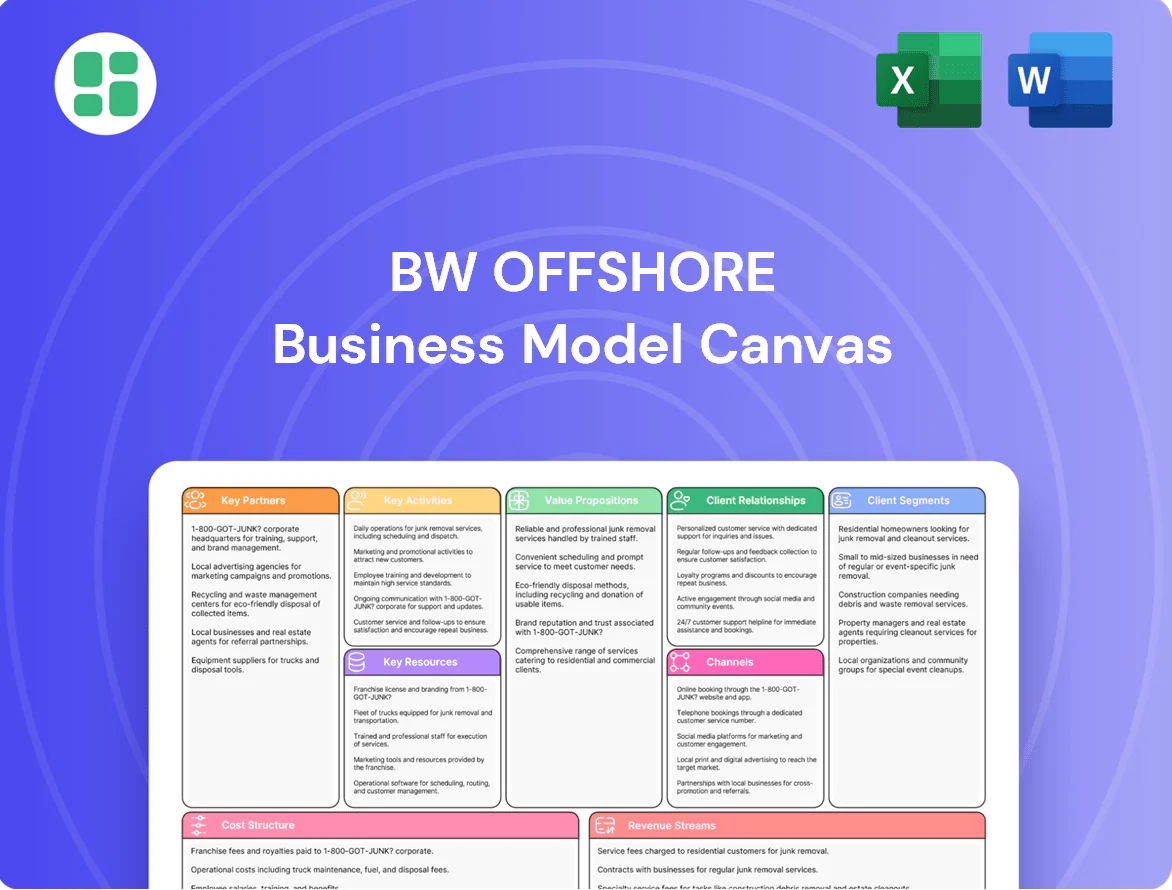
The BW Offshore Business Model Canvas you are previewing is the exact document you will receive upon purchase. This comprehensive overview details their operational strategy, key partners, revenue streams, and cost structure, providing a clear roadmap of their business. You'll gain full access to this same professionally structured and informative canvas, ready for your analysis.

Original: $10.00
-70%$10.00
$3.00Product Information
Product Information
Shipping & Returns
Shipping & Returns
Description
BW Offshore: Business Model Unveiled
Discover the strategic core of BW Offshore with our comprehensive Business Model Canvas. This detailed analysis unpacks how they deliver value through innovative offshore solutions and secure long-term client relationships. Ready to explore their competitive advantage?
Unlock the full strategic blueprint behind BW Offshore's business model. This in-depth Business Model Canvas reveals how the company drives value, captures market share, and stays ahead in a competitive landscape. Ideal for entrepreneurs, consultants, and investors looking for actionable insights.
Partnerships
Strategic Alliances for New Technologies
BW Offshore actively forms strategic alliances with technology providers and other industry leaders to drive the development of new energy solutions. A prime example is their partnership with McDermott, focusing on offshore blue ammonia production, a key area for decarbonization.
These collaborations are vital for BW Offshore to tap into specialized expertise and accelerate their progress in nascent low-carbon markets. By working with partners, they can share the risks associated with innovative projects and efficiently expand their reach into new geographical and technological territories.
Offshore Wind Co-development Partners
BW Offshore's strategic approach to offshore wind involves significant co-development partnerships, most notably its 64% ownership in BW Ideol, a frontrunner in floating offshore wind technology. This substantial stake underscores BW Offshore's dedication to advancing renewable energy, enabling shared risk and expertise in the execution of floating wind projects.
Collaborations with other key developers are crucial for bringing these ambitious projects to fruition. For instance, partnerships with entities like EDF Renewables and Maple Power were instrumental in securing projects from the Mediterranean Tender, highlighting the importance of these alliances in navigating complex tender processes and project development.
Shipyards and Fabrication Facilities
BW Offshore collaborates with premier shipyards worldwide for the construction, conversion, and upkeep of its Floating Production Storage and Offloading (FPSO) units. These partnerships are vital for accessing specialized infrastructure and skilled labor necessary for complex, large-scale maritime projects, ensuring the operational readiness of their fleet.
A prime example of this synergy is BW Offshore's relationship with Seatrium in Singapore. Seatrium played a crucial role in delivering significant FPSO projects, such as the BW Opal. This collaboration underscores the importance of strong shipyard relationships in executing major vessel developments and maintaining BW Offshore's extensive fleet capabilities.
Oil and Gas Field Operators
BW Offshore's core strength lies in its strategic alliances with international and national oil and gas field operators. These vital partnerships are the bedrock of its operations, enabling the deployment of Floating Production, Storage, and Offloading (FPSO) units for hydrocarbon extraction and processing. For instance, BW Offshore's collaboration with Santos on the Barossa project highlights this crucial relationship, as does its involvement with Equinor for the Bay du Nord pre-FEED study.
These long-term contracts with field operators are not merely transactional; they represent a symbiotic relationship where BW Offshore provides essential infrastructure and services, and the operators secure reliable production solutions. This reliance translates directly into a stable revenue stream and a robust project pipeline for BW Offshore, underscoring the significance of these key partnerships in its business model.
- Client Reliance: Operators like Santos and Equinor depend on BW Offshore's FPSO technology for efficient offshore field development and production.
- Revenue Generation: Long-term contracts with these major oil and gas companies are the primary drivers of BW Offshore's financial performance and project visibility.
- Strategic Importance: These partnerships are fundamental to BW Offshore's ability to execute complex offshore projects and maintain its market position.
Financial Institutions and Investors
BW Offshore's financial partnerships are crucial for its capital-intensive operations. The company actively collaborates with a wide array of financial institutions, including major banks and investment funds, to secure project financing and various debt facilities. These relationships are fundamental for raising the necessary capital to fund its substantial fleet expansion and to support its strategic pivot towards energy transition initiatives.
Maintaining robust connections with these financial stakeholders is paramount. It ensures BW Offshore has consistent access to liquidity, which is vital for undertaking large-scale projects. For instance, in 2024, the company continued to leverage its strong banking relationships to manage its debt portfolio and explore new funding avenues for its growing renewable energy ventures, such as the floating solar projects.
- Project Financing: BW Offshore secures funding for specific offshore projects through syndicated loans and partnerships with development banks.
- Debt Facilities: The company utilizes various credit facilities and bond issuances to manage its overall capital structure and operational needs.
- Capital Raising: Equity offerings and private placements are employed to raise capital for strategic growth, including fleet upgrades and investments in new energy technologies.
- Investor Relations: Consistent engagement with institutional investors and shareholders is maintained to ensure confidence and support for the company's long-term strategy.
Strategic Alliances Drive Offshore Innovation and Operations
BW Offshore's key partnerships are multifaceted, spanning technology providers, shipyards, and crucially, oil and gas field operators. These alliances are essential for project execution and revenue generation. For example, collaborations with technology firms are driving innovation in blue ammonia production, while shipyard partnerships ensure the construction and maintenance of their FPSO fleet. In 2024, BW Offshore continued to rely on these relationships to navigate complex offshore projects and maintain its operational capabilities.
What is included in the product
Detailed Word Document
This BW Offshore Business Model Canvas provides a structured overview of their operations, detailing key partnerships, core activities, and revenue streams derived from offshore production and floating storage solutions.
It clearly outlines their value propositions to oil and gas clients, customer relationships, and cost structures, offering a comprehensive view of their strategic approach to the offshore energy sector.
Customizable Excel Spreadsheet
BW Offshore's Business Model Canvas acts as a pain point reliever by providing a clear, visual framework to identify and address operational inefficiencies and strategic gaps.
It simplifies complex challenges, enabling rapid understanding and targeted solutions for improved performance and profitability.
Activities
FPSO Design, Engineering, and Construction
BW Offshore's core strength lies in its comprehensive approach to FPSO (Floating Production, Storage, and Offloading) vessels, encompassing design, engineering, and construction. This end-to-end capability allows them to manage the entire lifecycle of these complex offshore assets.
The company's expertise is evident in projects like the BW Opal for the Barossa field, a testament to their ability to handle intricate technical planning and execution. This project highlights their commitment to delivering specialized offshore production solutions.
Leveraging decades of accumulated experience, BW Offshore excels at creating bespoke FPSO units tailored to specific field requirements. Their track record demonstrates a consistent ability to deliver high-quality, integrated offshore production facilities.
FPSO Operation and Maintenance Services
BW Offshore's core activity revolves around the operation and maintenance of its Floating Production Storage and Offloading (FPSO) vessels. This ensures their fleet achieves high commercial uptime and maximizes hydrocarbon production efficiency.
This crucial function demands robust technical support, intricate logistics planning, and skilled personnel management, all executed within challenging offshore conditions. For instance, in 2023, BW Offshore reported an average fleet availability of 95%, underscoring their operational prowess.
These comprehensive FPSO services are typically secured through long-term contracts, which are vital for generating predictable and stable revenue streams for the company.
Offshore Wind Project Development
BW Offshore is actively developing offshore wind projects, focusing on floating wind technology via its subsidiary, BW Ideol. This strategic move diversifies their energy portfolio, moving beyond traditional oil and gas operations.
The company participates in competitive tenders and manages project progression from initial design through to potential installation phases. For instance, BW Ideol is involved in the development of the Windfloat Atlantic project, a significant floating offshore wind farm.
This expansion into offshore wind aligns with global energy transition goals and represents a key part of BW Offshore's strategy to capitalize on the growing renewable energy market.
Strategic Asset Management and Divestments
BW Offshore actively manages its fleet through strategic asset management and divestments to maintain a competitive and modern operational base. This involves the careful selection of assets for sale or acquisition, aiming to optimize capital allocation and align the fleet with evolving market needs and technological advancements.
The company's approach ensures a dynamic portfolio, shedding older units while integrating newer, more efficient vessels. For instance, the divestment of the FPSO BW Pioneer exemplifies this strategy, freeing up capital and resources. Simultaneously, the acquisition of FPSO Nganhurra signals a commitment to acquiring assets with potential for future redeployment, demonstrating foresight in fleet expansion and optimization.
- Fleet Optimization: BW Offshore continuously evaluates its fleet, divesting older assets like FPSO BW Pioneer to improve overall efficiency and financial performance.
- Strategic Acquisitions: The company acquires new or repurposed assets, such as FPSO Nganhurra, to enhance its operational capabilities and meet future project demands.
- Capital Allocation: Divestment proceeds are strategically reinvested into new projects or fleet upgrades, ensuring efficient use of capital.
- Market Alignment: These activities ensure the fleet remains modern and capable of servicing current and future offshore production requirements.
Low-Carbon Energy Solution Development
BW Offshore is actively developing innovative low-carbon energy solutions. This includes venturing into areas like CO2 transport, gas-to-power projects, and pioneering floating ammonia production facilities. These efforts are designed to address the growing global demand for cleaner energy sources.
Leveraging their extensive experience with Floating Production Storage and Offloading (FPSO) units, BW Offshore is strategically expanding its capabilities. This expansion into new energy sectors is a direct response to shifting market dynamics and the urgent need for decarbonization.
These initiatives are crucial for BW Offshore’s long-term strategy, aligning with worldwide decarbonization goals. For instance, in 2024, the company continued to explore opportunities in the renewable energy space, building on its established offshore engineering expertise.
- Focus on CO2 Transport: BW Offshore is developing solutions for the safe and efficient transportation of captured carbon dioxide, a key component of carbon capture and storage (CCS) value chains.
- Gas-to-Power Solutions: The company is exploring and developing projects to convert natural gas into electricity offshore, offering a more flexible and potentially lower-emission power generation option.
- Floating Ammonia Production: BW Offshore is investing in the development of floating facilities for ammonia production, recognizing ammonia's potential as a clean fuel and hydrogen carrier.
- Leveraging FPSO Expertise: The company's core competency in designing, building, and operating FPSOs is being adapted and applied to these new low-carbon energy ventures.
Offshore Energy Evolution: From FPSOs to Renewables
BW Offshore's core activities center on the design, engineering, construction, operation, and maintenance of FPSO units. This integrated approach ensures high fleet availability, with 2023 seeing an average of 95% uptime. These services are primarily delivered through long-term contracts, providing a stable revenue foundation.
The company is also strategically expanding into offshore wind, notably through its subsidiary BW Ideol and its involvement in projects like Windfloat Atlantic. This diversification into renewables is a key part of their strategy to capitalize on the growing clean energy market.
Furthermore, BW Offshore is actively developing low-carbon energy solutions. This includes exploring CO2 transport, gas-to-power projects, and pioneering floating ammonia production, all leveraging their extensive offshore engineering expertise to align with global decarbonization goals.
Fleet optimization is another critical activity, involving strategic divestments of older assets, such as the FPSO BW Pioneer, and acquisitions of new or repurposed vessels, like the FPSO Nganhurra, to maintain a modern and competitive operational base.
What You See Is What You Get
Business Model Canvas
The BW Offshore Business Model Canvas you are previewing is the exact document you will receive upon purchase. This comprehensive overview details their operational strategy, key partners, revenue streams, and cost structure, providing a clear roadmap of their business. You'll gain full access to this same professionally structured and informative canvas, ready for your analysis.