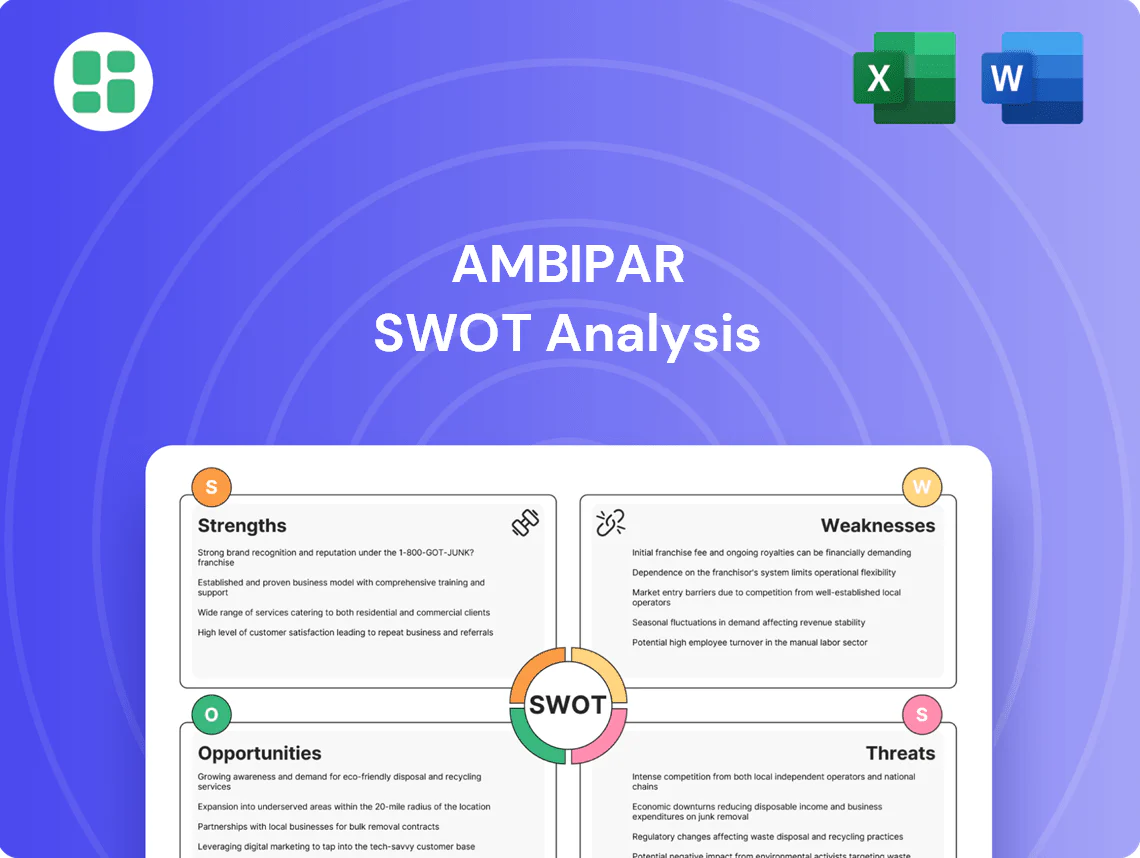
Ambipar SWOT Analysis

Dive Deeper Into the Company’s Strategic Blueprint
Ambipar's current SWOT analysis reveals a company with significant market presence and a strong commitment to sustainability, but also highlights potential challenges in market saturation and regulatory shifts.
Want the full story behind Ambipar's strengths, risks, and growth drivers? Purchase the complete SWOT analysis to gain access to a professionally written, fully editable report designed to support planning, pitches, and research.
Strengths

Global Presence and Comprehensive Service Portfolio
Ambipar boasts an impressive global reach, operating in 40 countries across six continents with over 500 operational bases. This extensive network, as of early 2024, allows them to effectively serve a diverse international clientele and swiftly address environmental incidents on a global scale.
Their comprehensive service portfolio is a significant strength, integrating waste management solutions like valorization, treatment, and disposal with critical environmental emergency response capabilities. This holistic approach provides clients with a one-stop solution for a wide range of environmental challenges.
Strong Alignment with Circular Economy and ESG Principles
Ambipar's core business of waste valorization and resource recovery is a natural fit for the circular economy, a model gaining significant traction globally. This inherent alignment resonates strongly with growing investor and regulatory focus on sustainability. For instance, in 2023, Ambipar reported a significant increase in the volume of materials processed for recycling, contributing to a more resource-efficient economy.

Growing Market Demand for Environmental Services
The global market for environmental services, encompassing waste management and consulting, is on a strong upward trajectory. This growth is fueled by a heightened awareness of environmental issues, more stringent government regulations, and a global commitment to sustainability. For instance, the waste management market alone was valued at over $1.5 trillion globally in 2023 and is projected to reach nearly $2 trillion by 2030, indicating substantial expansion.
Ambipar is strategically positioned to benefit from this expanding market. The company’s comprehensive suite of services, including specialized hazardous waste management and critical emergency response solutions, directly addresses the increasing need for integrated environmental solutions. This alignment with market trends provides a significant advantage.

Proven Financial Performance and Strategic Acquisitions
Ambipar showcases a history of robust financial performance, with recent periods marked by record revenues and EBITDA. This consistent growth is evident across both its Environment and Response divisions, underscoring operational strength.
The company’s proactive approach to strategic acquisitions is a key driver of its expansion. By integrating new businesses, Ambipar effectively broadens its service offerings and enhances its market presence.
- Record Revenue Growth: Ambipar reported a significant increase in revenue, reaching R$7.3 billion in 2023, a 24.6% jump from the previous year.
- EBITDA Expansion: The company’s EBITDA also saw substantial growth, climbing 30.5% to R$2.4 billion in 2023, reflecting improved profitability.
- Strategic M&A: In 2023 alone, Ambipar completed 15 acquisitions, integrating diverse capabilities and expanding its geographical footprint.
This dual strategy of fostering organic growth alongside opportunistic mergers and acquisitions solidifies Ambipar's competitive standing and market leadership.
Expertise in Hazardous Materials and Emergency Response
Ambipar's deep specialization in hazardous materials and emergency response is a significant strength. They offer comprehensive preparedness and response services, a critical need for industries facing environmental risks. This niche expertise is highly valued, especially given the increasing focus on environmental protection and regulatory compliance.
The market for emergency spill response is experiencing robust growth. For instance, the global oil spill response market was valued at approximately USD 10.5 billion in 2023 and is expected to grow at a compound annual growth rate (CAGR) of around 4.5% through 2030. This expansion directly benefits companies like Ambipar with specialized capabilities.
- Specialized Niche: Expertise in handling hazardous materials and environmental incidents.
- Critical Service: Essential for minimizing damage and regulatory fines in high-risk sectors.
- Market Growth: Benefiting from a growing global market for spill response services, projected to expand significantly in the coming years.
Global Environmental Solutions: Record Growth & Strategic Expansion
Ambipar's extensive global presence across 40 countries and over 500 operational bases provides a significant competitive advantage in responding to environmental needs worldwide. Their integrated service model, combining waste management with emergency response, offers clients a comprehensive and efficient solution. This broad operational scope and service integration are key differentiators in the environmental services sector.
The company's alignment with the circular economy principles, particularly in waste valorization and resource recovery, positions it favorably for sustainable growth. This focus is further amplified by strong financial performance, as evidenced by record revenues and EBITDA in recent periods. Strategic acquisitions also play a crucial role, consistently expanding Ambipar's capabilities and market reach.
| Metric | 2023 Value | Year-over-Year Change |
| Revenue | R$7.3 billion | +24.6% |
| EBITDA | R$2.4 billion | +30.5% |
| Acquisitions Completed | 15 | N/A |
What is included in the product
 Detailed Word Document
Delivers a strategic overview of Ambipar’s internal and external business factors, highlighting its strengths in environmental management and emergency response, alongside opportunities for expansion in sustainability services and potential threats from regulatory changes.

 Customizable Excel Spreadsheet
Offers a clear, actionable SWOT analysis for Ambipar, pinpointing areas for growth and mitigating potential risks.
Weaknesses

High Operational Costs
Ambipar's specialized environmental management and emergency response services, especially those involving hazardous materials, inherently lead to significant operational expenses. These costs are driven by the necessity of acquiring and maintaining sophisticated equipment, providing ongoing, specialized training for a highly skilled workforce, and rigorously adhering to demanding safety regulations. For instance, in 2023, Ambipar reported that its operational expenditures, influenced by these specialized needs, represented a substantial portion of its revenue, impacting its net profit margins.
Regulatory Compliance Burden and Complexity
Ambipar faces a significant challenge in managing the complex and constantly changing environmental regulations across the many countries it operates in. This regulatory web requires constant vigilance and substantial resources to ensure compliance.
The evolving nature of rules, such as those concerning hazardous waste disposal, emerging PFAS standards, and e-waste management, necessitates continuous adaptation. For instance, the anticipated tightening of PFAS regulations globally in 2025 will likely demand new investment in treatment technologies and updated operational protocols, adding to administrative and financial overhead.

Reputational Risk from Environmental Incidents
While Ambipar specializes in environmental emergency response, the company itself is not immune to reputational damage from environmental incidents. Should Ambipar be involved in or perceived as mishandling an environmental event, its brand image could suffer considerably. This could lead to increased public scrutiny and potential legal and financial penalties.

Dependence on Industrial and Corporate Clients
Ambipar's revenue generation is significantly tied to its industrial and corporate client base, especially within the oil & gas, chemical, and manufacturing sectors. This concentration exposes the company to the volatility of these specific industries.
A slowdown or disruption in these key sectors, such as a downturn in oil prices or reduced industrial production, directly impacts the demand for Ambipar's waste management and emergency response services. For instance, in the first quarter of 2024, revenue from its Environmental business segment, which heavily serves industrial clients, showed a year-on-year increase but remained susceptible to the cyclical nature of its customer base.
- Client Concentration: Reliance on a few large industrial sectors makes Ambipar vulnerable to sector-specific economic shocks.
- Economic Sensitivity: Downturns in oil & gas, chemicals, or manufacturing can directly reduce demand for services.
- Revenue Volatility: Shifts in industrial activity can lead to fluctuations in Ambipar's overall revenue streams.
Intense Competition in Specific Market Segments
Ambipar operates in a market with significant competition, particularly in specialized areas like hazardous waste treatment and industrial cleaning. Established global players and numerous regional providers often compete fiercely for contracts, potentially impacting Ambipar's pricing power and ability to expand market share. For instance, in 2024, the global environmental services market, while robust, saw increased consolidation and aggressive bidding in key segments, as reported by industry analysts.
This intense rivalry necessitates continuous investment in advanced technologies and service offerings to maintain a competitive edge. Without ongoing innovation and a clear value proposition, Ambipar could face challenges in differentiating itself and securing profitable contracts. The need to constantly adapt to evolving regulatory landscapes and client demands further amplifies the pressure from competitors.
- Intensified Rivalry: Specific environmental service niches, such as specialized waste disposal and environmental remediation, are crowded with both large multinational corporations and agile local businesses.
- Pricing Pressure: High competition can lead to downward pressure on service fees, potentially squeezing profit margins if operational efficiencies are not maintained.
- Market Share Erosion: Competitors with strong existing client relationships or lower cost structures may capture market share, requiring Ambipar to actively defend its position through superior service and innovation.
Client Concentration Fuels Revenue Volatility
Ambipar's reliance on a concentrated client base, primarily within volatile sectors like oil & gas and chemicals, exposes it to significant revenue fluctuations. A downturn in these industries, as observed in early 2024 with some industrial clients scaling back operations, directly impacts demand for Ambipar's environmental services. This economic sensitivity means that shifts in industrial activity can lead to unpredictable revenue streams, making financial forecasting more challenging.
Full Version Awaits
Ambipar SWOT Analysis
This preview reflects the real document you'll receive—professional, structured, and ready to use. You're seeing the actual Ambipar SWOT analysis, providing a clear understanding of its strengths, weaknesses, opportunities, and threats.
The content below is pulled directly from the final SWOT analysis. Unlock the full report when you purchase to gain comprehensive insights into Ambipar's strategic position.

Original: $10.00
-70%$10.00
$3.00Product Information
Product Information
Shipping & Returns
Shipping & Returns
Description
Dive Deeper Into the Company’s Strategic Blueprint
Ambipar's current SWOT analysis reveals a company with significant market presence and a strong commitment to sustainability, but also highlights potential challenges in market saturation and regulatory shifts.
Want the full story behind Ambipar's strengths, risks, and growth drivers? Purchase the complete SWOT analysis to gain access to a professionally written, fully editable report designed to support planning, pitches, and research.
Strengths
Global Presence and Comprehensive Service Portfolio
Ambipar boasts an impressive global reach, operating in 40 countries across six continents with over 500 operational bases. This extensive network, as of early 2024, allows them to effectively serve a diverse international clientele and swiftly address environmental incidents on a global scale.
Their comprehensive service portfolio is a significant strength, integrating waste management solutions like valorization, treatment, and disposal with critical environmental emergency response capabilities. This holistic approach provides clients with a one-stop solution for a wide range of environmental challenges.
Strong Alignment with Circular Economy and ESG Principles
Ambipar's core business of waste valorization and resource recovery is a natural fit for the circular economy, a model gaining significant traction globally. This inherent alignment resonates strongly with growing investor and regulatory focus on sustainability. For instance, in 2023, Ambipar reported a significant increase in the volume of materials processed for recycling, contributing to a more resource-efficient economy.
Growing Market Demand for Environmental Services
The global market for environmental services, encompassing waste management and consulting, is on a strong upward trajectory. This growth is fueled by a heightened awareness of environmental issues, more stringent government regulations, and a global commitment to sustainability. For instance, the waste management market alone was valued at over $1.5 trillion globally in 2023 and is projected to reach nearly $2 trillion by 2030, indicating substantial expansion.
Ambipar is strategically positioned to benefit from this expanding market. The company’s comprehensive suite of services, including specialized hazardous waste management and critical emergency response solutions, directly addresses the increasing need for integrated environmental solutions. This alignment with market trends provides a significant advantage.
Proven Financial Performance and Strategic Acquisitions
Ambipar showcases a history of robust financial performance, with recent periods marked by record revenues and EBITDA. This consistent growth is evident across both its Environment and Response divisions, underscoring operational strength.
The company’s proactive approach to strategic acquisitions is a key driver of its expansion. By integrating new businesses, Ambipar effectively broadens its service offerings and enhances its market presence.
- Record Revenue Growth: Ambipar reported a significant increase in revenue, reaching R$7.3 billion in 2023, a 24.6% jump from the previous year.
- EBITDA Expansion: The company’s EBITDA also saw substantial growth, climbing 30.5% to R$2.4 billion in 2023, reflecting improved profitability.
- Strategic M&A: In 2023 alone, Ambipar completed 15 acquisitions, integrating diverse capabilities and expanding its geographical footprint.
This dual strategy of fostering organic growth alongside opportunistic mergers and acquisitions solidifies Ambipar's competitive standing and market leadership.
Expertise in Hazardous Materials and Emergency Response
Ambipar's deep specialization in hazardous materials and emergency response is a significant strength. They offer comprehensive preparedness and response services, a critical need for industries facing environmental risks. This niche expertise is highly valued, especially given the increasing focus on environmental protection and regulatory compliance.
The market for emergency spill response is experiencing robust growth. For instance, the global oil spill response market was valued at approximately USD 10.5 billion in 2023 and is expected to grow at a compound annual growth rate (CAGR) of around 4.5% through 2030. This expansion directly benefits companies like Ambipar with specialized capabilities.
- Specialized Niche: Expertise in handling hazardous materials and environmental incidents.
- Critical Service: Essential for minimizing damage and regulatory fines in high-risk sectors.
- Market Growth: Benefiting from a growing global market for spill response services, projected to expand significantly in the coming years.
Global Environmental Solutions: Record Growth & Strategic Expansion
Ambipar's extensive global presence across 40 countries and over 500 operational bases provides a significant competitive advantage in responding to environmental needs worldwide. Their integrated service model, combining waste management with emergency response, offers clients a comprehensive and efficient solution. This broad operational scope and service integration are key differentiators in the environmental services sector.
The company's alignment with the circular economy principles, particularly in waste valorization and resource recovery, positions it favorably for sustainable growth. This focus is further amplified by strong financial performance, as evidenced by record revenues and EBITDA in recent periods. Strategic acquisitions also play a crucial role, consistently expanding Ambipar's capabilities and market reach.
| Metric | 2023 Value | Year-over-Year Change |
| Revenue | R$7.3 billion | +24.6% |
| EBITDA | R$2.4 billion | +30.5% |
| Acquisitions Completed | 15 | N/A |
What is included in the product
Detailed Word Document
Delivers a strategic overview of Ambipar’s internal and external business factors, highlighting its strengths in environmental management and emergency response, alongside opportunities for expansion in sustainability services and potential threats from regulatory changes.
Customizable Excel Spreadsheet
Offers a clear, actionable SWOT analysis for Ambipar, pinpointing areas for growth and mitigating potential risks.
Weaknesses
High Operational Costs
Ambipar's specialized environmental management and emergency response services, especially those involving hazardous materials, inherently lead to significant operational expenses. These costs are driven by the necessity of acquiring and maintaining sophisticated equipment, providing ongoing, specialized training for a highly skilled workforce, and rigorously adhering to demanding safety regulations. For instance, in 2023, Ambipar reported that its operational expenditures, influenced by these specialized needs, represented a substantial portion of its revenue, impacting its net profit margins.
Regulatory Compliance Burden and Complexity
Ambipar faces a significant challenge in managing the complex and constantly changing environmental regulations across the many countries it operates in. This regulatory web requires constant vigilance and substantial resources to ensure compliance.
The evolving nature of rules, such as those concerning hazardous waste disposal, emerging PFAS standards, and e-waste management, necessitates continuous adaptation. For instance, the anticipated tightening of PFAS regulations globally in 2025 will likely demand new investment in treatment technologies and updated operational protocols, adding to administrative and financial overhead.
Reputational Risk from Environmental Incidents
While Ambipar specializes in environmental emergency response, the company itself is not immune to reputational damage from environmental incidents. Should Ambipar be involved in or perceived as mishandling an environmental event, its brand image could suffer considerably. This could lead to increased public scrutiny and potential legal and financial penalties.
Dependence on Industrial and Corporate Clients
Ambipar's revenue generation is significantly tied to its industrial and corporate client base, especially within the oil & gas, chemical, and manufacturing sectors. This concentration exposes the company to the volatility of these specific industries.
A slowdown or disruption in these key sectors, such as a downturn in oil prices or reduced industrial production, directly impacts the demand for Ambipar's waste management and emergency response services. For instance, in the first quarter of 2024, revenue from its Environmental business segment, which heavily serves industrial clients, showed a year-on-year increase but remained susceptible to the cyclical nature of its customer base.
- Client Concentration: Reliance on a few large industrial sectors makes Ambipar vulnerable to sector-specific economic shocks.
- Economic Sensitivity: Downturns in oil & gas, chemicals, or manufacturing can directly reduce demand for services.
- Revenue Volatility: Shifts in industrial activity can lead to fluctuations in Ambipar's overall revenue streams.
Intense Competition in Specific Market Segments
Ambipar operates in a market with significant competition, particularly in specialized areas like hazardous waste treatment and industrial cleaning. Established global players and numerous regional providers often compete fiercely for contracts, potentially impacting Ambipar's pricing power and ability to expand market share. For instance, in 2024, the global environmental services market, while robust, saw increased consolidation and aggressive bidding in key segments, as reported by industry analysts.
This intense rivalry necessitates continuous investment in advanced technologies and service offerings to maintain a competitive edge. Without ongoing innovation and a clear value proposition, Ambipar could face challenges in differentiating itself and securing profitable contracts. The need to constantly adapt to evolving regulatory landscapes and client demands further amplifies the pressure from competitors.
- Intensified Rivalry: Specific environmental service niches, such as specialized waste disposal and environmental remediation, are crowded with both large multinational corporations and agile local businesses.
- Pricing Pressure: High competition can lead to downward pressure on service fees, potentially squeezing profit margins if operational efficiencies are not maintained.
- Market Share Erosion: Competitors with strong existing client relationships or lower cost structures may capture market share, requiring Ambipar to actively defend its position through superior service and innovation.
Client Concentration Fuels Revenue Volatility
Ambipar's reliance on a concentrated client base, primarily within volatile sectors like oil & gas and chemicals, exposes it to significant revenue fluctuations. A downturn in these industries, as observed in early 2024 with some industrial clients scaling back operations, directly impacts demand for Ambipar's environmental services. This economic sensitivity means that shifts in industrial activity can lead to unpredictable revenue streams, making financial forecasting more challenging.
Full Version Awaits
Ambipar SWOT Analysis
This preview reflects the real document you'll receive—professional, structured, and ready to use. You're seeing the actual Ambipar SWOT analysis, providing a clear understanding of its strengths, weaknesses, opportunities, and threats.
The content below is pulled directly from the final SWOT analysis. Unlock the full report when you purchase to gain comprehensive insights into Ambipar's strategic position.