Camil Alimentos SWOT Analysis

Your Strategic Toolkit Starts Here
Camil Alimentos, a major player in the food industry, boasts strong brand recognition and a diversified product portfolio, yet faces intense competition and fluctuating commodity prices. Understanding these internal capabilities and external pressures is crucial for navigating its market.
Want the full story behind Camil Alimentos' strengths, risks, and growth drivers? Purchase the complete SWOT analysis to gain access to a professionally written, fully editable report designed to support planning, pitches, and research.
Strengths

Market Leadership and Brand Recognition
Camil Alimentos boasts significant market leadership, holding top positions in essential food categories like rice, beans, and refined sugar throughout Brazil, Uruguay, Chile, and Peru. This dominance is underpinned by a portfolio of highly recognized and trusted brands, including Camil, União, Coqueiro, Saman, Tucapel, and Costeño.
The company's strong brand equity translates into a distinct competitive advantage, enabling Camil Alimentos to implement price premiums and solidify its market standing. For instance, in 2023, Camil's net revenue reached R$17.7 billion, reflecting the consumer trust and market penetration of its established brands.
Diversified Product Portfolio
Camil Alimentos boasts a significantly diversified product portfolio, encompassing staples like rice, beans, sugar, coffee, pasta, and seafood. This broad offering is a key strength, reducing reliance on any single market segment and allowing the company to meet a wide array of consumer demands. For instance, in the first quarter of 2024, Camil reported net revenue of R$1.5 billion, with its diverse segments contributing to this robust performance.

Extensive Distribution Network in South America
Camil Alimentos boasts a formidable distribution network spanning South America, with a presence in Brazil, Uruguay, Chile, Peru, Argentina, and Ecuador. This extensive reach is supported by 33 processing plants and 23 distribution centers, enabling efficient product flow to a broad consumer and retail base.

Strategic Acquisitions and Growth History
Camil Alimentos boasts a robust history of strategic acquisitions, consistently fueling its growth trajectory. This approach has not only diversified its geographical footprint but also broadened its product portfolio, strengthening its market position. For instance, the company's continued integration of past acquisitions, such as Santa Amália and Seleto, alongside recent moves into markets like Ecuador, underscores a deliberate strategy for market consolidation and increased market share.
This strategic acquisition model has been a key driver in Camil's expansion. By integrating acquired businesses effectively, Camil has been able to leverage synergies and achieve economies of scale. This has been particularly evident in its performance over the past few years, with reported revenue growth bolstered by these strategic integrations.
The company's ability to successfully integrate acquired entities is a significant strength. This operational capability ensures that the value generated from acquisitions is realized, contributing to sustained earnings growth. For example, the successful integration of Santa Amália, acquired in 2010, has been a cornerstone of Camil's diversification into pasta and cookies, significantly enhancing its revenue streams and market penetration in these segments.
Camil's growth strategy is clearly demonstrated by its consistent expansion. The company has a proven ability to identify, acquire, and integrate businesses that complement its existing operations or open new avenues for growth. This foresight has allowed Camil to navigate market complexities and emerge as a leading player in its various operating segments.
Commitment to Sustainability and ESG
Camil Alimentos demonstrates a robust commitment to sustainability and Environmental, Social, and Governance (ESG) principles. Initiatives such as the 'Clean Fishing Project' and investments in renewable energy, like generating power from rice husks, underscore this dedication. These efforts are recognized through its inclusion in B3's Corporate Sustainability Index (ISE), reinforcing its standing among ethically-minded investors and consumers.
The company's consistent publication of sustainability reports further solidifies its transparency regarding ethical operations, responsible sourcing, and environmental stewardship. This focus not only enhances Camil's brand reputation but also appeals to a growing market segment prioritizing sustainable business practices.
- ESG Integration: Camil actively integrates ESG factors into its business strategy.
- Renewable Energy: Investments in renewable energy, such as using rice husks, reduce environmental impact.
- Market Recognition: Inclusion in B3's ISE highlights its leadership in corporate sustainability.
- Stakeholder Appeal: Strong ESG performance attracts conscious consumers and investors.
South American Food Powerhouse: Market Leadership & Growth
Camil Alimentos possesses significant market leadership across key food categories in South America, notably in rice, beans, and sugar, bolstered by a portfolio of trusted brands like Camil and União. This strong brand equity allows for price premiums, as evidenced by its net revenue of R$17.7 billion in 2023, reflecting deep consumer trust.
The company's diversified product range, including rice, beans, sugar, coffee, and seafood, reduces dependency on single segments and caters to broad consumer needs. This diversity contributed to a robust net revenue of R$1.5 billion in Q1 2024.
Camil's extensive distribution network, comprising 33 processing plants and 23 distribution centers across seven South American countries, ensures efficient market reach. Furthermore, its successful track record of strategic acquisitions, such as the integration of Santa Amália, consistently fuels growth and market share expansion.
A strong commitment to ESG principles, including renewable energy initiatives and inclusion in B3's ISE, enhances its reputation and appeals to ethically-minded stakeholders.
What is included in the product
 Detailed Word Document
Delivers a strategic overview of Camil Alimentos’s internal and external business factors, highlighting its market position and potential for growth.

 Customizable Excel Spreadsheet
Identifies key competitive advantages and potential market threats for Camil Alimentos, enabling proactive strategy development.
Weaknesses

Vulnerability to Commodity Price Volatility
Camil Alimentos' significant reliance on staple agricultural commodities like rice and beans makes it inherently vulnerable to price swings. For instance, a substantial drop in rice prices in Brazil during early 2024 directly squeezed Camil's revenue streams and profitability, highlighting the impact of raw material cost volatility on its financial performance.
High Net Debt and Leverage
Camil Alimentos' financial position in the first quarter of 2025 showed a net debt of BRL 3.6 billion, with a net debt to EBITDA ratio of 4x. This level of leverage suggests a significant reliance on borrowed funds.
While the company utilizes debenture issuances to manage its debt, this substantial leverage could constrain its financial agility. It might limit Camil's capacity for new investments or strategic acquisitions and makes it more vulnerable to fluctuations in interest rates.

Challenges in Domestic Market Performance
Camil Alimentos faced significant headwinds in its core Brazilian market, with domestic volumes dropping by more than 13% in the first quarter of 2025. This downturn was particularly pronounced in the grains and sugar segments, often referred to as 'Alto Giro'.
The decline suggests a strong consumer shift towards more budget-friendly alternatives, directly impacting Camil's ability to maintain both sales volume and pricing power in its most crucial market. Intense competition, especially within the sugar sector, further exacerbates these challenges.

Seasonal Working Capital Needs
Camil Alimentos' operations, especially in its core rice and fish segments, are heavily influenced by seasonal working capital demands. This means the company needs more cash at certain times of the year than others, which can be a challenge.
The early part of the year, specifically the first quarter, typically requires Camil to spend more cash to fund its operations. Conversely, the fourth quarter often results in a freeing up of working capital as sales pick up and inventory is sold. This ebb and flow can strain the company's liquidity.
For instance, in the first quarter of 2024, Camil likely faced increased inventory purchases and production costs before the main selling seasons. Managing these fluctuations requires robust financial planning to ensure sufficient cash is available when needed and excess cash is deployed effectively during lighter periods.
- Seasonal Cash Flow: Camil's business model, centered on agricultural products like rice, inherently creates significant swings in its need for working capital throughout the year.
- Q1 Cash Consumption: The first quarter (January-March) typically sees higher cash outflows as the company invests in inventory and production ahead of peak demand periods.
- Q4 Working Capital Release: By the fourth quarter (October-December), sales often increase, leading to a reduction in inventory and a subsequent release of working capital back into the business.
- Liquidity Management: These seasonal patterns necessitate careful financial management to avoid liquidity shortages during high-demand periods and to optimize cash use during slower months.
Underutilized Capacity in High-Value Categories
Camil Alimentos faces a challenge with underutilized capacity in its high-value product lines, such as pasta, biscuits, and coffee. Despite strategic efforts to boost these segments, the installed production capacity is currently only about 50% utilized.
This situation can create operational inefficiencies and increase the cost of producing each unit. To improve profitability, Camil Alimentos needs to find ways to increase sales volumes for these premium products.
- Underutilization: High-value segments like pasta, biscuits, and coffee are operating at roughly 50% of their installed production capacity.
- Efficiency Impact: This underutilization can lead to higher per-unit production costs, potentially hindering profitability.
- Growth Opportunity: Increasing sales volumes in these categories is crucial to leverage existing capacity and improve financial performance.
Financial Headwinds: Debt, Price Volatility, and Volume Declines
Camil Alimentos' significant reliance on staple agricultural commodities like rice and beans makes it inherently vulnerable to price swings, impacting revenue and profitability. For instance, a substantial drop in rice prices in Brazil during early 2024 directly squeezed Camil's financial performance.
The company's substantial net debt of BRL 3.6 billion in Q1 2025, with a net debt to EBITDA ratio of 4x, indicates a significant reliance on borrowed funds. This leverage could constrain financial agility, limiting new investments and increasing vulnerability to interest rate fluctuations.
Camil faced a significant challenge with domestic volume drops exceeding 13% in Q1 2025, particularly in grains and sugar, suggesting a consumer shift to budget alternatives and intense competition impacting sales and pricing power.
Furthermore, high-value product lines like pasta, biscuits, and coffee are operating at only 50% of their installed capacity, leading to potential operational inefficiencies and higher per-unit production costs, highlighting a need to boost sales in these segments.
Full Version Awaits
Camil Alimentos SWOT Analysis
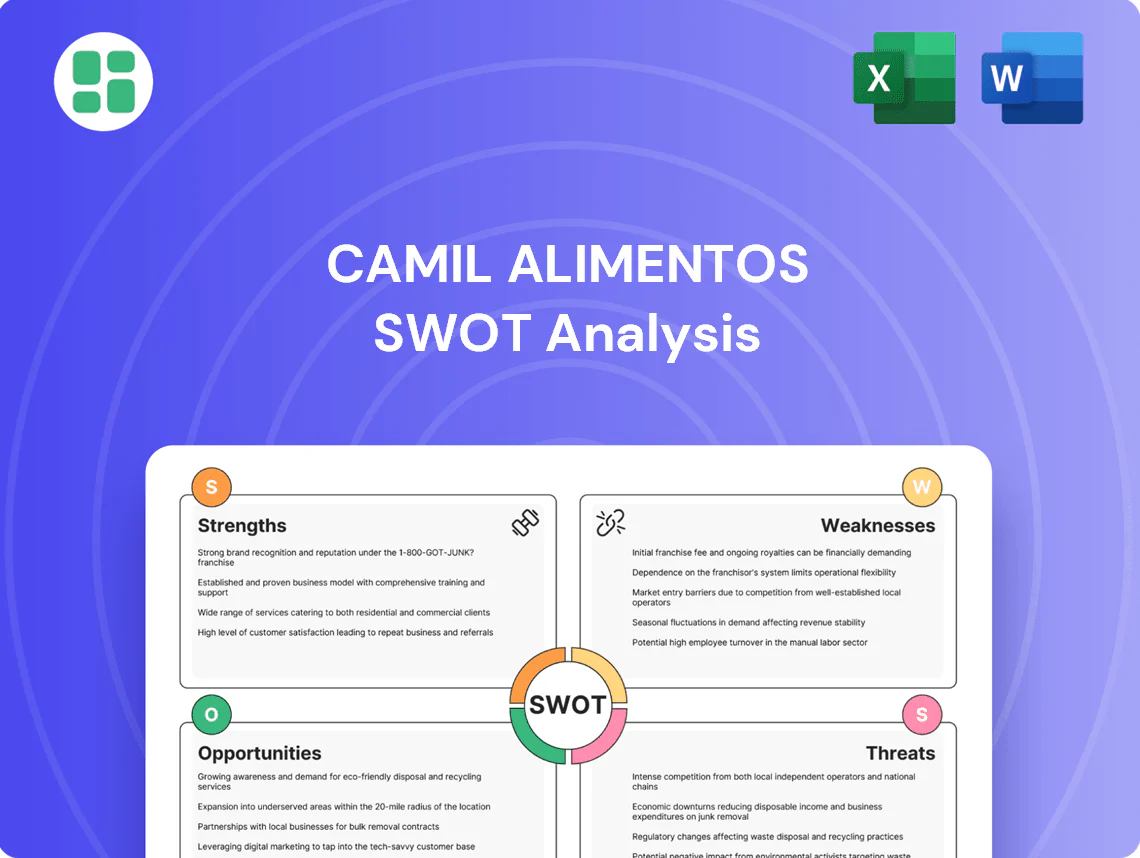
This is the actual Camil Alimentos SWOT analysis document you’ll receive upon purchase—no surprises, just professional quality. It provides a comprehensive overview of the company's internal Strengths and Weaknesses, alongside external Opportunities and Threats. This detailed analysis is crucial for strategic planning.

Original: $10.00
-70%$10.00
$3.00Product Information
Product Information
Shipping & Returns
Shipping & Returns
Description
Your Strategic Toolkit Starts Here
Camil Alimentos, a major player in the food industry, boasts strong brand recognition and a diversified product portfolio, yet faces intense competition and fluctuating commodity prices. Understanding these internal capabilities and external pressures is crucial for navigating its market.
Want the full story behind Camil Alimentos' strengths, risks, and growth drivers? Purchase the complete SWOT analysis to gain access to a professionally written, fully editable report designed to support planning, pitches, and research.
Strengths
Market Leadership and Brand Recognition
Camil Alimentos boasts significant market leadership, holding top positions in essential food categories like rice, beans, and refined sugar throughout Brazil, Uruguay, Chile, and Peru. This dominance is underpinned by a portfolio of highly recognized and trusted brands, including Camil, União, Coqueiro, Saman, Tucapel, and Costeño.
The company's strong brand equity translates into a distinct competitive advantage, enabling Camil Alimentos to implement price premiums and solidify its market standing. For instance, in 2023, Camil's net revenue reached R$17.7 billion, reflecting the consumer trust and market penetration of its established brands.
Diversified Product Portfolio
Camil Alimentos boasts a significantly diversified product portfolio, encompassing staples like rice, beans, sugar, coffee, pasta, and seafood. This broad offering is a key strength, reducing reliance on any single market segment and allowing the company to meet a wide array of consumer demands. For instance, in the first quarter of 2024, Camil reported net revenue of R$1.5 billion, with its diverse segments contributing to this robust performance.
Extensive Distribution Network in South America
Camil Alimentos boasts a formidable distribution network spanning South America, with a presence in Brazil, Uruguay, Chile, Peru, Argentina, and Ecuador. This extensive reach is supported by 33 processing plants and 23 distribution centers, enabling efficient product flow to a broad consumer and retail base.
Strategic Acquisitions and Growth History
Camil Alimentos boasts a robust history of strategic acquisitions, consistently fueling its growth trajectory. This approach has not only diversified its geographical footprint but also broadened its product portfolio, strengthening its market position. For instance, the company's continued integration of past acquisitions, such as Santa Amália and Seleto, alongside recent moves into markets like Ecuador, underscores a deliberate strategy for market consolidation and increased market share.
This strategic acquisition model has been a key driver in Camil's expansion. By integrating acquired businesses effectively, Camil has been able to leverage synergies and achieve economies of scale. This has been particularly evident in its performance over the past few years, with reported revenue growth bolstered by these strategic integrations.
The company's ability to successfully integrate acquired entities is a significant strength. This operational capability ensures that the value generated from acquisitions is realized, contributing to sustained earnings growth. For example, the successful integration of Santa Amália, acquired in 2010, has been a cornerstone of Camil's diversification into pasta and cookies, significantly enhancing its revenue streams and market penetration in these segments.
Camil's growth strategy is clearly demonstrated by its consistent expansion. The company has a proven ability to identify, acquire, and integrate businesses that complement its existing operations or open new avenues for growth. This foresight has allowed Camil to navigate market complexities and emerge as a leading player in its various operating segments.
Commitment to Sustainability and ESG
Camil Alimentos demonstrates a robust commitment to sustainability and Environmental, Social, and Governance (ESG) principles. Initiatives such as the 'Clean Fishing Project' and investments in renewable energy, like generating power from rice husks, underscore this dedication. These efforts are recognized through its inclusion in B3's Corporate Sustainability Index (ISE), reinforcing its standing among ethically-minded investors and consumers.
The company's consistent publication of sustainability reports further solidifies its transparency regarding ethical operations, responsible sourcing, and environmental stewardship. This focus not only enhances Camil's brand reputation but also appeals to a growing market segment prioritizing sustainable business practices.
- ESG Integration: Camil actively integrates ESG factors into its business strategy.
- Renewable Energy: Investments in renewable energy, such as using rice husks, reduce environmental impact.
- Market Recognition: Inclusion in B3's ISE highlights its leadership in corporate sustainability.
- Stakeholder Appeal: Strong ESG performance attracts conscious consumers and investors.
South American Food Powerhouse: Market Leadership & Growth
Camil Alimentos possesses significant market leadership across key food categories in South America, notably in rice, beans, and sugar, bolstered by a portfolio of trusted brands like Camil and União. This strong brand equity allows for price premiums, as evidenced by its net revenue of R$17.7 billion in 2023, reflecting deep consumer trust.
The company's diversified product range, including rice, beans, sugar, coffee, and seafood, reduces dependency on single segments and caters to broad consumer needs. This diversity contributed to a robust net revenue of R$1.5 billion in Q1 2024.
Camil's extensive distribution network, comprising 33 processing plants and 23 distribution centers across seven South American countries, ensures efficient market reach. Furthermore, its successful track record of strategic acquisitions, such as the integration of Santa Amália, consistently fuels growth and market share expansion.
A strong commitment to ESG principles, including renewable energy initiatives and inclusion in B3's ISE, enhances its reputation and appeals to ethically-minded stakeholders.
What is included in the product
Detailed Word Document
Delivers a strategic overview of Camil Alimentos’s internal and external business factors, highlighting its market position and potential for growth.
Customizable Excel Spreadsheet
Identifies key competitive advantages and potential market threats for Camil Alimentos, enabling proactive strategy development.
Weaknesses
Vulnerability to Commodity Price Volatility
Camil Alimentos' significant reliance on staple agricultural commodities like rice and beans makes it inherently vulnerable to price swings. For instance, a substantial drop in rice prices in Brazil during early 2024 directly squeezed Camil's revenue streams and profitability, highlighting the impact of raw material cost volatility on its financial performance.
High Net Debt and Leverage
Camil Alimentos' financial position in the first quarter of 2025 showed a net debt of BRL 3.6 billion, with a net debt to EBITDA ratio of 4x. This level of leverage suggests a significant reliance on borrowed funds.
While the company utilizes debenture issuances to manage its debt, this substantial leverage could constrain its financial agility. It might limit Camil's capacity for new investments or strategic acquisitions and makes it more vulnerable to fluctuations in interest rates.
Challenges in Domestic Market Performance
Camil Alimentos faced significant headwinds in its core Brazilian market, with domestic volumes dropping by more than 13% in the first quarter of 2025. This downturn was particularly pronounced in the grains and sugar segments, often referred to as 'Alto Giro'.
The decline suggests a strong consumer shift towards more budget-friendly alternatives, directly impacting Camil's ability to maintain both sales volume and pricing power in its most crucial market. Intense competition, especially within the sugar sector, further exacerbates these challenges.
Seasonal Working Capital Needs
Camil Alimentos' operations, especially in its core rice and fish segments, are heavily influenced by seasonal working capital demands. This means the company needs more cash at certain times of the year than others, which can be a challenge.
The early part of the year, specifically the first quarter, typically requires Camil to spend more cash to fund its operations. Conversely, the fourth quarter often results in a freeing up of working capital as sales pick up and inventory is sold. This ebb and flow can strain the company's liquidity.
For instance, in the first quarter of 2024, Camil likely faced increased inventory purchases and production costs before the main selling seasons. Managing these fluctuations requires robust financial planning to ensure sufficient cash is available when needed and excess cash is deployed effectively during lighter periods.
- Seasonal Cash Flow: Camil's business model, centered on agricultural products like rice, inherently creates significant swings in its need for working capital throughout the year.
- Q1 Cash Consumption: The first quarter (January-March) typically sees higher cash outflows as the company invests in inventory and production ahead of peak demand periods.
- Q4 Working Capital Release: By the fourth quarter (October-December), sales often increase, leading to a reduction in inventory and a subsequent release of working capital back into the business.
- Liquidity Management: These seasonal patterns necessitate careful financial management to avoid liquidity shortages during high-demand periods and to optimize cash use during slower months.
Underutilized Capacity in High-Value Categories
Camil Alimentos faces a challenge with underutilized capacity in its high-value product lines, such as pasta, biscuits, and coffee. Despite strategic efforts to boost these segments, the installed production capacity is currently only about 50% utilized.
This situation can create operational inefficiencies and increase the cost of producing each unit. To improve profitability, Camil Alimentos needs to find ways to increase sales volumes for these premium products.
- Underutilization: High-value segments like pasta, biscuits, and coffee are operating at roughly 50% of their installed production capacity.
- Efficiency Impact: This underutilization can lead to higher per-unit production costs, potentially hindering profitability.
- Growth Opportunity: Increasing sales volumes in these categories is crucial to leverage existing capacity and improve financial performance.
Financial Headwinds: Debt, Price Volatility, and Volume Declines
Camil Alimentos' significant reliance on staple agricultural commodities like rice and beans makes it inherently vulnerable to price swings, impacting revenue and profitability. For instance, a substantial drop in rice prices in Brazil during early 2024 directly squeezed Camil's financial performance.
The company's substantial net debt of BRL 3.6 billion in Q1 2025, with a net debt to EBITDA ratio of 4x, indicates a significant reliance on borrowed funds. This leverage could constrain financial agility, limiting new investments and increasing vulnerability to interest rate fluctuations.
Camil faced a significant challenge with domestic volume drops exceeding 13% in Q1 2025, particularly in grains and sugar, suggesting a consumer shift to budget alternatives and intense competition impacting sales and pricing power.
Furthermore, high-value product lines like pasta, biscuits, and coffee are operating at only 50% of their installed capacity, leading to potential operational inefficiencies and higher per-unit production costs, highlighting a need to boost sales in these segments.
Full Version Awaits
Camil Alimentos SWOT Analysis
This is the actual Camil Alimentos SWOT analysis document you’ll receive upon purchase—no surprises, just professional quality. It provides a comprehensive overview of the company's internal Strengths and Weaknesses, alongside external Opportunities and Threats. This detailed analysis is crucial for strategic planning.