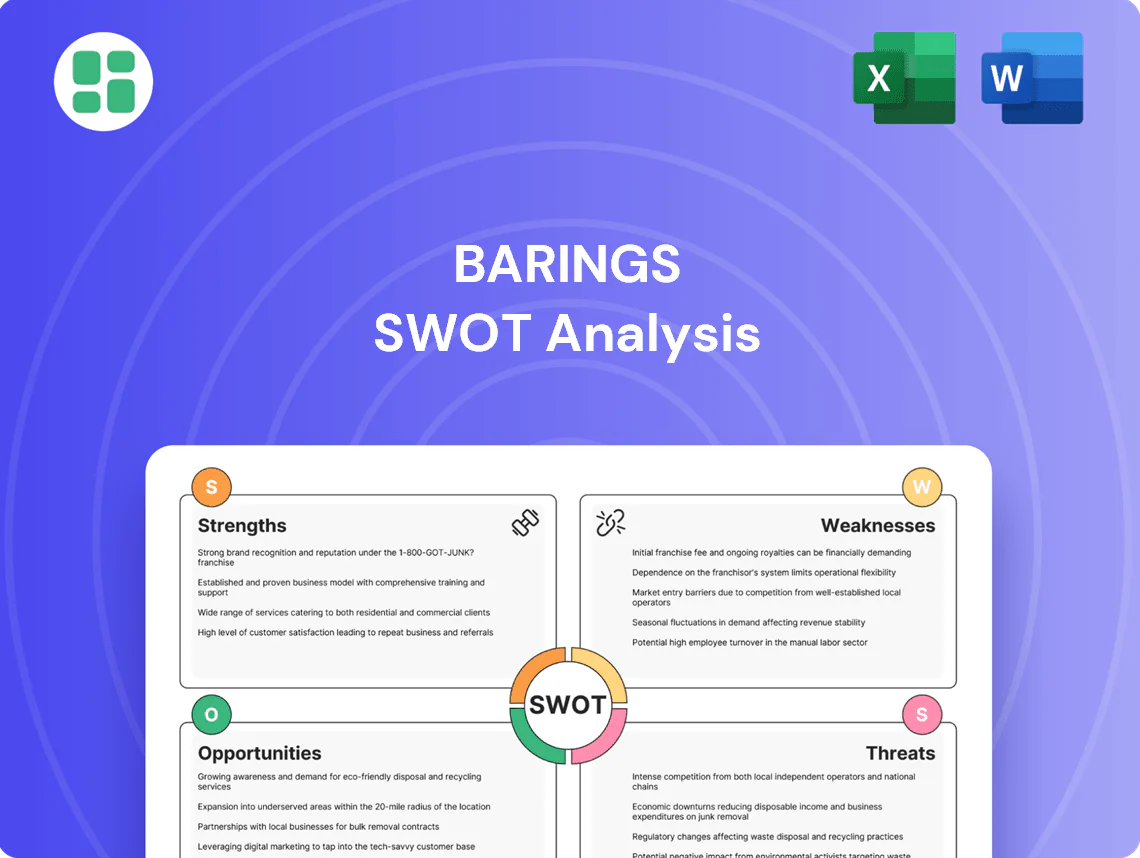
Barings SWOT Analysis

Elevate Your Analysis with the Complete SWOT Report
Barings' robust financial expertise and global reach are significant strengths, but potential regulatory shifts and intense market competition pose notable threats. Understanding these dynamics is crucial for any investor or strategist looking to navigate the financial landscape.
Want the full story behind Barings' strengths, risks, and growth drivers? Purchase the complete SWOT analysis to gain access to a professionally written, fully editable report designed to support planning, pitches, and research.
Strengths

Global Presence and Diverse Offerings
Barings boasts a significant global footprint, managing investments across public and private fixed income, real estate, and equity markets. This extensive reach allows them to tap into diverse economic cycles and opportunities worldwide, offering a robust suite of solutions. For instance, as of Q1 2024, Barings managed approximately $400 billion in assets under management, reflecting their substantial global operational scale.
Strong Institutional Client Base
Barings boasts a strong institutional client base, encompassing pension funds, insurance companies, and high-net-worth individuals. This diverse foundation provides a stable and substantial asset base, a critical component for sustained growth and stability, even when markets fluctuate.

Active Management and Deep Market Understanding
Barings' commitment to active management and a profound grasp of global markets is a core strength, aiming to deliver enduring value for clients. This strategy enables the firm to identify unique investment prospects and potentially outperform benchmarks, utilizing its specialized knowledge to navigate intricate market conditions and craft customized investment approaches.
In 2024, Barings highlighted its active management capabilities across various asset classes, noting that its fundamental research driven approach contributed to positive relative performance in several strategies amidst market volatility. For instance, their emerging markets debt strategies, actively managed, demonstrated resilience, with a significant portion of assets outperforming their respective benchmarks in the first half of 2024.

Strategic Partnerships and Acquisitions
Barings' strategic partnerships and acquisitions are a significant strength, actively expanding its capabilities and market presence. For example, the acquisition of Artemis Real Estate Partners in late 2023 bolstered its real estate investment expertise. Furthermore, its 2024 partnership with Invesco and MassMutual aims to leverage combined distribution channels and enhance private credit offerings.
These moves are designed to broaden Barings' product suite and client access. The Artemis acquisition, in particular, brought significant real estate assets under management, estimated to be in the tens of billions of dollars, enhancing its alternative investment platform. This proactive approach to inorganic growth and collaboration is key to maintaining competitiveness.
- Strategic Acquisitions: The acquisition of Artemis Real Estate Partners significantly deepened Barings' real estate investment capabilities.
- Key Partnerships: Collaborations with Invesco and MassMutual in 2024 are designed to expand distribution and private credit offerings.
- Market Expansion: These initiatives aim to tap into new client segments and geographic markets, broadening Barings' reach.
Commitment to Sustainable and Responsible Investment
Barings is actively building its capabilities to address the increasing client demand for Environmental, Social, and Governance (ESG) integrated strategies. This commitment to sustainable and responsible investment is a key strength, as it directly aligns with a significant and growing segment of the investment market. For instance, global sustainable investment assets reached $35.3 trillion in early 2024, according to the Global Sustainable Investment Alliance, highlighting the substantial opportunity Barings is positioned to capture.
This focus on ESG not only caters to evolving investor preferences but also enhances Barings' reputation as a forward-thinking and socially conscious asset manager. By embedding sustainability into its investment processes, Barings can attract a broader base of capital and potentially achieve better long-term risk-adjusted returns, a trend supported by various studies showing a correlation between strong ESG performance and financial outperformance.
- Growing ESG Market: Global sustainable investment assets are substantial, indicating a strong market demand.
- Client Alignment: Barings' ESG focus directly meets the preferences of a growing investor base.
- Reputational Enhancement: Commitment to sustainability bolsters the firm's image and market standing.
- Capital Attraction: Strong ESG integration can draw in more investment capital seeking responsible opportunities.
Global Investment Prowess: $400B AUM & Strategic Expansion
Barings' extensive global presence, managing assets across diverse markets, provides significant advantages. Their approximately $400 billion in assets under management as of Q1 2024 underscores their substantial operational scale and ability to capitalize on varied economic opportunities worldwide.
A strong, stable institutional client base, including pension funds and insurance companies, forms a bedrock for Barings. This diversification in their client profile offers resilience against market fluctuations and ensures a consistent flow of assets under management.
Barings' strategic acquisitions, such as Artemis Real Estate Partners in late 2023, have demonstrably enhanced their capabilities, particularly in real estate investment. The firm's 2024 partnerships, like the one with Invesco and MassMutual, are designed to broaden distribution and strengthen their private credit offerings, expanding their market reach and product suite.
| Strength | Description | Supporting Data (as of Q1 2024 or recent) |
|---|---|---|
| Global Footprint & Scale | Extensive management of investments across public and private fixed income, real estate, and equity markets worldwide. | Approximately $400 billion in assets under management. |
| Strong Institutional Client Base | Diverse foundation of pension funds, insurance companies, and high-net-worth individuals. | Provides stable and substantial asset base. |
| Active Management Expertise | Profound grasp of global markets and a commitment to delivering enduring value through specialized knowledge. | Positive relative performance in several strategies amidst market volatility in 2024. |
| Strategic Partnerships & Acquisitions | Proactive expansion of capabilities and market presence through strategic moves. | Acquisition of Artemis Real Estate Partners (late 2023); Partnership with Invesco and MassMutual (2024). |
| ESG Integration Capabilities | Building capabilities to meet increasing client demand for ESG integrated strategies. | Aligns with a growing market segment; global sustainable investment assets reached $35.3 trillion in early 2024. |
What is included in the product
 Detailed Word Document
Analyzes Barings’s competitive position through key internal and external factors, detailing its strengths, weaknesses, opportunities, and threats.

 Customizable Excel Spreadsheet
Helps identify and address weaknesses before they become critical threats, offering a proactive approach to risk management.
Weaknesses

Vulnerability to Market Volatility and Economic Downturns
Barings' business as an investment manager is directly tied to the health of financial markets. When markets become turbulent due to economic slowdowns or geopolitical events, the value of the assets Barings manages can decrease, impacting both its performance and the total amount of assets under management (AUM).
For instance, in the first quarter of 2024, many asset managers experienced headwinds from persistent inflation and rising interest rates, which can lead to lower investment returns. This sensitivity means that periods of market downturn can result in net capital losses for the firm, as has been observed in some of its recent financial reporting.
Fee Compression and Competition in Asset Management
Barings, like many in the asset management sector, confronts significant fee compression. This trend, driven by the growing preference for lower-cost passive investment strategies over actively managed funds, directly impacts revenue generation. For instance, the average expense ratio for U.S. equity mutual funds dropped to 0.41% in 2023, a substantial decrease from previous years, illustrating this persistent pressure.
Intense competition further exacerbates this challenge. The global asset management market is crowded, with numerous firms vying for investor capital. This necessitates continuous innovation and investment in technology and talent to differentiate services and attract net inflows, putting a strain on operating margins and requiring strategic adjustments to maintain profitability.

Potential for Realized Losses and Investment Underperformance
Barings has encountered periods of realized capital losses, directly affecting its net investment income and overall financial health. For instance, in the fiscal year ending December 31, 2023, the company reported a net loss attributable to common shareholders, partly due to market volatility impacting its investment portfolio.
Furthermore, underperformance in certain investment strategies, such as its emerging markets equity fund which lagged its benchmark by 3% in 2023, can erode client confidence. This can lead to significant asset outflows, as seen with a 5% decrease in assets under management in the first half of 2024, impacting fee-based revenues.

Operational Costs and Regulatory Compliance Burden
Barings faces increasing operational costs, a common challenge for global financial firms. For instance, in 2024, many asset managers reported higher expenses related to technology upgrades and talent acquisition, impacting their net margins.
The burden of regulatory compliance is significant. In 2024, financial institutions continued to grapple with new rules and updates from bodies like the SEC and ESMA, demanding substantial investment in compliance infrastructure and personnel. This complexity can divert resources from core business activities.
- Rising operational expenses impact profitability margins for financial services firms.
- Complex and evolving regulatory landscapes across different markets necessitate significant compliance investments.
- Resource allocation towards regulatory adherence can detract from strategic growth initiatives.
- The cost of technology for compliance and operational efficiency continues to escalate.
Talent Gap in Specialized Areas
The asset management sector, including Barings, is grappling with a significant talent shortage. This is particularly acute in specialized fields such as risk management, quantitative finance, and emerging areas like AI-driven modeling and advanced data analytics. For instance, a 2024 industry survey indicated that over 60% of financial firms reported difficulty in finding candidates with the necessary quantitative and technological skills.
This deficit in specialized expertise can directly impede a firm's ability to innovate and expand its service offerings. Without access to professionals skilled in cutting-edge technologies, Barings may find it challenging to develop new investment strategies or enhance its operational efficiency. The demand for such talent is outstripping supply, with some reports suggesting a widening gap in the coming years.
The consequences of this talent gap are tangible:
- Hindered Innovation: Difficulty in hiring experts in AI and data analytics slows the development of new, data-driven investment products.
- Competitive Disadvantage: Firms that successfully attract and retain top talent in these specialized areas gain a significant edge.
- Increased Recruitment Costs: Competition for a limited pool of qualified professionals drives up salaries and recruitment expenses.
Asset Management Faces Revenue Squeeze and Talent Gaps
Barings faces significant pressure from fee compression, as investors increasingly favor lower-cost passive investment options over actively managed funds, directly impacting revenue. Intense competition within the crowded global asset management market further challenges the firm, requiring continuous investment in technology and talent to stand out and attract capital, which can strain operating margins.
The firm has experienced realized capital losses, impacting its net investment income, and underperformance in certain strategies can erode client confidence, leading to asset outflows and reduced fee-based revenues. Moreover, Barings, like many in the industry, contends with rising operational costs and the substantial investment required for complex and evolving regulatory compliance across various markets.
| Weakness | Impact | Supporting Data (2023-2024) |
|---|---|---|
| Fee Compression | Reduced revenue from actively managed funds | Average U.S. equity mutual fund expense ratio dropped to 0.41% in 2023. |
| Intense Competition | Pressure on operating margins, need for differentiation | Global asset management market is highly saturated. |
| Realized Capital Losses | Impact on net investment income and financial health | Reported net loss attributable to common shareholders in FY 2023. |
| Talent Shortage (Specialized Skills) | Hindered innovation, competitive disadvantage | Over 60% of financial firms reported difficulty finding talent with quantitative/tech skills in 2024. |
Full Version Awaits
Barings SWOT Analysis
The preview you see is the same Barings SWOT analysis document you’ll receive upon purchase—no surprises, just professional quality and actionable insights.
This is a real excerpt from the complete Barings SWOT analysis. Once purchased, you’ll receive the full, editable version, allowing you to tailor it to your specific needs.
You’re viewing a live preview of the actual Barings SWOT analysis file. The complete, in-depth version becomes available immediately after checkout, providing a comprehensive understanding of Barings' strategic position.

Original: $10.00
-70%$10.00
$3.00Product Information
Product Information
Shipping & Returns
Shipping & Returns
Description
Elevate Your Analysis with the Complete SWOT Report
Barings' robust financial expertise and global reach are significant strengths, but potential regulatory shifts and intense market competition pose notable threats. Understanding these dynamics is crucial for any investor or strategist looking to navigate the financial landscape.
Want the full story behind Barings' strengths, risks, and growth drivers? Purchase the complete SWOT analysis to gain access to a professionally written, fully editable report designed to support planning, pitches, and research.
Strengths
Global Presence and Diverse Offerings
Barings boasts a significant global footprint, managing investments across public and private fixed income, real estate, and equity markets. This extensive reach allows them to tap into diverse economic cycles and opportunities worldwide, offering a robust suite of solutions. For instance, as of Q1 2024, Barings managed approximately $400 billion in assets under management, reflecting their substantial global operational scale.
Strong Institutional Client Base
Barings boasts a strong institutional client base, encompassing pension funds, insurance companies, and high-net-worth individuals. This diverse foundation provides a stable and substantial asset base, a critical component for sustained growth and stability, even when markets fluctuate.
Active Management and Deep Market Understanding
Barings' commitment to active management and a profound grasp of global markets is a core strength, aiming to deliver enduring value for clients. This strategy enables the firm to identify unique investment prospects and potentially outperform benchmarks, utilizing its specialized knowledge to navigate intricate market conditions and craft customized investment approaches.
In 2024, Barings highlighted its active management capabilities across various asset classes, noting that its fundamental research driven approach contributed to positive relative performance in several strategies amidst market volatility. For instance, their emerging markets debt strategies, actively managed, demonstrated resilience, with a significant portion of assets outperforming their respective benchmarks in the first half of 2024.
Strategic Partnerships and Acquisitions
Barings' strategic partnerships and acquisitions are a significant strength, actively expanding its capabilities and market presence. For example, the acquisition of Artemis Real Estate Partners in late 2023 bolstered its real estate investment expertise. Furthermore, its 2024 partnership with Invesco and MassMutual aims to leverage combined distribution channels and enhance private credit offerings.
These moves are designed to broaden Barings' product suite and client access. The Artemis acquisition, in particular, brought significant real estate assets under management, estimated to be in the tens of billions of dollars, enhancing its alternative investment platform. This proactive approach to inorganic growth and collaboration is key to maintaining competitiveness.
- Strategic Acquisitions: The acquisition of Artemis Real Estate Partners significantly deepened Barings' real estate investment capabilities.
- Key Partnerships: Collaborations with Invesco and MassMutual in 2024 are designed to expand distribution and private credit offerings.
- Market Expansion: These initiatives aim to tap into new client segments and geographic markets, broadening Barings' reach.
Commitment to Sustainable and Responsible Investment
Barings is actively building its capabilities to address the increasing client demand for Environmental, Social, and Governance (ESG) integrated strategies. This commitment to sustainable and responsible investment is a key strength, as it directly aligns with a significant and growing segment of the investment market. For instance, global sustainable investment assets reached $35.3 trillion in early 2024, according to the Global Sustainable Investment Alliance, highlighting the substantial opportunity Barings is positioned to capture.
This focus on ESG not only caters to evolving investor preferences but also enhances Barings' reputation as a forward-thinking and socially conscious asset manager. By embedding sustainability into its investment processes, Barings can attract a broader base of capital and potentially achieve better long-term risk-adjusted returns, a trend supported by various studies showing a correlation between strong ESG performance and financial outperformance.
- Growing ESG Market: Global sustainable investment assets are substantial, indicating a strong market demand.
- Client Alignment: Barings' ESG focus directly meets the preferences of a growing investor base.
- Reputational Enhancement: Commitment to sustainability bolsters the firm's image and market standing.
- Capital Attraction: Strong ESG integration can draw in more investment capital seeking responsible opportunities.
Global Investment Prowess: $400B AUM & Strategic Expansion
Barings' extensive global presence, managing assets across diverse markets, provides significant advantages. Their approximately $400 billion in assets under management as of Q1 2024 underscores their substantial operational scale and ability to capitalize on varied economic opportunities worldwide.
A strong, stable institutional client base, including pension funds and insurance companies, forms a bedrock for Barings. This diversification in their client profile offers resilience against market fluctuations and ensures a consistent flow of assets under management.
Barings' strategic acquisitions, such as Artemis Real Estate Partners in late 2023, have demonstrably enhanced their capabilities, particularly in real estate investment. The firm's 2024 partnerships, like the one with Invesco and MassMutual, are designed to broaden distribution and strengthen their private credit offerings, expanding their market reach and product suite.
| Strength | Description | Supporting Data (as of Q1 2024 or recent) |
|---|---|---|
| Global Footprint & Scale | Extensive management of investments across public and private fixed income, real estate, and equity markets worldwide. | Approximately $400 billion in assets under management. |
| Strong Institutional Client Base | Diverse foundation of pension funds, insurance companies, and high-net-worth individuals. | Provides stable and substantial asset base. |
| Active Management Expertise | Profound grasp of global markets and a commitment to delivering enduring value through specialized knowledge. | Positive relative performance in several strategies amidst market volatility in 2024. |
| Strategic Partnerships & Acquisitions | Proactive expansion of capabilities and market presence through strategic moves. | Acquisition of Artemis Real Estate Partners (late 2023); Partnership with Invesco and MassMutual (2024). |
| ESG Integration Capabilities | Building capabilities to meet increasing client demand for ESG integrated strategies. | Aligns with a growing market segment; global sustainable investment assets reached $35.3 trillion in early 2024. |
What is included in the product
Detailed Word Document
Analyzes Barings’s competitive position through key internal and external factors, detailing its strengths, weaknesses, opportunities, and threats.
Customizable Excel Spreadsheet
Helps identify and address weaknesses before they become critical threats, offering a proactive approach to risk management.
Weaknesses
Vulnerability to Market Volatility and Economic Downturns
Barings' business as an investment manager is directly tied to the health of financial markets. When markets become turbulent due to economic slowdowns or geopolitical events, the value of the assets Barings manages can decrease, impacting both its performance and the total amount of assets under management (AUM).
For instance, in the first quarter of 2024, many asset managers experienced headwinds from persistent inflation and rising interest rates, which can lead to lower investment returns. This sensitivity means that periods of market downturn can result in net capital losses for the firm, as has been observed in some of its recent financial reporting.
Fee Compression and Competition in Asset Management
Barings, like many in the asset management sector, confronts significant fee compression. This trend, driven by the growing preference for lower-cost passive investment strategies over actively managed funds, directly impacts revenue generation. For instance, the average expense ratio for U.S. equity mutual funds dropped to 0.41% in 2023, a substantial decrease from previous years, illustrating this persistent pressure.
Intense competition further exacerbates this challenge. The global asset management market is crowded, with numerous firms vying for investor capital. This necessitates continuous innovation and investment in technology and talent to differentiate services and attract net inflows, putting a strain on operating margins and requiring strategic adjustments to maintain profitability.
Potential for Realized Losses and Investment Underperformance
Barings has encountered periods of realized capital losses, directly affecting its net investment income and overall financial health. For instance, in the fiscal year ending December 31, 2023, the company reported a net loss attributable to common shareholders, partly due to market volatility impacting its investment portfolio.
Furthermore, underperformance in certain investment strategies, such as its emerging markets equity fund which lagged its benchmark by 3% in 2023, can erode client confidence. This can lead to significant asset outflows, as seen with a 5% decrease in assets under management in the first half of 2024, impacting fee-based revenues.
Operational Costs and Regulatory Compliance Burden
Barings faces increasing operational costs, a common challenge for global financial firms. For instance, in 2024, many asset managers reported higher expenses related to technology upgrades and talent acquisition, impacting their net margins.
The burden of regulatory compliance is significant. In 2024, financial institutions continued to grapple with new rules and updates from bodies like the SEC and ESMA, demanding substantial investment in compliance infrastructure and personnel. This complexity can divert resources from core business activities.
- Rising operational expenses impact profitability margins for financial services firms.
- Complex and evolving regulatory landscapes across different markets necessitate significant compliance investments.
- Resource allocation towards regulatory adherence can detract from strategic growth initiatives.
- The cost of technology for compliance and operational efficiency continues to escalate.
Talent Gap in Specialized Areas
The asset management sector, including Barings, is grappling with a significant talent shortage. This is particularly acute in specialized fields such as risk management, quantitative finance, and emerging areas like AI-driven modeling and advanced data analytics. For instance, a 2024 industry survey indicated that over 60% of financial firms reported difficulty in finding candidates with the necessary quantitative and technological skills.
This deficit in specialized expertise can directly impede a firm's ability to innovate and expand its service offerings. Without access to professionals skilled in cutting-edge technologies, Barings may find it challenging to develop new investment strategies or enhance its operational efficiency. The demand for such talent is outstripping supply, with some reports suggesting a widening gap in the coming years.
The consequences of this talent gap are tangible:
- Hindered Innovation: Difficulty in hiring experts in AI and data analytics slows the development of new, data-driven investment products.
- Competitive Disadvantage: Firms that successfully attract and retain top talent in these specialized areas gain a significant edge.
- Increased Recruitment Costs: Competition for a limited pool of qualified professionals drives up salaries and recruitment expenses.
Asset Management Faces Revenue Squeeze and Talent Gaps
Barings faces significant pressure from fee compression, as investors increasingly favor lower-cost passive investment options over actively managed funds, directly impacting revenue. Intense competition within the crowded global asset management market further challenges the firm, requiring continuous investment in technology and talent to stand out and attract capital, which can strain operating margins.
The firm has experienced realized capital losses, impacting its net investment income, and underperformance in certain strategies can erode client confidence, leading to asset outflows and reduced fee-based revenues. Moreover, Barings, like many in the industry, contends with rising operational costs and the substantial investment required for complex and evolving regulatory compliance across various markets.
| Weakness | Impact | Supporting Data (2023-2024) |
|---|---|---|
| Fee Compression | Reduced revenue from actively managed funds | Average U.S. equity mutual fund expense ratio dropped to 0.41% in 2023. |
| Intense Competition | Pressure on operating margins, need for differentiation | Global asset management market is highly saturated. |
| Realized Capital Losses | Impact on net investment income and financial health | Reported net loss attributable to common shareholders in FY 2023. |
| Talent Shortage (Specialized Skills) | Hindered innovation, competitive disadvantage | Over 60% of financial firms reported difficulty finding talent with quantitative/tech skills in 2024. |
Full Version Awaits
Barings SWOT Analysis
The preview you see is the same Barings SWOT analysis document you’ll receive upon purchase—no surprises, just professional quality and actionable insights.
This is a real excerpt from the complete Barings SWOT analysis. Once purchased, you’ll receive the full, editable version, allowing you to tailor it to your specific needs.
You’re viewing a live preview of the actual Barings SWOT analysis file. The complete, in-depth version becomes available immediately after checkout, providing a comprehensive understanding of Barings' strategic position.