BW Offshore SWOT Analysis

Make Insightful Decisions Backed by Expert Research
BW Offshore's market position is shaped by its strong operational expertise and a fleet of floating production storage and offloading (FPSO) units, but also faces challenges from evolving energy markets and project execution risks. Discover the complete picture behind the company’s market position with our full SWOT analysis. This in-depth report reveals actionable insights, financial context, and strategic takeaways—ideal for entrepreneurs, analysts, and investors.
Strengths

Global Leadership in FPSO Operations
BW Offshore stands as a preeminent global leader in Floating Production Storage and Offloading (FPSO) vessel operations, built on more than 40 years of offshore experience. This deep well of expertise has been honed through the successful execution of 40 FPSO and Floating Storage and Offloading (FSO) projects.
The company's operational prowess is further evidenced by its consistent high commercial uptime across its entire fleet, a critical metric for reliability and client trust in the demanding offshore sector. This strong track record underpins BW Offshore's robust foundation for continued success and expansion in the FPSO market.
Comprehensive Service Offering and Integrated Solutions
BW Offshore's extensive service portfolio, covering everything from initial design and engineering to the full operation of offshore production units, is a significant strength. This integrated model allows them to provide complete, end-to-end solutions for oil and gas clients, streamlining the complex process of hydrocarbon extraction and processing.
This comprehensive capability positions BW Offshore as a valuable partner for demanding offshore projects. For instance, their successful delivery of the floating production storage and offloading (FPSO) vessel for the Tortue Ahmeyim project in 2024, a complex undertaking involving multiple phases, highlights their integrated approach and execution prowess.

Strong Financial Position and Backlog
BW Offshore's financial standing is exceptionally strong, with Q1 2025 results showing a robust balance sheet and substantial liquidity. The company reported being net cash positive, a testament to its sound financial management and operational efficiency.
This financial health is further bolstered by a significant firm contract backlog, which provides a predictable and stable revenue stream for the foreseeable future. This backlog not only secures current operations but also offers a solid foundation for future investments and strategic growth initiatives, enhancing overall business resilience.

Strategic Diversification into Energy Transition
BW Offshore's strategic move into the energy transition is a significant strength, with the company actively pursuing offshore wind projects and embracing technologies like carbon capture and storage (CCS). This proactive approach is crucial for long-term relevance in a rapidly changing energy landscape. For instance, by 2024, BW Offshore's commitment to renewables is underscored by its growing portfolio of offshore wind development projects, aiming to capture a substantial share of this expanding market.
Their investment in BW Ideol, a key player in floating offshore wind technology, further solidifies this strategic advantage. This partnership allows BW Offshore to leverage cutting-edge solutions for offshore wind deployment, particularly in areas where fixed-bottom foundations are not feasible. As of early 2025, BW Ideol has secured a robust pipeline of projects, demonstrating the tangible progress and market validation of their technology.
- Active involvement in offshore wind development, positioning BW Offshore for growth in the renewable energy sector.
- Exploration of carbon capture and storage (CCS) technologies, aligning with global decarbonization efforts.
- Strategic ownership stake in BW Ideol, a leader in floating offshore wind, enhancing technological capabilities.
- Diversification strategy is expected to contribute an increasing percentage of revenue from renewable projects by 2025.
High Commercial Uptime and Operational Excellence
BW Offshore's commitment to operational excellence is a significant strength, directly translating into high commercial uptime for its Floating Production, Storage, and Offloading (FPSO) units. This reliability is crucial for consistent revenue generation in the offshore energy sector.
The company's operational performance is underscored by impressive uptime figures. For example, BW Offshore reported a weighted average uptime of 100.0% across its fleet in the first quarter of 2025. This exceptional performance highlights the effectiveness of their maintenance strategies and operational management.
This consistent high uptime ensures predictable cash flows, which is a key factor for investors and stakeholders. It also reflects a deep-seated commitment to safety and efficiency, building a reputation for dependable service delivery in a demanding industry.
- Consistent High Commercial Uptime: BW Offshore's fleet consistently achieves excellent uptime, demonstrating robust operational capabilities.
- Q1 2025 Fleet Uptime: The company achieved a weighted average uptime of 100.0% in Q1 2025, showcasing superior operational reliability.
- Steady Cash Generation: High uptime directly contributes to stable and predictable revenue streams, a critical advantage in the industry.
- Commitment to Safety and Efficiency: This operational excellence is a testament to BW Offshore's dedication to maintaining high standards in safety and operational efficiency.
BW Offshore: 40 Years, 40 Projects, 100% Uptime
BW Offshore's extensive experience, spanning over 40 years and 40 successful FPSO/FSO projects, forms a bedrock of operational strength. This deep expertise is directly reflected in their fleet's exceptional uptime, with a weighted average of 100.0% achieved in Q1 2025, ensuring reliable revenue generation.
What is included in the product
 Detailed Word Document
Analyzes BW Offshore’s competitive position through key internal and external factors, highlighting its operational strengths and market opportunities while acknowledging potential weaknesses and industry threats.

 Customizable Excel Spreadsheet
Uncovers hidden opportunities and mitigates potential threats, offering a clear path to improved operational efficiency.
Weaknesses

Exposure to Oil and Gas Price Volatility
BW Offshore's reliance on the oil and gas sector means its revenue is indirectly exposed to the volatile nature of global commodity prices. A sharp decline in oil and gas prices, such as the significant drops seen in early 2020 impacting Brent crude futures, can curb exploration and production investments by clients. This downturn in client spending can translate to fewer new project opportunities and less favorable contract renegotiations for BW Offshore.
High Capital Expenditure Requirements
BW Offshore faces a significant hurdle with its high capital expenditure requirements. Building and maintaining its fleet of floating production, storage, and offloading (FPSO) vessels demands massive upfront investments for new construction, conversions, and ongoing upgrades. For instance, the Barossa FPSO project alone represents a substantial capital outlay.
These substantial investments can lock up considerable amounts of capital, thereby amplifying financial risks, particularly for ambitious, large-scale projects. The escalating costs associated with FPSOs, coupled with persistent concerns regarding supply chain expenses, further exacerbate this weakness.

Dependence on Long-Term Contracts and Project Delays
BW Offshore's business model hinges on long-term contracts with oil and gas majors, offering a degree of revenue predictability. However, this reliance also presents a significant weakness. For instance, the company's Barossa FPSO project experienced initial timing adjustments, which can disrupt the anticipated flow of cash and revenue recognition, directly impacting financial performance.
These project delays are not merely about timing; they often translate into increased operational costs for BW Offshore. The extended timelines necessitate continued resource allocation and can introduce unforeseen expenses, potentially eroding profit margins on these crucial long-term agreements. This sensitivity to project execution timelines remains a key vulnerability.

Aging Fleet Considerations
BW Offshore's aging fleet presents a significant challenge. While the company is investing in new assets, some existing Floating Production Storage and Offloading (FPSO) units will necessitate substantial maintenance and upgrades to ensure they remain competitive and meet increasingly stringent environmental regulations. For instance, as of the first half of 2024, BW Offshore reported that its fleet utilization remained strong, but the ongoing operational demands of managing a diverse and aging asset base require continuous capital allocation for upkeep.
The complexity of maintaining larger, more advanced vessels is escalating. This trend is driving a strategic shift within BW Offshore towards more condition-based maintenance approaches rather than traditional time-based schedules. This evolution aims to optimize asset performance and manage costs more effectively across the fleet.
- Fleet Age Profile: While specific average age data fluctuates, a portion of BW Offshore's FPSO fleet operates beyond 20 years, requiring proactive lifecycle management.
- Maintenance Costs: Capex for maintenance and upgrades on older units can be substantial, impacting profitability and cash flow.
- Environmental Compliance: Evolving emissions standards and operational efficiency requirements necessitate investments to keep older assets compliant.
- Operational Complexity: Managing the technical intricacies of older, yet still operational, FPSOs demands specialized expertise and resources.
Environmental and Regulatory Scrutiny
BW Offshore, like others in the offshore oil and gas sector, faces heightened environmental and regulatory pressures. These regulations, particularly those focused on reducing carbon emissions and preventing pollution, demand significant and ongoing investment in cleaner technologies and operational adjustments. For instance, the increasing focus on carbon capture, utilization, and storage (CCUS) solutions, while vital for long-term sustainability, can directly impact operational expenditures and introduce greater complexity.
The industry's commitment to lowering its carbon intensity is not merely a compliance issue but a critical factor for future market access and financial health. Companies are increasingly evaluated on their environmental, social, and governance (ESG) performance, which can influence investor confidence and access to capital. For 2024, many energy companies are reporting increased CAPEX for decarbonization efforts, with some allocating upwards of 15-20% of their total capital expenditure towards these initiatives to meet evolving climate targets.
- Increased Compliance Costs: Stricter environmental regulations necessitate higher spending on emissions reduction technologies and pollution prevention measures.
- Carbon Capture Investment: Implementing carbon capture solutions, while environmentally beneficial, adds to operational costs and technical complexity.
- ESG Performance Scrutiny: Investor and stakeholder focus on ESG metrics means companies must demonstrate tangible progress in reducing their environmental footprint to maintain market favor.
- Operational Adjustments: Adapting operations to meet new environmental standards can require significant changes, potentially impacting efficiency and requiring specialized expertise.
Financial Headwinds: Capex, Fleet Upkeep, & ESG Compliance
BW Offshore's significant capital expenditure for newbuilds and conversions, such as the Barossa FPSO, ties up substantial capital and increases financial risk. Supply chain cost escalations further compound these expenses, potentially impacting project profitability and cash flow. The company's reliance on long-term contracts, while providing revenue predictability, also creates vulnerability if projects face delays, as seen with initial timing adjustments on the Barossa FPSO, leading to increased operational costs and potential margin erosion.
The company's aging fleet requires continuous, substantial investment in maintenance and upgrades to remain competitive and compliant with evolving environmental standards. This ongoing capital allocation for upkeep, alongside the increasing complexity of managing advanced vessels, presents a persistent financial drain. For instance, managing the lifecycle of FPSOs operating beyond 20 years demands proactive management and significant capital for upkeep.
BW Offshore faces considerable financial pressure from increased environmental and regulatory compliance costs. Investing in cleaner technologies and operational adjustments, such as carbon capture solutions, adds to operational expenditures and technical complexity. The industry's push for lower carbon intensity requires companies to demonstrate strong ESG performance, influencing investor confidence and access to capital, with many energy firms allocating 15-20% of CAPEX to decarbonization in 2024.
Full Version Awaits
BW Offshore SWOT Analysis
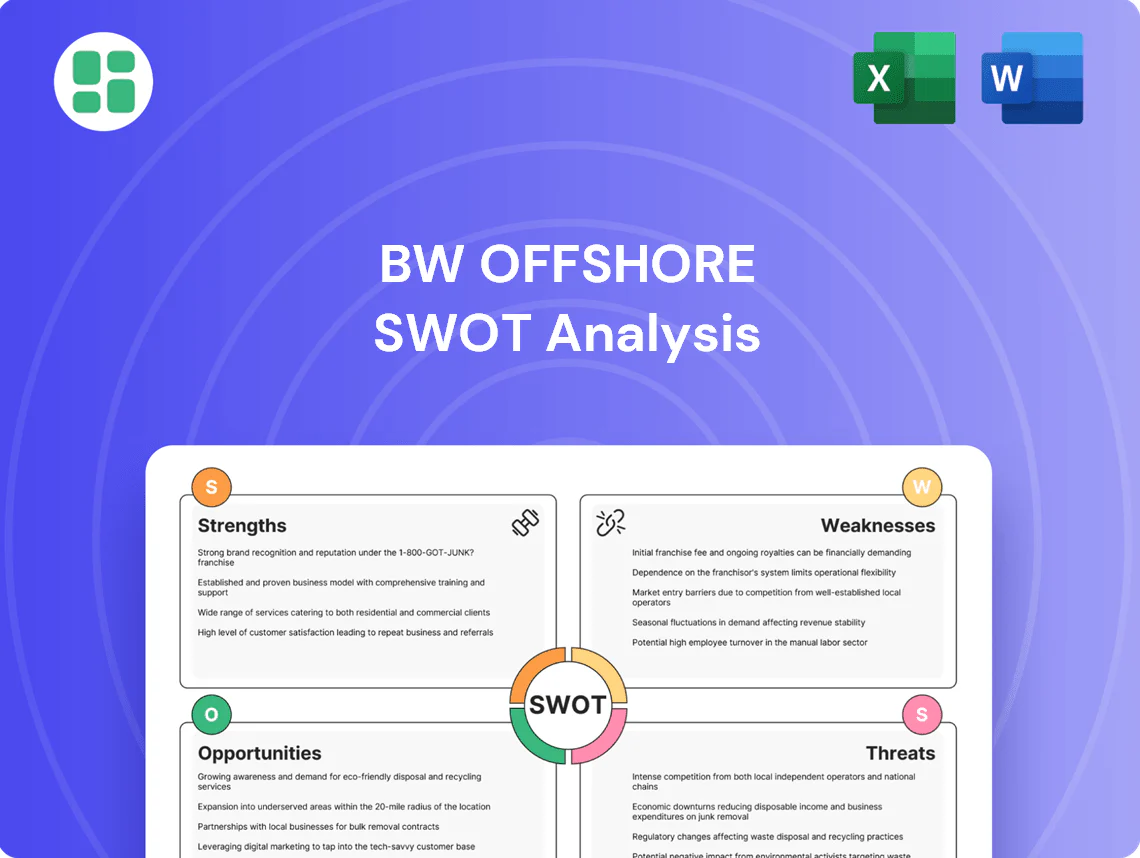
The file shown below is not a sample—it’s the real BW Offshore SWOT analysis you'll download post-purchase, in full detail. This comprehensive report covers all key internal and external factors influencing the company's strategic position. Upon purchase, you gain access to the complete, actionable insights.

Original: $10.00
-70%$10.00
$3.00Product Information
Product Information
Shipping & Returns
Shipping & Returns
Description
Make Insightful Decisions Backed by Expert Research
BW Offshore's market position is shaped by its strong operational expertise and a fleet of floating production storage and offloading (FPSO) units, but also faces challenges from evolving energy markets and project execution risks. Discover the complete picture behind the company’s market position with our full SWOT analysis. This in-depth report reveals actionable insights, financial context, and strategic takeaways—ideal for entrepreneurs, analysts, and investors.
Strengths
Global Leadership in FPSO Operations
BW Offshore stands as a preeminent global leader in Floating Production Storage and Offloading (FPSO) vessel operations, built on more than 40 years of offshore experience. This deep well of expertise has been honed through the successful execution of 40 FPSO and Floating Storage and Offloading (FSO) projects.
The company's operational prowess is further evidenced by its consistent high commercial uptime across its entire fleet, a critical metric for reliability and client trust in the demanding offshore sector. This strong track record underpins BW Offshore's robust foundation for continued success and expansion in the FPSO market.
Comprehensive Service Offering and Integrated Solutions
BW Offshore's extensive service portfolio, covering everything from initial design and engineering to the full operation of offshore production units, is a significant strength. This integrated model allows them to provide complete, end-to-end solutions for oil and gas clients, streamlining the complex process of hydrocarbon extraction and processing.
This comprehensive capability positions BW Offshore as a valuable partner for demanding offshore projects. For instance, their successful delivery of the floating production storage and offloading (FPSO) vessel for the Tortue Ahmeyim project in 2024, a complex undertaking involving multiple phases, highlights their integrated approach and execution prowess.
Strong Financial Position and Backlog
BW Offshore's financial standing is exceptionally strong, with Q1 2025 results showing a robust balance sheet and substantial liquidity. The company reported being net cash positive, a testament to its sound financial management and operational efficiency.
This financial health is further bolstered by a significant firm contract backlog, which provides a predictable and stable revenue stream for the foreseeable future. This backlog not only secures current operations but also offers a solid foundation for future investments and strategic growth initiatives, enhancing overall business resilience.
Strategic Diversification into Energy Transition
BW Offshore's strategic move into the energy transition is a significant strength, with the company actively pursuing offshore wind projects and embracing technologies like carbon capture and storage (CCS). This proactive approach is crucial for long-term relevance in a rapidly changing energy landscape. For instance, by 2024, BW Offshore's commitment to renewables is underscored by its growing portfolio of offshore wind development projects, aiming to capture a substantial share of this expanding market.
Their investment in BW Ideol, a key player in floating offshore wind technology, further solidifies this strategic advantage. This partnership allows BW Offshore to leverage cutting-edge solutions for offshore wind deployment, particularly in areas where fixed-bottom foundations are not feasible. As of early 2025, BW Ideol has secured a robust pipeline of projects, demonstrating the tangible progress and market validation of their technology.
- Active involvement in offshore wind development, positioning BW Offshore for growth in the renewable energy sector.
- Exploration of carbon capture and storage (CCS) technologies, aligning with global decarbonization efforts.
- Strategic ownership stake in BW Ideol, a leader in floating offshore wind, enhancing technological capabilities.
- Diversification strategy is expected to contribute an increasing percentage of revenue from renewable projects by 2025.
High Commercial Uptime and Operational Excellence
BW Offshore's commitment to operational excellence is a significant strength, directly translating into high commercial uptime for its Floating Production, Storage, and Offloading (FPSO) units. This reliability is crucial for consistent revenue generation in the offshore energy sector.
The company's operational performance is underscored by impressive uptime figures. For example, BW Offshore reported a weighted average uptime of 100.0% across its fleet in the first quarter of 2025. This exceptional performance highlights the effectiveness of their maintenance strategies and operational management.
This consistent high uptime ensures predictable cash flows, which is a key factor for investors and stakeholders. It also reflects a deep-seated commitment to safety and efficiency, building a reputation for dependable service delivery in a demanding industry.
- Consistent High Commercial Uptime: BW Offshore's fleet consistently achieves excellent uptime, demonstrating robust operational capabilities.
- Q1 2025 Fleet Uptime: The company achieved a weighted average uptime of 100.0% in Q1 2025, showcasing superior operational reliability.
- Steady Cash Generation: High uptime directly contributes to stable and predictable revenue streams, a critical advantage in the industry.
- Commitment to Safety and Efficiency: This operational excellence is a testament to BW Offshore's dedication to maintaining high standards in safety and operational efficiency.
BW Offshore: 40 Years, 40 Projects, 100% Uptime
BW Offshore's extensive experience, spanning over 40 years and 40 successful FPSO/FSO projects, forms a bedrock of operational strength. This deep expertise is directly reflected in their fleet's exceptional uptime, with a weighted average of 100.0% achieved in Q1 2025, ensuring reliable revenue generation.
What is included in the product
Detailed Word Document
Analyzes BW Offshore’s competitive position through key internal and external factors, highlighting its operational strengths and market opportunities while acknowledging potential weaknesses and industry threats.
Customizable Excel Spreadsheet
Uncovers hidden opportunities and mitigates potential threats, offering a clear path to improved operational efficiency.
Weaknesses
Exposure to Oil and Gas Price Volatility
BW Offshore's reliance on the oil and gas sector means its revenue is indirectly exposed to the volatile nature of global commodity prices. A sharp decline in oil and gas prices, such as the significant drops seen in early 2020 impacting Brent crude futures, can curb exploration and production investments by clients. This downturn in client spending can translate to fewer new project opportunities and less favorable contract renegotiations for BW Offshore.
High Capital Expenditure Requirements
BW Offshore faces a significant hurdle with its high capital expenditure requirements. Building and maintaining its fleet of floating production, storage, and offloading (FPSO) vessels demands massive upfront investments for new construction, conversions, and ongoing upgrades. For instance, the Barossa FPSO project alone represents a substantial capital outlay.
These substantial investments can lock up considerable amounts of capital, thereby amplifying financial risks, particularly for ambitious, large-scale projects. The escalating costs associated with FPSOs, coupled with persistent concerns regarding supply chain expenses, further exacerbate this weakness.
Dependence on Long-Term Contracts and Project Delays
BW Offshore's business model hinges on long-term contracts with oil and gas majors, offering a degree of revenue predictability. However, this reliance also presents a significant weakness. For instance, the company's Barossa FPSO project experienced initial timing adjustments, which can disrupt the anticipated flow of cash and revenue recognition, directly impacting financial performance.
These project delays are not merely about timing; they often translate into increased operational costs for BW Offshore. The extended timelines necessitate continued resource allocation and can introduce unforeseen expenses, potentially eroding profit margins on these crucial long-term agreements. This sensitivity to project execution timelines remains a key vulnerability.
Aging Fleet Considerations
BW Offshore's aging fleet presents a significant challenge. While the company is investing in new assets, some existing Floating Production Storage and Offloading (FPSO) units will necessitate substantial maintenance and upgrades to ensure they remain competitive and meet increasingly stringent environmental regulations. For instance, as of the first half of 2024, BW Offshore reported that its fleet utilization remained strong, but the ongoing operational demands of managing a diverse and aging asset base require continuous capital allocation for upkeep.
The complexity of maintaining larger, more advanced vessels is escalating. This trend is driving a strategic shift within BW Offshore towards more condition-based maintenance approaches rather than traditional time-based schedules. This evolution aims to optimize asset performance and manage costs more effectively across the fleet.
- Fleet Age Profile: While specific average age data fluctuates, a portion of BW Offshore's FPSO fleet operates beyond 20 years, requiring proactive lifecycle management.
- Maintenance Costs: Capex for maintenance and upgrades on older units can be substantial, impacting profitability and cash flow.
- Environmental Compliance: Evolving emissions standards and operational efficiency requirements necessitate investments to keep older assets compliant.
- Operational Complexity: Managing the technical intricacies of older, yet still operational, FPSOs demands specialized expertise and resources.
Environmental and Regulatory Scrutiny
BW Offshore, like others in the offshore oil and gas sector, faces heightened environmental and regulatory pressures. These regulations, particularly those focused on reducing carbon emissions and preventing pollution, demand significant and ongoing investment in cleaner technologies and operational adjustments. For instance, the increasing focus on carbon capture, utilization, and storage (CCUS) solutions, while vital for long-term sustainability, can directly impact operational expenditures and introduce greater complexity.
The industry's commitment to lowering its carbon intensity is not merely a compliance issue but a critical factor for future market access and financial health. Companies are increasingly evaluated on their environmental, social, and governance (ESG) performance, which can influence investor confidence and access to capital. For 2024, many energy companies are reporting increased CAPEX for decarbonization efforts, with some allocating upwards of 15-20% of their total capital expenditure towards these initiatives to meet evolving climate targets.
- Increased Compliance Costs: Stricter environmental regulations necessitate higher spending on emissions reduction technologies and pollution prevention measures.
- Carbon Capture Investment: Implementing carbon capture solutions, while environmentally beneficial, adds to operational costs and technical complexity.
- ESG Performance Scrutiny: Investor and stakeholder focus on ESG metrics means companies must demonstrate tangible progress in reducing their environmental footprint to maintain market favor.
- Operational Adjustments: Adapting operations to meet new environmental standards can require significant changes, potentially impacting efficiency and requiring specialized expertise.
Financial Headwinds: Capex, Fleet Upkeep, & ESG Compliance
BW Offshore's significant capital expenditure for newbuilds and conversions, such as the Barossa FPSO, ties up substantial capital and increases financial risk. Supply chain cost escalations further compound these expenses, potentially impacting project profitability and cash flow. The company's reliance on long-term contracts, while providing revenue predictability, also creates vulnerability if projects face delays, as seen with initial timing adjustments on the Barossa FPSO, leading to increased operational costs and potential margin erosion.
The company's aging fleet requires continuous, substantial investment in maintenance and upgrades to remain competitive and compliant with evolving environmental standards. This ongoing capital allocation for upkeep, alongside the increasing complexity of managing advanced vessels, presents a persistent financial drain. For instance, managing the lifecycle of FPSOs operating beyond 20 years demands proactive management and significant capital for upkeep.
BW Offshore faces considerable financial pressure from increased environmental and regulatory compliance costs. Investing in cleaner technologies and operational adjustments, such as carbon capture solutions, adds to operational expenditures and technical complexity. The industry's push for lower carbon intensity requires companies to demonstrate strong ESG performance, influencing investor confidence and access to capital, with many energy firms allocating 15-20% of CAPEX to decarbonization in 2024.
Full Version Awaits
BW Offshore SWOT Analysis
The file shown below is not a sample—it’s the real BW Offshore SWOT analysis you'll download post-purchase, in full detail. This comprehensive report covers all key internal and external factors influencing the company's strategic position. Upon purchase, you gain access to the complete, actionable insights.