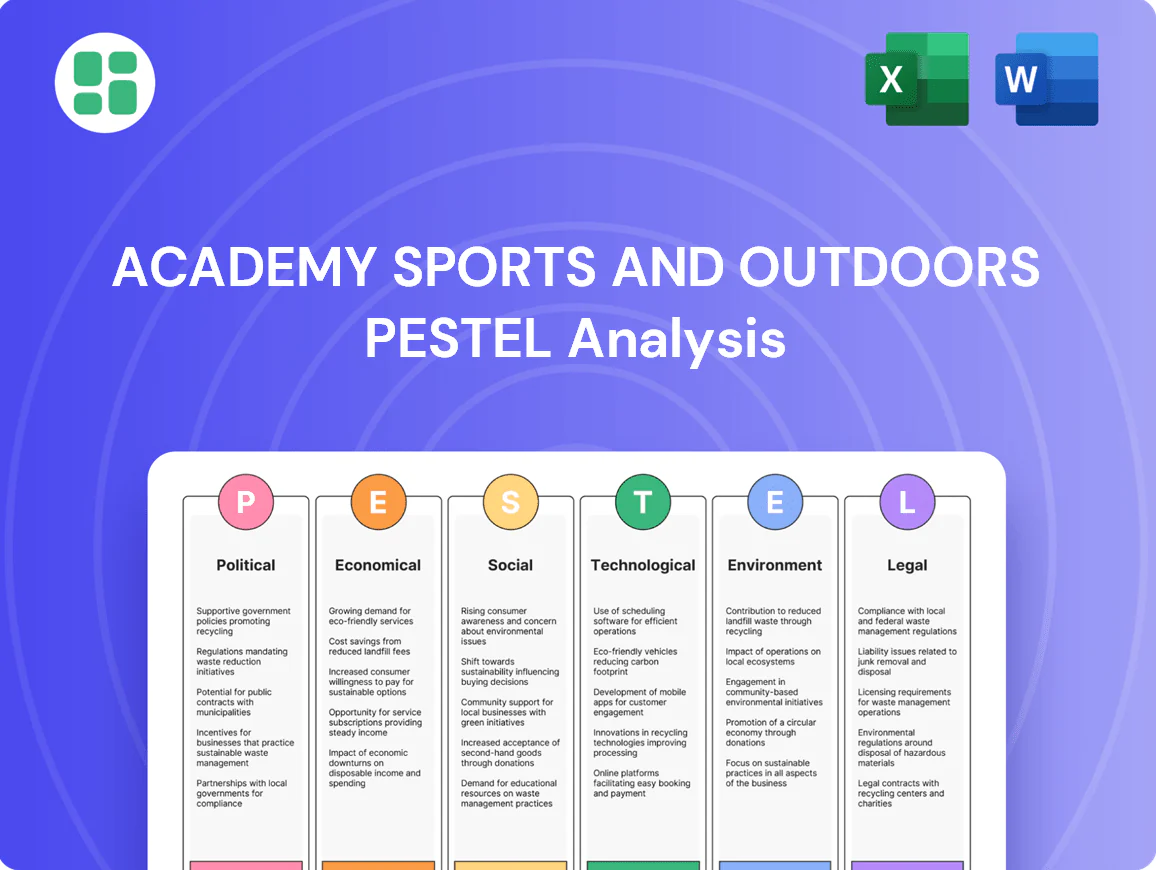
Academy Sports and Outdoors PESTLE Analysis

Your Competitive Advantage Starts with This Report
Understand the critical political, economic, social, technological, environmental, and legal forces shaping Academy Sports and Outdoors's future. This comprehensive PESTLE analysis provides actionable insights to navigate market complexities and identify strategic opportunities. Gain a competitive edge by downloading the full report today.
Political factors

Trade Policies and Tariffs
Changes in global trade policies, particularly tariffs on imported goods, directly influence Academy Sports + Outdoors' cost of sourcing products. For instance, shifts in trade agreements or the imposition of new tariffs can alter the landed cost of merchandise, impacting the company's profitability and its ability to offer competitive pricing.
Academy Sports + Outdoors has acknowledged these challenges and is actively working to lessen their impact. The company's strategy involves diversifying its sourcing locations beyond China, aiming to reduce its vulnerability to specific trade disputes or policy changes. This proactive approach is crucial for maintaining healthy profit margins and ensuring consistent value for its customer base.
Government Regulations on Product Safety
Academy Sports + Outdoors must navigate a complex web of government regulations concerning product safety, particularly for sporting goods and outdoor equipment. Failure to comply with these standards, which can range from material testing to labeling requirements, can result in significant financial penalties and damage to the brand's reputation. For instance, in 2024, the Consumer Product Safety Commission (CPSC) continued its focus on ensuring the safety of children's products, a category relevant to Academy's offerings.
Staying ahead of evolving safety standards is paramount. This includes ensuring that items such as firearms sold in their stores meet all federal and state regulations, camping gear adheres to flammability standards, and sports equipment is designed to minimize injury risks. The company's commitment to rigorous quality control and staying informed about regulatory updates, such as those potentially impacting the sale of certain hunting accessories in 2025, is critical for operational continuity and consumer trust.

Labor Laws and Employment Regulations
Academy Sports + Outdoors, like any major retailer, navigates a complex web of labor laws. These include federal mandates like the Fair Labor Standards Act, which sets minimum wage and overtime rules, and state-specific regulations that can vary significantly. For instance, in 2024, several states saw increases in their minimum wage, directly impacting labor costs for companies with a widespread presence.
Changes in employment regulations, such as those concerning paid sick leave or scheduling predictability, can necessitate adjustments to Academy's human resource strategies and operational budgets. The company must also maintain strict compliance with employment agreements and ensure all workers have the proper documentation, a process that becomes more intricate with a diverse workforce across multiple states.

Political Stability and Consumer Confidence
Political stability in the United States, where Academy Sports + Outdoors primarily operates, is a significant driver of consumer confidence. Periods of political uncertainty or major policy shifts can make consumers more hesitant to spend on discretionary items, directly affecting sales of sporting goods and apparel. For instance, the 2024 election cycle could introduce economic uncertainty that might temper consumer spending.
Academy Sports + Outdoors' historical performance demonstrates a sensitivity to the broader macroeconomic environment, which is often influenced by political stability. Fluctuations in consumer confidence, a key metric, can be directly linked to perceptions of political stability and future economic prospects. In 2024, continued consumer spending growth remains a factor, but potential political headwinds could introduce volatility.
- Consumer confidence levels are directly tied to political stability, influencing discretionary spending on items like sporting goods.
- Economic uncertainty stemming from political shifts can lead consumers to postpone non-essential purchases.
- Academy Sports + Outdoors' sales performance is notably influenced by the prevailing macroeconomic conditions, which are in turn affected by political factors.
Government Support for Outdoor Recreation
Government support for outdoor recreation, through initiatives like increased funding for national parks and public land, directly benefits companies like Academy Sports + Outdoors. For instance, the U.S. Department of the Interior's Great American Outdoors Act, enacted in 2020, allocates significant funds for infrastructure improvements in national parks, which often correlates with increased visitor numbers and, consequently, demand for outdoor gear. This trend is expected to continue, with projections indicating sustained growth in outdoor recreation participation.
Policies encouraging physical activity and healthy lifestyles also create a more robust customer base. In 2024, many states continued to invest in community sports programs and public health campaigns promoting exercise. This broader societal shift towards wellness naturally expands the market for sporting goods and outdoor equipment, providing a favorable backdrop for Academy Sports + Outdoors' product lines.
- Increased Funding: The U.S. government's commitment to outdoor infrastructure, such as through the Great American Outdoors Act, supports park access and usage.
- Health Initiatives: Public health campaigns promoting active lifestyles in 2024-2025 are driving greater consumer interest in sports and outdoor activities.
- Market Expansion: These government-backed trends create a favorable environment, indirectly boosting demand for Academy Sports + Outdoors' core product offerings.
Policy's Grip on Retail: Costs, Compliance, Growth
Government trade policies, including tariffs and trade agreements, directly impact Academy Sports + Outdoors' sourcing costs and pricing strategies. The company's efforts to diversify suppliers beyond China aim to mitigate risks associated with trade disputes, a strategy crucial for maintaining profitability and competitive pricing through 2025.
Regulatory compliance, particularly regarding product safety standards for sporting goods and firearms, is a critical operational factor. Adherence to evolving regulations, such as those from the CPSC in 2024 and potential changes affecting hunting accessories in 2025, is essential to avoid penalties and uphold brand reputation.
Labor laws, including minimum wage increases seen in various states during 2024, directly affect Academy's operational expenditures. Adapting to employment regulations concerning paid leave and scheduling is vital for managing human resources and budgets effectively.
Political stability influences consumer confidence, a key driver for discretionary spending on Academy's products. Economic uncertainty, potentially amplified by events like the 2024 election cycle, could temper consumer spending, impacting sales performance.
Government initiatives supporting outdoor recreation, such as the Great American Outdoors Act, and public health campaigns promoting active lifestyles in 2024-2025, expand the market for Academy Sports + Outdoors. These favorable policy environments are expected to continue driving demand for outdoor and sports equipment.
What is included in the product
 Detailed Word Document
This PESTLE analysis of Academy Sports + Outdoors examines how political, economic, social, technological, environmental, and legal forces impact its operations and strategic planning.
It offers actionable insights for identifying market opportunities and potential challenges within the sporting goods retail sector.

 Customizable Excel Spreadsheet
The Academy Sports and Outdoors PESTLE analysis acts as a pain point reliever by providing a clear, summarized version of external factors for easy referencing during meetings and presentations.
This analysis offers a concise version that can be dropped into PowerPoints or used in group planning sessions, helping to align teams on critical market dynamics.
Economic factors

Consumer Spending and Discretionary Income
Academy Sports + Outdoors' success is closely tied to how much money consumers have left after essentials and their overall willingness to spend, especially for active families. For instance, in Q1 2024, Academy reported a 5.7% decrease in net sales compared to the previous year, reflecting this consumer caution.
Inflationary pressures and increasing credit card balances are making many shoppers more hesitant, impacting sales of non-essential items like sporting goods. This economic climate has led Academy to emphasize value-oriented products to attract budget-conscious customers.
Inflationary Pressures and Cost of Goods
Persistent inflation, particularly for imported sporting goods and apparel, directly affects Academy Sports + Outdoors' cost of goods sold and gross profit margins. For instance, the U.S. Consumer Price Index (CPI) for apparel and footwear saw a notable increase in early 2024, a trend expected to continue into fiscal year 2025.
The company has explicitly stated that these inflationary pressures represent a significant downside risk for the remainder of fiscal year 2025, potentially impacting profitability. This situation underscores the need for Academy Sports + Outdoors to implement strategic pricing adjustments and explore supply chain diversification to lessen these adverse effects.

Interest Rates and Access to Capital
Fluctuations in interest rates directly impact Academy Sports + Outdoors' cost of borrowing for crucial initiatives like opening new stores or upgrading existing ones. For instance, if the Federal Reserve raises the federal funds rate, Academy's borrowing expenses for capital expenditures would likely increase, potentially impacting profitability.
Higher interest rates also affect consumers. When borrowing becomes more expensive, customers may be less inclined to finance large purchases, such as sporting goods or outdoor equipment, which could dampen sales for Academy.
Despite these potential headwinds, Academy Sports + Outdoors has demonstrated strategic financial management by funding its aggressive expansion plans, which include opening new stores, primarily through available cash reserves. This approach reduces reliance on debt financing, mitigating some of the direct impact of rising interest rates on their growth strategy.

Unemployment Rates and Labor Market
Unemployment rates directly influence Academy Sports + Outdoors' customer base and workforce. For instance, the U.S. unemployment rate stood at 3.9% in April 2024, a slight increase from March's 3.8%, indicating a still relatively tight labor market but with some emerging signs of cooling. This impacts consumer spending power; lower unemployment generally means more disposable income for discretionary purchases like sporting goods.
A robust labor market typically bolsters consumer confidence, which translates into higher retail sales. When people feel secure in their jobs, they are more likely to spend on non-essential items. This positive sentiment benefits retailers like Academy Sports + Outdoors.
Conversely, an uptick in unemployment can curb consumer spending, particularly on goods that are not necessities. If unemployment were to rise significantly, Academy Sports + Outdoors might see reduced demand. Furthermore, competition for skilled labor in a tight market can drive up wages, potentially increasing operating costs for the company.
- U.S. Unemployment Rate (April 2024): 3.9%
- U.S. Unemployment Rate (March 2024): 3.8%
- Impact on Spending: Lower unemployment generally boosts discretionary spending.
- Impact on Costs: A tight labor market can lead to increased labor costs.
Competitive Landscape and Pricing Strategies
Academy Sports + Outdoors operates in a highly competitive sporting goods retail sector, facing pressure from both online giants like Dick's Sporting Goods and Amazon, as well as numerous brick-and-mortar stores. This intense rivalry directly shapes their pricing strategies and ability to capture market share. For instance, in the first quarter of 2024, Academy reported a net sales increase of 5.1% to $1.4 billion, demonstrating their ability to compete effectively despite market pressures.
The company's focus on value leadership, coupled with the expansion of its private label brands, is a deliberate response to this competitive environment and the economic climate. By offering more affordable in-house options, Academy aims to attract price-sensitive consumers who are increasingly important in a challenging economic landscape. This strategy is crucial for maintaining customer loyalty and driving sales volume.
- Competitive Pressure: Major online and physical retailers intensify competition, impacting Academy's pricing flexibility.
- Value Proposition: Academy prioritizes value leadership to appeal to a broad customer base.
- Private Label Growth: Expansion of private label brands offers more affordable alternatives, enhancing competitiveness.
- Economic Sensitivity: Pricing strategies are adapted to economic conditions, targeting price-conscious shoppers.
Economic Factors Influence Consumer Spending Power
Consumer spending power remains a critical economic factor for Academy Sports + Outdoors, directly influenced by inflation and interest rates. For example, the U.S. inflation rate, while showing some moderation, continued to impact purchasing power through early 2024, with the CPI for apparel and footwear seeing increases that were projected to persist into fiscal year 2025. This economic environment necessitates Academy's focus on value offerings and private label expansion to cater to budget-conscious consumers, as evidenced by their Q1 2024 net sales decrease of 5.7% year-over-year, indicating consumer caution.
| Economic Indicator | Value/Trend (Early 2024 - Mid 2025 Projection) | Impact on Academy Sports + Outdoors |
|---|---|---|
| U.S. Inflation Rate | Moderating but persistent, with specific sector increases (e.g., apparel/footwear) | Increased cost of goods, pressure on margins, need for value-focused strategies |
| Interest Rates | Potential for increases impacting borrowing costs and consumer financing | Higher capital expenditure costs, potential dampening of consumer demand for larger purchases |
| Unemployment Rate | 3.9% (April 2024), indicating a tight but potentially cooling labor market | Generally supports consumer spending, but wage pressures could increase operating costs |
Full Version Awaits
Academy Sports and Outdoors PESTLE Analysis
The preview shown here is the exact document you’ll receive after purchase—fully formatted and ready to use. This comprehensive PESTLE analysis for Academy Sports and Outdoors delves into Political, Economic, Social, Technological, Legal, and Environmental factors impacting the company's operations and strategic decisions. You'll gain a clear understanding of the external forces shaping its market landscape.

Original: $10.00
-70%$10.00
$3.00Product Information
Product Information
Shipping & Returns
Shipping & Returns
Description
Your Competitive Advantage Starts with This Report
Understand the critical political, economic, social, technological, environmental, and legal forces shaping Academy Sports and Outdoors's future. This comprehensive PESTLE analysis provides actionable insights to navigate market complexities and identify strategic opportunities. Gain a competitive edge by downloading the full report today.
Political factors
Trade Policies and Tariffs
Changes in global trade policies, particularly tariffs on imported goods, directly influence Academy Sports + Outdoors' cost of sourcing products. For instance, shifts in trade agreements or the imposition of new tariffs can alter the landed cost of merchandise, impacting the company's profitability and its ability to offer competitive pricing.
Academy Sports + Outdoors has acknowledged these challenges and is actively working to lessen their impact. The company's strategy involves diversifying its sourcing locations beyond China, aiming to reduce its vulnerability to specific trade disputes or policy changes. This proactive approach is crucial for maintaining healthy profit margins and ensuring consistent value for its customer base.
Government Regulations on Product Safety
Academy Sports + Outdoors must navigate a complex web of government regulations concerning product safety, particularly for sporting goods and outdoor equipment. Failure to comply with these standards, which can range from material testing to labeling requirements, can result in significant financial penalties and damage to the brand's reputation. For instance, in 2024, the Consumer Product Safety Commission (CPSC) continued its focus on ensuring the safety of children's products, a category relevant to Academy's offerings.
Staying ahead of evolving safety standards is paramount. This includes ensuring that items such as firearms sold in their stores meet all federal and state regulations, camping gear adheres to flammability standards, and sports equipment is designed to minimize injury risks. The company's commitment to rigorous quality control and staying informed about regulatory updates, such as those potentially impacting the sale of certain hunting accessories in 2025, is critical for operational continuity and consumer trust.
Labor Laws and Employment Regulations
Academy Sports + Outdoors, like any major retailer, navigates a complex web of labor laws. These include federal mandates like the Fair Labor Standards Act, which sets minimum wage and overtime rules, and state-specific regulations that can vary significantly. For instance, in 2024, several states saw increases in their minimum wage, directly impacting labor costs for companies with a widespread presence.
Changes in employment regulations, such as those concerning paid sick leave or scheduling predictability, can necessitate adjustments to Academy's human resource strategies and operational budgets. The company must also maintain strict compliance with employment agreements and ensure all workers have the proper documentation, a process that becomes more intricate with a diverse workforce across multiple states.
Political Stability and Consumer Confidence
Political stability in the United States, where Academy Sports + Outdoors primarily operates, is a significant driver of consumer confidence. Periods of political uncertainty or major policy shifts can make consumers more hesitant to spend on discretionary items, directly affecting sales of sporting goods and apparel. For instance, the 2024 election cycle could introduce economic uncertainty that might temper consumer spending.
Academy Sports + Outdoors' historical performance demonstrates a sensitivity to the broader macroeconomic environment, which is often influenced by political stability. Fluctuations in consumer confidence, a key metric, can be directly linked to perceptions of political stability and future economic prospects. In 2024, continued consumer spending growth remains a factor, but potential political headwinds could introduce volatility.
- Consumer confidence levels are directly tied to political stability, influencing discretionary spending on items like sporting goods.
- Economic uncertainty stemming from political shifts can lead consumers to postpone non-essential purchases.
- Academy Sports + Outdoors' sales performance is notably influenced by the prevailing macroeconomic conditions, which are in turn affected by political factors.
Government Support for Outdoor Recreation
Government support for outdoor recreation, through initiatives like increased funding for national parks and public land, directly benefits companies like Academy Sports + Outdoors. For instance, the U.S. Department of the Interior's Great American Outdoors Act, enacted in 2020, allocates significant funds for infrastructure improvements in national parks, which often correlates with increased visitor numbers and, consequently, demand for outdoor gear. This trend is expected to continue, with projections indicating sustained growth in outdoor recreation participation.
Policies encouraging physical activity and healthy lifestyles also create a more robust customer base. In 2024, many states continued to invest in community sports programs and public health campaigns promoting exercise. This broader societal shift towards wellness naturally expands the market for sporting goods and outdoor equipment, providing a favorable backdrop for Academy Sports + Outdoors' product lines.
- Increased Funding: The U.S. government's commitment to outdoor infrastructure, such as through the Great American Outdoors Act, supports park access and usage.
- Health Initiatives: Public health campaigns promoting active lifestyles in 2024-2025 are driving greater consumer interest in sports and outdoor activities.
- Market Expansion: These government-backed trends create a favorable environment, indirectly boosting demand for Academy Sports + Outdoors' core product offerings.
Policy's Grip on Retail: Costs, Compliance, Growth
Government trade policies, including tariffs and trade agreements, directly impact Academy Sports + Outdoors' sourcing costs and pricing strategies. The company's efforts to diversify suppliers beyond China aim to mitigate risks associated with trade disputes, a strategy crucial for maintaining profitability and competitive pricing through 2025.
Regulatory compliance, particularly regarding product safety standards for sporting goods and firearms, is a critical operational factor. Adherence to evolving regulations, such as those from the CPSC in 2024 and potential changes affecting hunting accessories in 2025, is essential to avoid penalties and uphold brand reputation.
Labor laws, including minimum wage increases seen in various states during 2024, directly affect Academy's operational expenditures. Adapting to employment regulations concerning paid leave and scheduling is vital for managing human resources and budgets effectively.
Political stability influences consumer confidence, a key driver for discretionary spending on Academy's products. Economic uncertainty, potentially amplified by events like the 2024 election cycle, could temper consumer spending, impacting sales performance.
Government initiatives supporting outdoor recreation, such as the Great American Outdoors Act, and public health campaigns promoting active lifestyles in 2024-2025, expand the market for Academy Sports + Outdoors. These favorable policy environments are expected to continue driving demand for outdoor and sports equipment.
What is included in the product
Detailed Word Document
This PESTLE analysis of Academy Sports + Outdoors examines how political, economic, social, technological, environmental, and legal forces impact its operations and strategic planning.
It offers actionable insights for identifying market opportunities and potential challenges within the sporting goods retail sector.
Customizable Excel Spreadsheet
The Academy Sports and Outdoors PESTLE analysis acts as a pain point reliever by providing a clear, summarized version of external factors for easy referencing during meetings and presentations.
This analysis offers a concise version that can be dropped into PowerPoints or used in group planning sessions, helping to align teams on critical market dynamics.
Economic factors
Consumer Spending and Discretionary Income
Academy Sports + Outdoors' success is closely tied to how much money consumers have left after essentials and their overall willingness to spend, especially for active families. For instance, in Q1 2024, Academy reported a 5.7% decrease in net sales compared to the previous year, reflecting this consumer caution.
Inflationary pressures and increasing credit card balances are making many shoppers more hesitant, impacting sales of non-essential items like sporting goods. This economic climate has led Academy to emphasize value-oriented products to attract budget-conscious customers.
Inflationary Pressures and Cost of Goods
Persistent inflation, particularly for imported sporting goods and apparel, directly affects Academy Sports + Outdoors' cost of goods sold and gross profit margins. For instance, the U.S. Consumer Price Index (CPI) for apparel and footwear saw a notable increase in early 2024, a trend expected to continue into fiscal year 2025.
The company has explicitly stated that these inflationary pressures represent a significant downside risk for the remainder of fiscal year 2025, potentially impacting profitability. This situation underscores the need for Academy Sports + Outdoors to implement strategic pricing adjustments and explore supply chain diversification to lessen these adverse effects.
Interest Rates and Access to Capital
Fluctuations in interest rates directly impact Academy Sports + Outdoors' cost of borrowing for crucial initiatives like opening new stores or upgrading existing ones. For instance, if the Federal Reserve raises the federal funds rate, Academy's borrowing expenses for capital expenditures would likely increase, potentially impacting profitability.
Higher interest rates also affect consumers. When borrowing becomes more expensive, customers may be less inclined to finance large purchases, such as sporting goods or outdoor equipment, which could dampen sales for Academy.
Despite these potential headwinds, Academy Sports + Outdoors has demonstrated strategic financial management by funding its aggressive expansion plans, which include opening new stores, primarily through available cash reserves. This approach reduces reliance on debt financing, mitigating some of the direct impact of rising interest rates on their growth strategy.
Unemployment Rates and Labor Market
Unemployment rates directly influence Academy Sports + Outdoors' customer base and workforce. For instance, the U.S. unemployment rate stood at 3.9% in April 2024, a slight increase from March's 3.8%, indicating a still relatively tight labor market but with some emerging signs of cooling. This impacts consumer spending power; lower unemployment generally means more disposable income for discretionary purchases like sporting goods.
A robust labor market typically bolsters consumer confidence, which translates into higher retail sales. When people feel secure in their jobs, they are more likely to spend on non-essential items. This positive sentiment benefits retailers like Academy Sports + Outdoors.
Conversely, an uptick in unemployment can curb consumer spending, particularly on goods that are not necessities. If unemployment were to rise significantly, Academy Sports + Outdoors might see reduced demand. Furthermore, competition for skilled labor in a tight market can drive up wages, potentially increasing operating costs for the company.
- U.S. Unemployment Rate (April 2024): 3.9%
- U.S. Unemployment Rate (March 2024): 3.8%
- Impact on Spending: Lower unemployment generally boosts discretionary spending.
- Impact on Costs: A tight labor market can lead to increased labor costs.
Competitive Landscape and Pricing Strategies
Academy Sports + Outdoors operates in a highly competitive sporting goods retail sector, facing pressure from both online giants like Dick's Sporting Goods and Amazon, as well as numerous brick-and-mortar stores. This intense rivalry directly shapes their pricing strategies and ability to capture market share. For instance, in the first quarter of 2024, Academy reported a net sales increase of 5.1% to $1.4 billion, demonstrating their ability to compete effectively despite market pressures.
The company's focus on value leadership, coupled with the expansion of its private label brands, is a deliberate response to this competitive environment and the economic climate. By offering more affordable in-house options, Academy aims to attract price-sensitive consumers who are increasingly important in a challenging economic landscape. This strategy is crucial for maintaining customer loyalty and driving sales volume.
- Competitive Pressure: Major online and physical retailers intensify competition, impacting Academy's pricing flexibility.
- Value Proposition: Academy prioritizes value leadership to appeal to a broad customer base.
- Private Label Growth: Expansion of private label brands offers more affordable alternatives, enhancing competitiveness.
- Economic Sensitivity: Pricing strategies are adapted to economic conditions, targeting price-conscious shoppers.
Economic Factors Influence Consumer Spending Power
Consumer spending power remains a critical economic factor for Academy Sports + Outdoors, directly influenced by inflation and interest rates. For example, the U.S. inflation rate, while showing some moderation, continued to impact purchasing power through early 2024, with the CPI for apparel and footwear seeing increases that were projected to persist into fiscal year 2025. This economic environment necessitates Academy's focus on value offerings and private label expansion to cater to budget-conscious consumers, as evidenced by their Q1 2024 net sales decrease of 5.7% year-over-year, indicating consumer caution.
| Economic Indicator | Value/Trend (Early 2024 - Mid 2025 Projection) | Impact on Academy Sports + Outdoors |
|---|---|---|
| U.S. Inflation Rate | Moderating but persistent, with specific sector increases (e.g., apparel/footwear) | Increased cost of goods, pressure on margins, need for value-focused strategies |
| Interest Rates | Potential for increases impacting borrowing costs and consumer financing | Higher capital expenditure costs, potential dampening of consumer demand for larger purchases |
| Unemployment Rate | 3.9% (April 2024), indicating a tight but potentially cooling labor market | Generally supports consumer spending, but wage pressures could increase operating costs |
Full Version Awaits
Academy Sports and Outdoors PESTLE Analysis
The preview shown here is the exact document you’ll receive after purchase—fully formatted and ready to use. This comprehensive PESTLE analysis for Academy Sports and Outdoors delves into Political, Economic, Social, Technological, Legal, and Environmental factors impacting the company's operations and strategic decisions. You'll gain a clear understanding of the external forces shaping its market landscape.