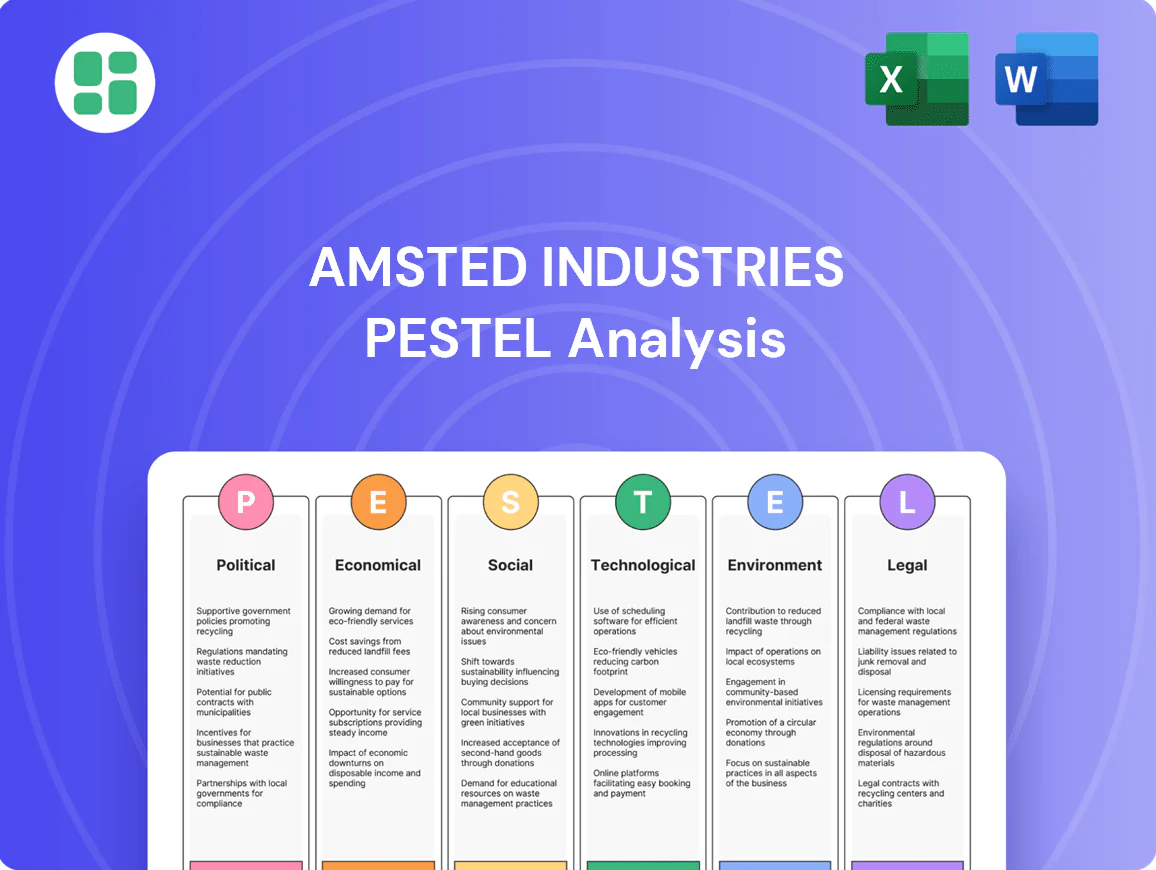
Amsted Industries PESTLE Analysis

Make Smarter Strategic Decisions with a Complete PESTEL View
Uncover the intricate web of external forces shaping Amsted Industries's path forward. From evolving political landscapes to shifting economic tides and rapid technological advancements, understanding these PESTLE factors is crucial for strategic success. Download our comprehensive analysis to gain actionable intelligence and anticipate future challenges and opportunities.
Political factors

Government Infrastructure Spending
Government investment in large-scale infrastructure projects, especially in rail and road networks, directly impacts Amsted Industries' demand for heavy-duty components. Political budgeting decisions and national infrastructure plans, such as the Bipartisan Infrastructure Law enacted in 2021, which allocates over $1 trillion to infrastructure improvements, create significant opportunities for Amsted's core markets.
Trade Policies and Tariffs
Amsted Industries, with its global manufacturing footprint, is significantly influenced by evolving trade policies. The imposition or removal of tariffs on steel, a key raw material, directly impacts production costs. For instance, in 2024, ongoing discussions around global steel tariffs and trade agreements, such as potential adjustments to the Section 232 tariffs on steel imports into the United States, could lead to increased material expenses or create opportunities for more favorable sourcing.
Changes in international trade agreements can also affect Amsted's market access for its diverse product lines, ranging from rail components to industrial flow control solutions. Trade disputes or the renegotiation of existing pacts can introduce uncertainty, potentially disrupting supply chains and altering competitive dynamics in key markets. For example, shifts in trade relationships between major economies in 2024 could necessitate adjustments in Amsted's sourcing strategies and export market focus.

Regulatory Changes in Transportation
Evolving government regulations for the railroad and vehicular sectors directly shape Amsted Industries' product development. For instance, stricter emissions standards, like those being implemented in many regions by 2024-2025, necessitate advanced materials and designs for exhaust systems and engine components. Compliance ensures market access, while non-compliance can lead to significant penalties and lost business opportunities, impacting manufacturing costs and operational efficiency.

Geopolitical Stability
Geopolitical stability is a significant consideration for Amsted Industries, given its global manufacturing footprint and supply chain dependencies. Political instability in key regions can directly impact operations, as seen in the potential for trade disputes or disruptions in countries where Amsted sources raw materials or sells its products. For instance, heightened tensions in Eastern Europe in 2024 continued to pose risks to global energy prices and supply chains, indirectly affecting manufacturing costs and demand for Amsted's components in sectors like transportation and infrastructure.
Shifts in international relations and trade policies can also create uncertainty. Amsted’s reliance on international trade means that changes in tariffs or import/export regulations, potentially influenced by political realignments, could affect profitability. The ongoing geopolitical landscape in 2024 and into 2025 presents a complex environment where companies must remain agile to navigate potential disruptions.
- Supply Chain Vulnerability: Political unrest in regions critical for raw material sourcing, such as rare earth minerals or specialized alloys, could lead to price volatility and availability issues for Amsted's manufacturing processes.
- Market Access and Demand: Instability in major customer markets, like the automotive or rail industries, due to political factors can reduce demand for Amsted's specialized components.
- Investment Risk: Geopolitical tensions can increase the perceived risk of foreign direct investment, potentially impacting Amsted's strategic expansion plans or the stability of its existing international assets.
Industrial Policy Shifts
Government shifts in industrial policy, such as incentives for domestic manufacturing or reshoring initiatives, can significantly impact Amsted Industries. For instance, policies promoting the resurgence of American manufacturing could offer Amsted a competitive edge by reducing reliance on overseas production and potentially lowering logistical costs.
Conversely, a strong focus on specific sectors, like green transportation, might present Amsted with opportunities to align its product development and market strategy. The US government's Inflation Reduction Act of 2022, with its substantial investments in clean energy and manufacturing, exemplifies this, potentially benefiting Amsted's rail sector through increased demand for components in modernized freight and passenger transport systems.
- Reshoring Incentives: Policies encouraging companies to bring production back to the US could reduce Amsted's supply chain risks and costs.
- Green Transportation Support: Government funding for electric vehicles and sustainable infrastructure may boost demand for Amsted's specialized components in these growing markets.
- Domestic Content Requirements: Mandates for using domestically sourced materials in government-funded projects could favor Amsted's manufacturing capabilities.
Government Policies: Fueling Demand and Shaping Costs for Components
Government investment in infrastructure, like the over $1 trillion allocated by the Bipartisan Infrastructure Law, directly fuels demand for Amsted's rail and heavy-duty components. Evolving trade policies and tariffs, particularly on steel, impact Amsted's raw material costs, with ongoing discussions in 2024 potentially altering sourcing dynamics. Stricter emissions standards for transportation sectors by 2024-2025 necessitate advanced product designs, influencing manufacturing costs and market access.
Geopolitical stability remains a concern for Amsted's global operations, as tensions in 2024 can disrupt supply chains and affect energy prices, indirectly impacting manufacturing costs. Government industrial policies, such as reshoring incentives and support for green transportation, as seen with the US Inflation Reduction Act of 2022, can create competitive advantages and drive demand in specific Amsted markets.
| Political Factor | Impact on Amsted Industries | 2024/2025 Data/Trend |
|---|---|---|
| Infrastructure Spending | Increased demand for rail and heavy components | Bipartisan Infrastructure Law allocating >$1 trillion |
| Trade Policies/Tariffs | Impacts raw material costs (e.g., steel) | Ongoing 2024 discussions on Section 232 tariffs |
| Environmental Regulations | Drives product innovation (e.g., emissions standards) | Stricter standards being implemented by 2024-2025 |
| Industrial Policy (Reshoring) | Potential cost reduction and supply chain stability | US government initiatives promoting domestic manufacturing |
| Green Transportation Support | Boosts demand for specialized components | Inflation Reduction Act (2022) investing in clean energy |
What is included in the product
 Detailed Word Document
This PESTLE analysis examines the Political, Economic, Social, Technological, Environmental, and Legal factors influencing Amsted Industries, providing actionable insights for strategic decision-making.

 Customizable Excel Spreadsheet
A concise PESTLE analysis for Amsted Industries provides a clear overview of external factors, acting as a pain point reliever by simplifying complex market dynamics for strategic decision-making.
Economic factors

Global Economic Growth Rates
Global economic growth is a significant driver for Amsted Industries, as its industrial components are integral to construction, transportation, and manufacturing sectors. A robust global economy, marked by expansions in these key areas, directly correlates with increased demand for Amsted's products, boosting sales volumes and revenue. For instance, the International Monetary Fund (IMF) projected global growth to be 3.2% in 2024, a slight deceleration from 3.1% in 2023, but still indicating a stable, albeit moderate, expansion.
Conversely, economic contractions or slowdowns in major markets can negatively impact Amsted's performance. A downturn in construction activity, for example, due to rising interest rates or reduced infrastructure spending, would likely lead to lower demand for Amsted's building components. Similarly, a slowdown in global trade or manufacturing output, perhaps influenced by geopolitical tensions or supply chain disruptions, can directly reduce the need for transportation and industrial machinery parts.
Raw Material Price Volatility
Amsted Industries, a major player in the manufacturing sector, is significantly exposed to the volatility of raw material prices, particularly steel, iron, and other metals. Fluctuations in these essential inputs directly impact production costs, creating either significant cost pressures or potential opportunities. For instance, the average price of hot-rolled coil steel, a key component for Amsted's products, saw considerable swings. In early 2024, prices remained relatively stable compared to the peaks of 2022, but market analysts projected potential increases later in the year due to anticipated demand shifts and geopolitical factors influencing global supply chains.
The dynamics of global commodity markets, driven by supply-demand imbalances and geopolitical events, directly influence Amsted's profitability. For example, disruptions in mining operations or trade disputes can lead to sudden price spikes, squeezing Amsted's margins if these costs cannot be passed on to customers. Conversely, periods of lower commodity prices can offer a competitive advantage by reducing manufacturing expenses, thereby enhancing profitability and potentially allowing for more aggressive pricing strategies.

Interest Rates and Investment Climate
Rising interest rates, such as the Federal Reserve's benchmark rate hovering around 5.25%-5.50% in early 2024, can significantly dampen capital expenditure by Amsted's customers. Higher borrowing costs make large investments in new railcars, construction equipment, or vehicle fleets less attractive, potentially slowing demand for Amsted's manufactured components.
The broader investment climate directly impacts Amsted's financing capabilities. A robust market may allow Amsted to secure favorable terms for debt or equity financing, supporting its expansion and R&D initiatives. Conversely, a volatile or uncertain investment climate, perhaps influenced by global economic slowdown fears, could increase borrowing costs and make capital more scarce for Amsted's own growth plans.

Supply Chain Disruptions
Supply chain disruptions continue to pose significant economic challenges, impacting Amsted Industries through increased logistics costs and production delays. Port congestion and labor shortages, prevalent throughout 2024, have escalated shipping expenses and extended lead times, directly affecting Amsted's operational efficiency and its capacity to fulfill customer orders promptly. Geopolitical events further exacerbate these issues, creating uncertainty and driving up the cost of raw materials.
The economic fallout from these disruptions is substantial. For instance, global shipping costs saw significant volatility in late 2024 and early 2025, with certain routes experiencing price surges of over 50% compared to pre-pandemic levels. This directly translates to higher input costs for Amsted and can pressure profit margins if these costs cannot be fully passed on to customers. The ongoing strain on global logistics networks means that reliable and timely delivery of components remains a critical concern for manufacturers like Amsted.
- Increased Costs: Higher freight rates and raw material prices due to supply chain bottlenecks.
- Production Delays: Extended lead times for critical components impacting manufacturing schedules.
- Reduced Availability: Difficulty in securing necessary materials and parts, potentially leading to stockouts.
- Lowered Demand Fulfillment: Inability to meet customer orders on time, risking lost sales and market share.
Inflationary Pressures
Rising inflation in 2024 and 2025 directly impacts Amsted Industries by increasing its operating expenses. Costs for raw materials, energy, and labor are expected to climb, potentially squeezing profit margins if not effectively managed. For instance, the U.S. Producer Price Index (PPI) for manufactured goods saw significant increases throughout 2024, indicating upstream cost pressures for industrial companies like Amsted.
Furthermore, inflation erodes customer purchasing power. This could lead to delayed or reduced capital expenditure plans for Amsted’s clients in sectors like transportation, construction, and manufacturing. Companies facing their own inflationary challenges may also reduce orders or seek more cost-effective alternatives, impacting Amsted's sales volumes and revenue streams.
- Increased Input Costs: Higher prices for steel, aluminum, and energy directly affect Amsted's manufacturing expenses.
- Labor Cost Escalation: Wage inflation, driven by a tight labor market, adds to Amsted's operational overhead.
- Pricing Strategy Adaptation: Amsted must balance passing on higher costs to customers with maintaining competitive pricing to preserve market share.
- Customer Demand Sensitivity: Inflationary pressures on Amsted's customers can lead to reduced demand for its products and services.
Inflation's Impact: Rising Costs and Shifting Demand in 2024-2025
Inflationary pressures in 2024 and 2025 are directly increasing Amsted Industries' operating costs, particularly for raw materials like steel and energy, as well as labor. This rise in expenses, reflected in a notable increase in the U.S. Producer Price Index for manufactured goods throughout 2024, challenges Amsted's profit margins unless costs are effectively passed on to customers. Additionally, inflation can diminish customer purchasing power, potentially leading to reduced capital expenditures and lower demand for Amsted's components.
| Economic Factor | Impact on Amsted Industries | 2024/2025 Data Point |
| Global Economic Growth | Drives demand for industrial components in construction, transportation, and manufacturing. | IMF projected global growth of 3.2% in 2024. |
| Raw Material Prices | Directly affects production costs and profitability. | Hot-rolled coil steel prices saw considerable swings, with projections for increases in late 2024. |
| Interest Rates | Influences customer capital expenditure and Amsted's financing costs. | Federal Reserve benchmark rate around 5.25%-5.50% in early 2024. |
| Supply Chain Disruptions | Increases logistics costs, causes production delays, and impacts material availability. | Global shipping costs experienced surges over 50% on certain routes in late 2024/early 2025 compared to pre-pandemic levels. |
| Inflation | Raises operating expenses and can reduce customer demand. | U.S. PPI for manufactured goods showed significant increases throughout 2024. |
Preview Before You Purchase
Amsted Industries PESTLE Analysis
The preview shown here is the exact document you’ll receive after purchase—fully formatted and ready to use. This Amsted Industries PESTLE analysis delves into the Political, Economic, Social, Technological, Legal, and Environmental factors impacting the company's operations and strategic direction.
This is a real screenshot of the product you’re buying—delivered exactly as shown, no surprises. You'll gain a comprehensive understanding of the external forces shaping Amsted Industries, from regulatory changes to market trends.
The content and structure shown in the preview is the same document you’ll download after payment. This detailed PESTLE analysis will equip you with the insights needed to navigate the complex business landscape Amsted Industries operates within.

Original: $10.00
-70%$10.00
$3.00Product Information
Product Information
Shipping & Returns
Shipping & Returns
Description
Make Smarter Strategic Decisions with a Complete PESTEL View
Uncover the intricate web of external forces shaping Amsted Industries's path forward. From evolving political landscapes to shifting economic tides and rapid technological advancements, understanding these PESTLE factors is crucial for strategic success. Download our comprehensive analysis to gain actionable intelligence and anticipate future challenges and opportunities.
Political factors
Government Infrastructure Spending
Government investment in large-scale infrastructure projects, especially in rail and road networks, directly impacts Amsted Industries' demand for heavy-duty components. Political budgeting decisions and national infrastructure plans, such as the Bipartisan Infrastructure Law enacted in 2021, which allocates over $1 trillion to infrastructure improvements, create significant opportunities for Amsted's core markets.
Trade Policies and Tariffs
Amsted Industries, with its global manufacturing footprint, is significantly influenced by evolving trade policies. The imposition or removal of tariffs on steel, a key raw material, directly impacts production costs. For instance, in 2024, ongoing discussions around global steel tariffs and trade agreements, such as potential adjustments to the Section 232 tariffs on steel imports into the United States, could lead to increased material expenses or create opportunities for more favorable sourcing.
Changes in international trade agreements can also affect Amsted's market access for its diverse product lines, ranging from rail components to industrial flow control solutions. Trade disputes or the renegotiation of existing pacts can introduce uncertainty, potentially disrupting supply chains and altering competitive dynamics in key markets. For example, shifts in trade relationships between major economies in 2024 could necessitate adjustments in Amsted's sourcing strategies and export market focus.
Regulatory Changes in Transportation
Evolving government regulations for the railroad and vehicular sectors directly shape Amsted Industries' product development. For instance, stricter emissions standards, like those being implemented in many regions by 2024-2025, necessitate advanced materials and designs for exhaust systems and engine components. Compliance ensures market access, while non-compliance can lead to significant penalties and lost business opportunities, impacting manufacturing costs and operational efficiency.
Geopolitical Stability
Geopolitical stability is a significant consideration for Amsted Industries, given its global manufacturing footprint and supply chain dependencies. Political instability in key regions can directly impact operations, as seen in the potential for trade disputes or disruptions in countries where Amsted sources raw materials or sells its products. For instance, heightened tensions in Eastern Europe in 2024 continued to pose risks to global energy prices and supply chains, indirectly affecting manufacturing costs and demand for Amsted's components in sectors like transportation and infrastructure.
Shifts in international relations and trade policies can also create uncertainty. Amsted’s reliance on international trade means that changes in tariffs or import/export regulations, potentially influenced by political realignments, could affect profitability. The ongoing geopolitical landscape in 2024 and into 2025 presents a complex environment where companies must remain agile to navigate potential disruptions.
- Supply Chain Vulnerability: Political unrest in regions critical for raw material sourcing, such as rare earth minerals or specialized alloys, could lead to price volatility and availability issues for Amsted's manufacturing processes.
- Market Access and Demand: Instability in major customer markets, like the automotive or rail industries, due to political factors can reduce demand for Amsted's specialized components.
- Investment Risk: Geopolitical tensions can increase the perceived risk of foreign direct investment, potentially impacting Amsted's strategic expansion plans or the stability of its existing international assets.
Industrial Policy Shifts
Government shifts in industrial policy, such as incentives for domestic manufacturing or reshoring initiatives, can significantly impact Amsted Industries. For instance, policies promoting the resurgence of American manufacturing could offer Amsted a competitive edge by reducing reliance on overseas production and potentially lowering logistical costs.
Conversely, a strong focus on specific sectors, like green transportation, might present Amsted with opportunities to align its product development and market strategy. The US government's Inflation Reduction Act of 2022, with its substantial investments in clean energy and manufacturing, exemplifies this, potentially benefiting Amsted's rail sector through increased demand for components in modernized freight and passenger transport systems.
- Reshoring Incentives: Policies encouraging companies to bring production back to the US could reduce Amsted's supply chain risks and costs.
- Green Transportation Support: Government funding for electric vehicles and sustainable infrastructure may boost demand for Amsted's specialized components in these growing markets.
- Domestic Content Requirements: Mandates for using domestically sourced materials in government-funded projects could favor Amsted's manufacturing capabilities.
Government Policies: Fueling Demand and Shaping Costs for Components
Government investment in infrastructure, like the over $1 trillion allocated by the Bipartisan Infrastructure Law, directly fuels demand for Amsted's rail and heavy-duty components. Evolving trade policies and tariffs, particularly on steel, impact Amsted's raw material costs, with ongoing discussions in 2024 potentially altering sourcing dynamics. Stricter emissions standards for transportation sectors by 2024-2025 necessitate advanced product designs, influencing manufacturing costs and market access.
Geopolitical stability remains a concern for Amsted's global operations, as tensions in 2024 can disrupt supply chains and affect energy prices, indirectly impacting manufacturing costs. Government industrial policies, such as reshoring incentives and support for green transportation, as seen with the US Inflation Reduction Act of 2022, can create competitive advantages and drive demand in specific Amsted markets.
| Political Factor | Impact on Amsted Industries | 2024/2025 Data/Trend |
|---|---|---|
| Infrastructure Spending | Increased demand for rail and heavy components | Bipartisan Infrastructure Law allocating >$1 trillion |
| Trade Policies/Tariffs | Impacts raw material costs (e.g., steel) | Ongoing 2024 discussions on Section 232 tariffs |
| Environmental Regulations | Drives product innovation (e.g., emissions standards) | Stricter standards being implemented by 2024-2025 |
| Industrial Policy (Reshoring) | Potential cost reduction and supply chain stability | US government initiatives promoting domestic manufacturing |
| Green Transportation Support | Boosts demand for specialized components | Inflation Reduction Act (2022) investing in clean energy |
What is included in the product
Detailed Word Document
This PESTLE analysis examines the Political, Economic, Social, Technological, Environmental, and Legal factors influencing Amsted Industries, providing actionable insights for strategic decision-making.
Customizable Excel Spreadsheet
A concise PESTLE analysis for Amsted Industries provides a clear overview of external factors, acting as a pain point reliever by simplifying complex market dynamics for strategic decision-making.
Economic factors
Global Economic Growth Rates
Global economic growth is a significant driver for Amsted Industries, as its industrial components are integral to construction, transportation, and manufacturing sectors. A robust global economy, marked by expansions in these key areas, directly correlates with increased demand for Amsted's products, boosting sales volumes and revenue. For instance, the International Monetary Fund (IMF) projected global growth to be 3.2% in 2024, a slight deceleration from 3.1% in 2023, but still indicating a stable, albeit moderate, expansion.
Conversely, economic contractions or slowdowns in major markets can negatively impact Amsted's performance. A downturn in construction activity, for example, due to rising interest rates or reduced infrastructure spending, would likely lead to lower demand for Amsted's building components. Similarly, a slowdown in global trade or manufacturing output, perhaps influenced by geopolitical tensions or supply chain disruptions, can directly reduce the need for transportation and industrial machinery parts.
Raw Material Price Volatility
Amsted Industries, a major player in the manufacturing sector, is significantly exposed to the volatility of raw material prices, particularly steel, iron, and other metals. Fluctuations in these essential inputs directly impact production costs, creating either significant cost pressures or potential opportunities. For instance, the average price of hot-rolled coil steel, a key component for Amsted's products, saw considerable swings. In early 2024, prices remained relatively stable compared to the peaks of 2022, but market analysts projected potential increases later in the year due to anticipated demand shifts and geopolitical factors influencing global supply chains.
The dynamics of global commodity markets, driven by supply-demand imbalances and geopolitical events, directly influence Amsted's profitability. For example, disruptions in mining operations or trade disputes can lead to sudden price spikes, squeezing Amsted's margins if these costs cannot be passed on to customers. Conversely, periods of lower commodity prices can offer a competitive advantage by reducing manufacturing expenses, thereby enhancing profitability and potentially allowing for more aggressive pricing strategies.
Interest Rates and Investment Climate
Rising interest rates, such as the Federal Reserve's benchmark rate hovering around 5.25%-5.50% in early 2024, can significantly dampen capital expenditure by Amsted's customers. Higher borrowing costs make large investments in new railcars, construction equipment, or vehicle fleets less attractive, potentially slowing demand for Amsted's manufactured components.
The broader investment climate directly impacts Amsted's financing capabilities. A robust market may allow Amsted to secure favorable terms for debt or equity financing, supporting its expansion and R&D initiatives. Conversely, a volatile or uncertain investment climate, perhaps influenced by global economic slowdown fears, could increase borrowing costs and make capital more scarce for Amsted's own growth plans.
Supply Chain Disruptions
Supply chain disruptions continue to pose significant economic challenges, impacting Amsted Industries through increased logistics costs and production delays. Port congestion and labor shortages, prevalent throughout 2024, have escalated shipping expenses and extended lead times, directly affecting Amsted's operational efficiency and its capacity to fulfill customer orders promptly. Geopolitical events further exacerbate these issues, creating uncertainty and driving up the cost of raw materials.
The economic fallout from these disruptions is substantial. For instance, global shipping costs saw significant volatility in late 2024 and early 2025, with certain routes experiencing price surges of over 50% compared to pre-pandemic levels. This directly translates to higher input costs for Amsted and can pressure profit margins if these costs cannot be fully passed on to customers. The ongoing strain on global logistics networks means that reliable and timely delivery of components remains a critical concern for manufacturers like Amsted.
- Increased Costs: Higher freight rates and raw material prices due to supply chain bottlenecks.
- Production Delays: Extended lead times for critical components impacting manufacturing schedules.
- Reduced Availability: Difficulty in securing necessary materials and parts, potentially leading to stockouts.
- Lowered Demand Fulfillment: Inability to meet customer orders on time, risking lost sales and market share.
Inflationary Pressures
Rising inflation in 2024 and 2025 directly impacts Amsted Industries by increasing its operating expenses. Costs for raw materials, energy, and labor are expected to climb, potentially squeezing profit margins if not effectively managed. For instance, the U.S. Producer Price Index (PPI) for manufactured goods saw significant increases throughout 2024, indicating upstream cost pressures for industrial companies like Amsted.
Furthermore, inflation erodes customer purchasing power. This could lead to delayed or reduced capital expenditure plans for Amsted’s clients in sectors like transportation, construction, and manufacturing. Companies facing their own inflationary challenges may also reduce orders or seek more cost-effective alternatives, impacting Amsted's sales volumes and revenue streams.
- Increased Input Costs: Higher prices for steel, aluminum, and energy directly affect Amsted's manufacturing expenses.
- Labor Cost Escalation: Wage inflation, driven by a tight labor market, adds to Amsted's operational overhead.
- Pricing Strategy Adaptation: Amsted must balance passing on higher costs to customers with maintaining competitive pricing to preserve market share.
- Customer Demand Sensitivity: Inflationary pressures on Amsted's customers can lead to reduced demand for its products and services.
Inflation's Impact: Rising Costs and Shifting Demand in 2024-2025
Inflationary pressures in 2024 and 2025 are directly increasing Amsted Industries' operating costs, particularly for raw materials like steel and energy, as well as labor. This rise in expenses, reflected in a notable increase in the U.S. Producer Price Index for manufactured goods throughout 2024, challenges Amsted's profit margins unless costs are effectively passed on to customers. Additionally, inflation can diminish customer purchasing power, potentially leading to reduced capital expenditures and lower demand for Amsted's components.
| Economic Factor | Impact on Amsted Industries | 2024/2025 Data Point |
| Global Economic Growth | Drives demand for industrial components in construction, transportation, and manufacturing. | IMF projected global growth of 3.2% in 2024. |
| Raw Material Prices | Directly affects production costs and profitability. | Hot-rolled coil steel prices saw considerable swings, with projections for increases in late 2024. |
| Interest Rates | Influences customer capital expenditure and Amsted's financing costs. | Federal Reserve benchmark rate around 5.25%-5.50% in early 2024. |
| Supply Chain Disruptions | Increases logistics costs, causes production delays, and impacts material availability. | Global shipping costs experienced surges over 50% on certain routes in late 2024/early 2025 compared to pre-pandemic levels. |
| Inflation | Raises operating expenses and can reduce customer demand. | U.S. PPI for manufactured goods showed significant increases throughout 2024. |
Preview Before You Purchase
Amsted Industries PESTLE Analysis
The preview shown here is the exact document you’ll receive after purchase—fully formatted and ready to use. This Amsted Industries PESTLE analysis delves into the Political, Economic, Social, Technological, Legal, and Environmental factors impacting the company's operations and strategic direction.
This is a real screenshot of the product you’re buying—delivered exactly as shown, no surprises. You'll gain a comprehensive understanding of the external forces shaping Amsted Industries, from regulatory changes to market trends.
The content and structure shown in the preview is the same document you’ll download after payment. This detailed PESTLE analysis will equip you with the insights needed to navigate the complex business landscape Amsted Industries operates within.