Cango PESTLE Analysis

Your Shortcut to Market Insight Starts Here
Uncover the critical political, economic, social, technological, legal, and environmental factors impacting Cango's trajectory. This meticulously researched PESTLE analysis offers a strategic roadmap, highlighting both opportunities and potential pitfalls. Equip yourself with actionable intelligence to navigate Cango's evolving landscape and make informed decisions. Download the full version now for an unparalleled understanding.
Political factors

Government Policies on Automotive Industry
The Chinese government's strategic directives are a major force shaping the automotive landscape, dictating production quotas, sales objectives, and offering preferential treatment for specific vehicle categories. These governmental actions directly influence Cango's capacity to support car transactions, particularly if policies lean towards new energy vehicles (NEVs) over traditional gasoline-powered cars. For instance, in 2023, China's NEV sales surged by 37.9% year-on-year, reaching 9.495 million units, demonstrating the impact of supportive policies on market dynamics that Cango must navigate.
Financial Regulatory Environment
China's financial regulatory environment significantly shapes Cango's operations. Stricter rules on consumer lending, for instance, could limit the volume of auto loans facilitated. In 2023, China's central bank, the People's Bank of China (PBOC), continued to emphasize financial stability, which often translates to tighter oversight of lending practices.
Changes in interest rate policies directly impact Cango's cost of capital and the attractiveness of its financing products. While specific rate adjustments fluctuate, the PBOC's monetary policy stance, aiming for controlled inflation and economic growth, influences these decisions. For example, a rise in benchmark lending rates could increase Cango's funding costs.
Furthermore, evolving regulations concerning financial technology (fintech) and digital lending platforms present both challenges and opportunities. Policies that promote innovation in digital finance could streamline Cango's processes and expand its reach, whereas increased scrutiny on data privacy or cybersecurity could necessitate costly compliance measures.

Geopolitical Tensions and Trade Relations
Broader geopolitical tensions, particularly those between China and major economies like the United States, can indirectly ripple through Cango's business. These tensions can disrupt global supply chains for automotive components, potentially affecting vehicle availability and pricing within China. For instance, trade disputes in 2023 led to increased tariffs on certain goods, which could raise costs for manufacturers relying on imported parts, thereby impacting Cango's transaction volumes.
Shifts in economic alliances and trade policies can also influence consumer confidence in China's automotive market. Uncertainty surrounding international trade relations might make consumers more hesitant to make large purchases like vehicles, leading to a slowdown in demand. This cautious consumer sentiment, fueled by geopolitical instability, could directly translate to fewer transactions processed through Cango's platform.
Furthermore, these geopolitical uncertainties can impact investor sentiment towards companies operating in China, including Cango. A perception of increased risk due to trade wars or political friction can lead to lower valuations and make it harder for Cango to attract investment or maintain its stock price, as seen in market reactions to escalating trade rhetoric.

Support for New Energy Vehicles (NEVs)
The Chinese government's unwavering commitment to New Energy Vehicles (NEVs) is a significant political factor. This support manifests through substantial subsidies, streamlined licensing processes, and aggressive investment in charging infrastructure. For instance, by the end of 2023, China had over 8.9 million charging facilities, a substantial increase from previous years, directly supporting NEV adoption.
This governmental push directly impacts Cango, as it operates within the automotive transaction ecosystem. The accelerating consumer preference for NEVs, fueled by these incentives, demands that Cango evolve its service offerings. This adaptation involves a deeper understanding of NEV-specific financing structures and the unique market dynamics governing these vehicles to maintain its competitive edge.
- Government Subsidies: Continued financial incentives encourage NEV purchases, boosting demand for related services.
- Infrastructure Development: Expanding charging networks makes NEVs more practical for consumers, increasing their appeal.
- Policy Alignment: Cango's ability to integrate NEV financing and services reflects its responsiveness to national energy and transportation policies.
Data Security and Privacy Regulations
China's tightening grip on data security and privacy, exemplified by the Cybersecurity Law (CSL) and the Personal Information Protection Law (PIPL), significantly shapes Cango's operations. These regulations mandate strict protocols for data collection, storage, and cross-border transfer, directly affecting how Cango manages its customer information. Failure to comply can result in substantial fines and reputational damage.
For Cango, adherence to these evolving legal frameworks is not just a matter of avoiding penalties; it's fundamental to maintaining customer trust. As of early 2024, the enforcement of PIPL continues to mature, requiring businesses like Cango to invest heavily in data governance and security infrastructure. This includes implementing clear consent mechanisms and robust anonymization techniques.
- CSL and PIPL Compliance: Cango must meticulously adhere to China's Cybersecurity Law and Personal Information Protection Law.
- Data Governance Investment: Significant investment in data governance and security infrastructure is necessary to meet regulatory demands.
- Customer Trust: Robust data protection measures are crucial for maintaining and building customer confidence in Cango's platform.
- Penalties for Non-Compliance: Non-compliance can lead to substantial fines, potentially impacting Cango's financial performance and market standing.
Navigating China's NEV Growth, Regulations, and Geopolitics
Governmental support for New Energy Vehicles (NEVs) remains a cornerstone of China's automotive policy, directly influencing Cango's business model. With NEV sales in China reaching approximately 9.5 million units in 2023, up from 6.887 million in 2022, the trend underscores the effectiveness of these policies. Cango must continue to adapt its financing solutions to cater to this rapidly growing segment, ensuring its services align with national objectives for green transportation.
China's regulatory landscape, particularly concerning financial technology and data privacy, presents ongoing challenges and opportunities for Cango. The implementation of laws like the Personal Information Protection Law (PIPL) necessitates robust data governance. As of early 2024, PIPL enforcement requires significant investment in security infrastructure, impacting operational costs but also building customer trust.
Geopolitical tensions, such as ongoing trade dialogues between China and the US, can indirectly affect Cango through supply chain disruptions and consumer confidence. While direct impacts are hard to quantify for 2024, historical trade disputes have shown the potential for increased costs and market volatility, which Cango must monitor.
What is included in the product
 Detailed Word Document
This Cango PESTLE analysis provides a comprehensive examination of the external macro-environmental factors influencing the company across Political, Economic, Social, Technological, Environmental, and Legal dimensions.
It offers actionable insights and forward-looking perspectives to empower strategic decision-making and identify potential opportunities and threats.

 Customizable Excel Spreadsheet
Provides a concise version that can be dropped into PowerPoints or used in group planning sessions, simplifying complex external factors into actionable insights.
Economic factors

China's Economic Growth and Consumer Spending
Cango's performance is intrinsically linked to China's economic trajectory and consumer spending power. A robust economy generally fuels consumer confidence, encouraging purchases of significant items such as automobiles, which directly benefits Cango's transaction services. For instance, China's GDP grew by 5.2% in 2023, indicating a recovering economy that supports higher consumer spending.
Conversely, any economic deceleration in China could dampen car sales and tighten credit availability, thereby negatively affecting Cango's revenue streams. The automotive sector, a key market for Cango, saw retail sales of passenger vehicles reach 21.7 million units in 2023, a 5.6% year-on-year increase, demonstrating the market's sensitivity to economic conditions.
Interest Rate Environment and Credit Availability
The People's Bank of China's benchmark lending rates significantly impact Cango's business. For instance, a key one-year loan prime rate stood at 3.45% as of early 2024, affecting both consumer affordability and the cost of capital for Cango's financing partners.
Fluctuations in these rates directly influence consumer demand for financed vehicles. When rates rise, car loans become more expensive, potentially slowing down sales and impacting Cango's transaction volumes. Conversely, lower rates can boost demand.
Credit availability is equally crucial. In 2023, China's financial sector saw efforts to maintain liquidity, which generally supported credit access. Cango needs to stay attuned to these dynamics to ensure its partner institutions can effectively provide financing to customers.

Inflation and Purchasing Power
Inflationary pressures in China have been a significant concern, with consumer price index (CPI) growth fluctuating. For instance, while CPI growth was moderate in early 2024, the potential for higher inflation in late 2024 and into 2025 could directly impact Cango's customer base. Higher inflation erodes purchasing power, making vehicle acquisition, particularly with financing, a less attractive proposition for many Chinese consumers.
This dynamic directly affects Cango's transaction volumes. As the cost of living rises, consumers may postpone or opt for less expensive vehicle models, shifting demand away from the types of vehicles Cango typically facilitates. Understanding these shifts in consumer behavior and the resulting affordability challenges for financing solutions is crucial for Cango's strategic planning.

Automotive Market Trends and Sales Volume
The Chinese automotive market's overall health is a primary driver for Cango. In 2023, China's auto sales reached a record 30.09 million units, a 12% increase year-on-year, signaling robust demand. This growth trajectory, particularly in new energy vehicles (NEVs) which saw a 37.9% surge to 9.495 million units in 2023, directly impacts Cango's transaction volumes and service offerings.
Market saturation and evolving consumer preferences are critical considerations. While new car sales are strong, the used car market also presents significant opportunities for Cango's platform. For instance, the China Automobile Dealers Association reported that the used car market transaction volume in 2023 exceeded 16 million units. Shifts towards SUVs and the continued dominance of NEVs influence the types of vehicles Cango facilitates transactions for, requiring adaptability in its service model.
- Record Sales: China's automotive market saw 30.09 million units sold in 2023, up 12% from the previous year.
- NEV Boom: New energy vehicle sales in China reached 9.495 million units in 2023, a 37.9% increase.
- Used Car Activity: Over 16 million used cars were transacted in China during 2023.
- Consumer Shifts: Growing preference for SUVs and NEVs shapes demand for Cango's services.
Availability of Capital and Funding Costs
Cango's business model hinges on its partnerships with financial institutions, making the availability and cost of capital for these lenders a critical factor. When capital is readily available and funding costs are low, lenders are more inclined to offer competitive auto loan terms through Cango's platform, boosting transaction volumes.
Conversely, a contraction in liquidity within the financial markets, a scenario that can be influenced by central bank policies or broader economic uncertainty, directly impacts Cango. This tightening can lead to reduced lending capacity and higher borrowing costs for consumers, potentially slowing down vehicle sales facilitated by Cango.
For instance, in early 2024, many financial institutions faced increased funding costs due to persistent inflation and higher interest rates set by central banks globally. This environment could have made it more challenging for Cango's partner lenders to provide the same volume of affordable financing as in previous periods, directly affecting Cango's transaction facilitation capabilities.
- Impact of Interest Rates: Rising benchmark interest rates, such as the Federal Reserve's federal funds rate, directly increase the cost of borrowing for financial institutions, which in turn can lead to higher interest rates on auto loans offered through Cango.
- Liquidity Crunch Concerns: Periods of financial market stress, like those seen during the 2023 regional banking issues, can reduce the overall availability of capital for lending, potentially limiting the number of auto loans Cango can help originate.
- Lender Profitability: The spread between a lender's cost of funds and the interest rate they charge consumers is crucial for profitability. If this spread narrows due to high funding costs, lenders may become more cautious in their lending practices on platforms like Cango.
China's Economy: Steering Vehicle Finance Growth
China's economic growth directly fuels consumer spending on vehicles, a key driver for Cango's business. With GDP growth at 5.2% in 2023 and automotive retail sales increasing by 5.6% year-on-year to 21.7 million units, the market shows resilience. However, economic slowdowns or increased inflation, which saw fluctuating CPI growth in 2023 and early 2024, can erode purchasing power and reduce demand for financed vehicles, impacting Cango's transaction volumes.
Interest rates set by the People's Bank of China, such as the one-year loan prime rate at 3.45% in early 2024, significantly influence affordability. Higher rates make auto loans more expensive, potentially dampening sales and affecting Cango's transaction facilitation. Conversely, lower rates can stimulate demand, benefiting the company.
The availability and cost of capital for Cango's financial partners are critical. In 2023, efforts to maintain liquidity generally supported credit access, but global financial market conditions and rising funding costs for institutions, as seen in early 2024, can lead to more cautious lending practices and impact Cango's ability to originate transactions.
| Economic Factor | 2023 Data Point | Early 2024 Trend/Data | Impact on Cango |
| GDP Growth (China) | 5.2% | Continued recovery expected | Supports consumer spending and vehicle purchases |
| Passenger Vehicle Retail Sales | 21.7 million units (5.6% YoY increase) | Ongoing market activity | Directly correlates with Cango's transaction volumes |
| One-Year Loan Prime Rate | N/A (historical data) | 3.45% (early 2024) | Higher rates increase financing costs for consumers |
| Consumer Price Index (CPI) Growth | Fluctuating | Moderate early 2024, potential for increase | Higher inflation reduces purchasing power for financed vehicles |
Preview Before You Purchase
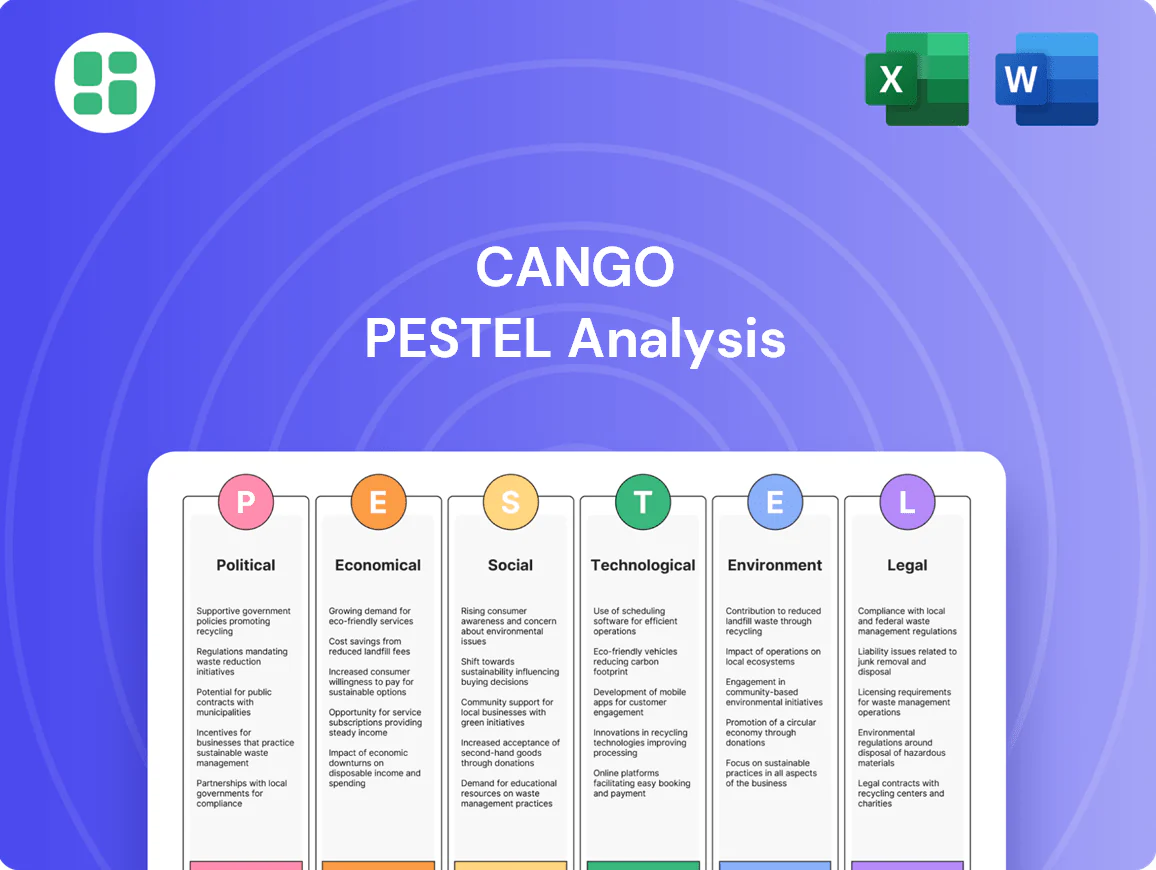
Cango PESTLE Analysis
The preview you see here is the exact Cango PESTLE Analysis document you’ll receive after purchase—fully formatted and ready to use.
This is a real screenshot of the product you’re buying—delivered exactly as shown, no surprises, providing a comprehensive look at Cango's external environment.
The content and structure shown in the preview is the same Cango PESTLE Analysis document you’ll download after payment, offering actionable insights.

Original: $10.00
-70%$10.00
$3.00Product Information
Product Information
Shipping & Returns
Shipping & Returns
Description
Your Shortcut to Market Insight Starts Here
Uncover the critical political, economic, social, technological, legal, and environmental factors impacting Cango's trajectory. This meticulously researched PESTLE analysis offers a strategic roadmap, highlighting both opportunities and potential pitfalls. Equip yourself with actionable intelligence to navigate Cango's evolving landscape and make informed decisions. Download the full version now for an unparalleled understanding.
Political factors
Government Policies on Automotive Industry
The Chinese government's strategic directives are a major force shaping the automotive landscape, dictating production quotas, sales objectives, and offering preferential treatment for specific vehicle categories. These governmental actions directly influence Cango's capacity to support car transactions, particularly if policies lean towards new energy vehicles (NEVs) over traditional gasoline-powered cars. For instance, in 2023, China's NEV sales surged by 37.9% year-on-year, reaching 9.495 million units, demonstrating the impact of supportive policies on market dynamics that Cango must navigate.
Financial Regulatory Environment
China's financial regulatory environment significantly shapes Cango's operations. Stricter rules on consumer lending, for instance, could limit the volume of auto loans facilitated. In 2023, China's central bank, the People's Bank of China (PBOC), continued to emphasize financial stability, which often translates to tighter oversight of lending practices.
Changes in interest rate policies directly impact Cango's cost of capital and the attractiveness of its financing products. While specific rate adjustments fluctuate, the PBOC's monetary policy stance, aiming for controlled inflation and economic growth, influences these decisions. For example, a rise in benchmark lending rates could increase Cango's funding costs.
Furthermore, evolving regulations concerning financial technology (fintech) and digital lending platforms present both challenges and opportunities. Policies that promote innovation in digital finance could streamline Cango's processes and expand its reach, whereas increased scrutiny on data privacy or cybersecurity could necessitate costly compliance measures.
Geopolitical Tensions and Trade Relations
Broader geopolitical tensions, particularly those between China and major economies like the United States, can indirectly ripple through Cango's business. These tensions can disrupt global supply chains for automotive components, potentially affecting vehicle availability and pricing within China. For instance, trade disputes in 2023 led to increased tariffs on certain goods, which could raise costs for manufacturers relying on imported parts, thereby impacting Cango's transaction volumes.
Shifts in economic alliances and trade policies can also influence consumer confidence in China's automotive market. Uncertainty surrounding international trade relations might make consumers more hesitant to make large purchases like vehicles, leading to a slowdown in demand. This cautious consumer sentiment, fueled by geopolitical instability, could directly translate to fewer transactions processed through Cango's platform.
Furthermore, these geopolitical uncertainties can impact investor sentiment towards companies operating in China, including Cango. A perception of increased risk due to trade wars or political friction can lead to lower valuations and make it harder for Cango to attract investment or maintain its stock price, as seen in market reactions to escalating trade rhetoric.
Support for New Energy Vehicles (NEVs)
The Chinese government's unwavering commitment to New Energy Vehicles (NEVs) is a significant political factor. This support manifests through substantial subsidies, streamlined licensing processes, and aggressive investment in charging infrastructure. For instance, by the end of 2023, China had over 8.9 million charging facilities, a substantial increase from previous years, directly supporting NEV adoption.
This governmental push directly impacts Cango, as it operates within the automotive transaction ecosystem. The accelerating consumer preference for NEVs, fueled by these incentives, demands that Cango evolve its service offerings. This adaptation involves a deeper understanding of NEV-specific financing structures and the unique market dynamics governing these vehicles to maintain its competitive edge.
- Government Subsidies: Continued financial incentives encourage NEV purchases, boosting demand for related services.
- Infrastructure Development: Expanding charging networks makes NEVs more practical for consumers, increasing their appeal.
- Policy Alignment: Cango's ability to integrate NEV financing and services reflects its responsiveness to national energy and transportation policies.
Data Security and Privacy Regulations
China's tightening grip on data security and privacy, exemplified by the Cybersecurity Law (CSL) and the Personal Information Protection Law (PIPL), significantly shapes Cango's operations. These regulations mandate strict protocols for data collection, storage, and cross-border transfer, directly affecting how Cango manages its customer information. Failure to comply can result in substantial fines and reputational damage.
For Cango, adherence to these evolving legal frameworks is not just a matter of avoiding penalties; it's fundamental to maintaining customer trust. As of early 2024, the enforcement of PIPL continues to mature, requiring businesses like Cango to invest heavily in data governance and security infrastructure. This includes implementing clear consent mechanisms and robust anonymization techniques.
- CSL and PIPL Compliance: Cango must meticulously adhere to China's Cybersecurity Law and Personal Information Protection Law.
- Data Governance Investment: Significant investment in data governance and security infrastructure is necessary to meet regulatory demands.
- Customer Trust: Robust data protection measures are crucial for maintaining and building customer confidence in Cango's platform.
- Penalties for Non-Compliance: Non-compliance can lead to substantial fines, potentially impacting Cango's financial performance and market standing.
Navigating China's NEV Growth, Regulations, and Geopolitics
Governmental support for New Energy Vehicles (NEVs) remains a cornerstone of China's automotive policy, directly influencing Cango's business model. With NEV sales in China reaching approximately 9.5 million units in 2023, up from 6.887 million in 2022, the trend underscores the effectiveness of these policies. Cango must continue to adapt its financing solutions to cater to this rapidly growing segment, ensuring its services align with national objectives for green transportation.
China's regulatory landscape, particularly concerning financial technology and data privacy, presents ongoing challenges and opportunities for Cango. The implementation of laws like the Personal Information Protection Law (PIPL) necessitates robust data governance. As of early 2024, PIPL enforcement requires significant investment in security infrastructure, impacting operational costs but also building customer trust.
Geopolitical tensions, such as ongoing trade dialogues between China and the US, can indirectly affect Cango through supply chain disruptions and consumer confidence. While direct impacts are hard to quantify for 2024, historical trade disputes have shown the potential for increased costs and market volatility, which Cango must monitor.
What is included in the product
Detailed Word Document
This Cango PESTLE analysis provides a comprehensive examination of the external macro-environmental factors influencing the company across Political, Economic, Social, Technological, Environmental, and Legal dimensions.
It offers actionable insights and forward-looking perspectives to empower strategic decision-making and identify potential opportunities and threats.
Customizable Excel Spreadsheet
Provides a concise version that can be dropped into PowerPoints or used in group planning sessions, simplifying complex external factors into actionable insights.
Economic factors
China's Economic Growth and Consumer Spending
Cango's performance is intrinsically linked to China's economic trajectory and consumer spending power. A robust economy generally fuels consumer confidence, encouraging purchases of significant items such as automobiles, which directly benefits Cango's transaction services. For instance, China's GDP grew by 5.2% in 2023, indicating a recovering economy that supports higher consumer spending.
Conversely, any economic deceleration in China could dampen car sales and tighten credit availability, thereby negatively affecting Cango's revenue streams. The automotive sector, a key market for Cango, saw retail sales of passenger vehicles reach 21.7 million units in 2023, a 5.6% year-on-year increase, demonstrating the market's sensitivity to economic conditions.
Interest Rate Environment and Credit Availability
The People's Bank of China's benchmark lending rates significantly impact Cango's business. For instance, a key one-year loan prime rate stood at 3.45% as of early 2024, affecting both consumer affordability and the cost of capital for Cango's financing partners.
Fluctuations in these rates directly influence consumer demand for financed vehicles. When rates rise, car loans become more expensive, potentially slowing down sales and impacting Cango's transaction volumes. Conversely, lower rates can boost demand.
Credit availability is equally crucial. In 2023, China's financial sector saw efforts to maintain liquidity, which generally supported credit access. Cango needs to stay attuned to these dynamics to ensure its partner institutions can effectively provide financing to customers.
Inflation and Purchasing Power
Inflationary pressures in China have been a significant concern, with consumer price index (CPI) growth fluctuating. For instance, while CPI growth was moderate in early 2024, the potential for higher inflation in late 2024 and into 2025 could directly impact Cango's customer base. Higher inflation erodes purchasing power, making vehicle acquisition, particularly with financing, a less attractive proposition for many Chinese consumers.
This dynamic directly affects Cango's transaction volumes. As the cost of living rises, consumers may postpone or opt for less expensive vehicle models, shifting demand away from the types of vehicles Cango typically facilitates. Understanding these shifts in consumer behavior and the resulting affordability challenges for financing solutions is crucial for Cango's strategic planning.
Automotive Market Trends and Sales Volume
The Chinese automotive market's overall health is a primary driver for Cango. In 2023, China's auto sales reached a record 30.09 million units, a 12% increase year-on-year, signaling robust demand. This growth trajectory, particularly in new energy vehicles (NEVs) which saw a 37.9% surge to 9.495 million units in 2023, directly impacts Cango's transaction volumes and service offerings.
Market saturation and evolving consumer preferences are critical considerations. While new car sales are strong, the used car market also presents significant opportunities for Cango's platform. For instance, the China Automobile Dealers Association reported that the used car market transaction volume in 2023 exceeded 16 million units. Shifts towards SUVs and the continued dominance of NEVs influence the types of vehicles Cango facilitates transactions for, requiring adaptability in its service model.
- Record Sales: China's automotive market saw 30.09 million units sold in 2023, up 12% from the previous year.
- NEV Boom: New energy vehicle sales in China reached 9.495 million units in 2023, a 37.9% increase.
- Used Car Activity: Over 16 million used cars were transacted in China during 2023.
- Consumer Shifts: Growing preference for SUVs and NEVs shapes demand for Cango's services.
Availability of Capital and Funding Costs
Cango's business model hinges on its partnerships with financial institutions, making the availability and cost of capital for these lenders a critical factor. When capital is readily available and funding costs are low, lenders are more inclined to offer competitive auto loan terms through Cango's platform, boosting transaction volumes.
Conversely, a contraction in liquidity within the financial markets, a scenario that can be influenced by central bank policies or broader economic uncertainty, directly impacts Cango. This tightening can lead to reduced lending capacity and higher borrowing costs for consumers, potentially slowing down vehicle sales facilitated by Cango.
For instance, in early 2024, many financial institutions faced increased funding costs due to persistent inflation and higher interest rates set by central banks globally. This environment could have made it more challenging for Cango's partner lenders to provide the same volume of affordable financing as in previous periods, directly affecting Cango's transaction facilitation capabilities.
- Impact of Interest Rates: Rising benchmark interest rates, such as the Federal Reserve's federal funds rate, directly increase the cost of borrowing for financial institutions, which in turn can lead to higher interest rates on auto loans offered through Cango.
- Liquidity Crunch Concerns: Periods of financial market stress, like those seen during the 2023 regional banking issues, can reduce the overall availability of capital for lending, potentially limiting the number of auto loans Cango can help originate.
- Lender Profitability: The spread between a lender's cost of funds and the interest rate they charge consumers is crucial for profitability. If this spread narrows due to high funding costs, lenders may become more cautious in their lending practices on platforms like Cango.
China's Economy: Steering Vehicle Finance Growth
China's economic growth directly fuels consumer spending on vehicles, a key driver for Cango's business. With GDP growth at 5.2% in 2023 and automotive retail sales increasing by 5.6% year-on-year to 21.7 million units, the market shows resilience. However, economic slowdowns or increased inflation, which saw fluctuating CPI growth in 2023 and early 2024, can erode purchasing power and reduce demand for financed vehicles, impacting Cango's transaction volumes.
Interest rates set by the People's Bank of China, such as the one-year loan prime rate at 3.45% in early 2024, significantly influence affordability. Higher rates make auto loans more expensive, potentially dampening sales and affecting Cango's transaction facilitation. Conversely, lower rates can stimulate demand, benefiting the company.
The availability and cost of capital for Cango's financial partners are critical. In 2023, efforts to maintain liquidity generally supported credit access, but global financial market conditions and rising funding costs for institutions, as seen in early 2024, can lead to more cautious lending practices and impact Cango's ability to originate transactions.
| Economic Factor | 2023 Data Point | Early 2024 Trend/Data | Impact on Cango |
| GDP Growth (China) | 5.2% | Continued recovery expected | Supports consumer spending and vehicle purchases |
| Passenger Vehicle Retail Sales | 21.7 million units (5.6% YoY increase) | Ongoing market activity | Directly correlates with Cango's transaction volumes |
| One-Year Loan Prime Rate | N/A (historical data) | 3.45% (early 2024) | Higher rates increase financing costs for consumers |
| Consumer Price Index (CPI) Growth | Fluctuating | Moderate early 2024, potential for increase | Higher inflation reduces purchasing power for financed vehicles |
Preview Before You Purchase
Cango PESTLE Analysis
The preview you see here is the exact Cango PESTLE Analysis document you’ll receive after purchase—fully formatted and ready to use.
This is a real screenshot of the product you’re buying—delivered exactly as shown, no surprises, providing a comprehensive look at Cango's external environment.
The content and structure shown in the preview is the same Cango PESTLE Analysis document you’ll download after payment, offering actionable insights.