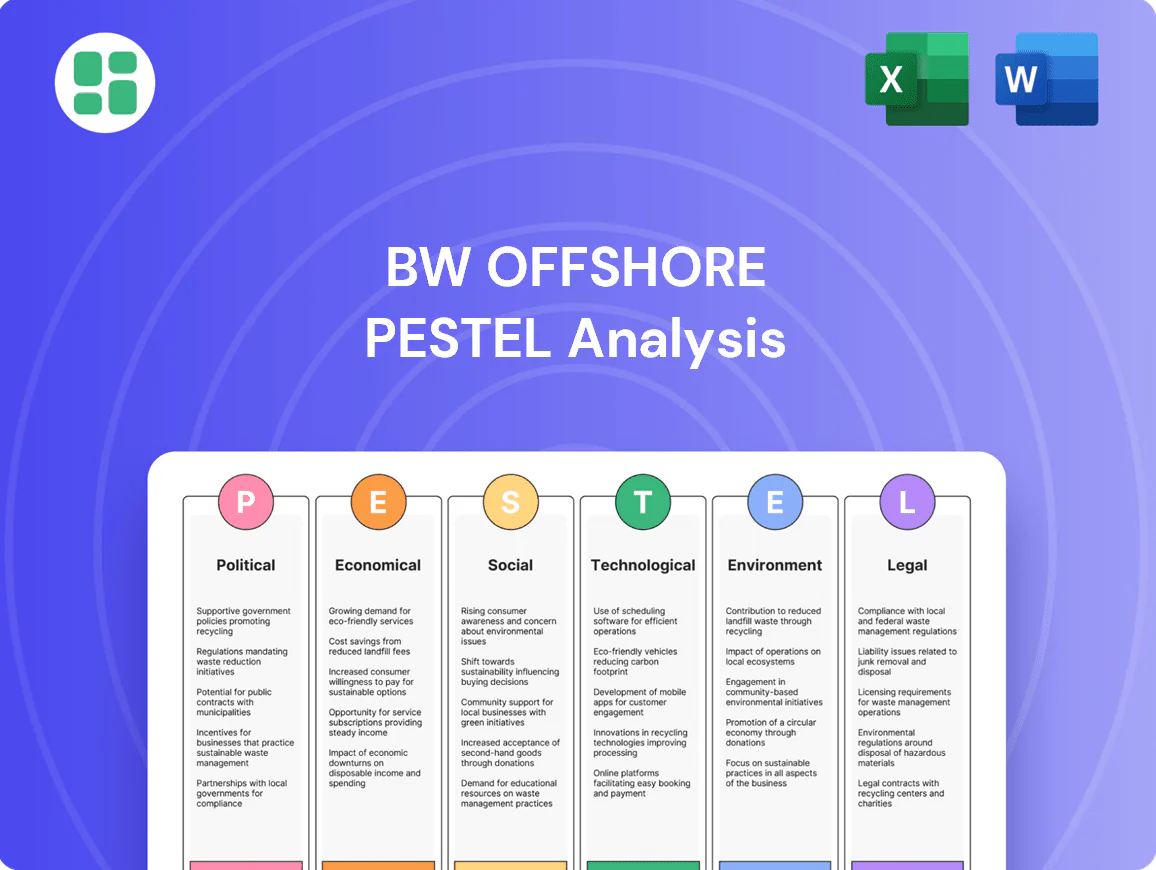
BW Offshore PESTLE Analysis

Plan Smarter. Present Sharper. Compete Stronger.
Navigate the complex external landscape impacting BW Offshore with our comprehensive PESTLE analysis. Understand how political stability, economic fluctuations, technological advancements, environmental regulations, and social trends are shaping the company's strategic direction. Gain a competitive edge by leveraging these critical insights to inform your investment decisions and business strategies. Download the full PESTLE analysis now for actionable intelligence.
Political factors

Geopolitical Stability and Regional Conflicts
Global geopolitical tensions and regional conflicts directly influence oil and gas supply chains and energy prices, impacting BW Offshore's operational environment. For instance, ongoing conflicts in regions like Eastern Europe and the Middle East have contributed to significant volatility in crude oil prices, with Brent crude futures trading around $80-$90 per barrel in early 2024, affecting project economics for offshore developments.
BW Offshore's global footprint exposes it to political instability across its operating regions, potentially delaying projects and influencing investment decisions. In 2023, the company reported that certain projects faced extended timelines due to local political uncertainties, highlighting the need for robust risk mitigation strategies.
Navigating complex international relations is crucial for BW Offshore's business continuity and asset protection. The company actively monitors geopolitical developments and maintains strong relationships with local stakeholders to manage risks associated with political shifts and potential disruptions to its offshore production facilities.
Government Energy Policies and Regulations
Government energy policies significantly shape BW Offshore's operational landscape. For instance, the European Union's ambitious Green Deal, aiming for climate neutrality by 2050, is driving substantial investment in renewable energy sources, directly impacting BW Offshore's strategic pivot towards offshore wind projects. Conversely, policies affecting fossil fuel production, such as potential carbon taxes or production quotas, can influence the demand for their Floating Production Storage and Offloading (FPSO) units, their traditional core business.
In 2024, many nations are increasing renewable energy subsidies to meet climate targets. For example, the United States' Inflation Reduction Act continues to provide significant tax credits for offshore wind development, a crucial factor for companies like BW Offshore looking to expand in this sector. However, regulatory hurdles and permitting processes for offshore wind farms can still pose challenges, requiring careful navigation by the company to capitalize on these incentives.

Regulatory Environment for Offshore Operations
The regulatory landscape for offshore energy projects, crucial for BW Offshore, is a patchwork of national and international laws. These govern everything from initial licensing and environmental impact assessments to day-to-day operational safety standards. For instance, in Norway, the Petroleum Safety Authority (PSA) sets stringent requirements for offshore installations, impacting BW Offshore's operational planning and investment in safety technologies.
BW Offshore navigates a complex web of compliance, where adherence to varying country-specific regulations can significantly influence project feasibility, overall costs, and development timelines. A new environmental permit in Brazil, for example, could add months and millions to a project's lifecycle.
Shifts in these regulations, such as the introduction of enhanced safety protocols or stricter emissions standards, directly translate to increased operational expenditures and necessitate ongoing investment in compliance measures. For 2024, many regions are seeing increased scrutiny on emissions, potentially raising operational costs for companies like BW Offshore.

Trade Policies and Sanctions
International trade policies, including tariffs and economic sanctions, significantly influence BW Offshore's global operations. For instance, the ongoing trade tensions between major economies can lead to unpredictable cost increases for essential equipment and disrupt project timelines. In 2024, the World Trade Organization (WTO) reported that the value of trade-restrictive measures implemented by its members had been steadily increasing, impacting sectors reliant on global supply chains.
These policies directly affect BW Offshore's ability to secure contracts and procure necessary components. Sanctions imposed on certain nations can create significant barriers to market entry or force the company to reroute supply chains, potentially escalating operational expenses. For example, sanctions affecting key oil-producing regions can limit BW Offshore's access to new projects or impact existing contracts.
- Tariff increases on specialized offshore equipment can raise project capital expenditures.
- Economic sanctions can restrict access to vital markets for offshore services.
- Evolving trade agreements necessitate continuous risk assessment and compliance adjustments.
- Disruptions to global shipping routes, often influenced by trade policies, can delay equipment delivery and increase logistics costs.
Fiscal Regimes and Taxation
Changes in fiscal regimes, royalties, and corporate taxation directly affect BW Offshore's profitability and the appeal of its projects. For instance, Brazil, a key operational area, has seen adjustments in its oil and gas tax framework, influencing investment decisions.
Governments worldwide are revising tax structures, sometimes to increase revenue from natural resources, as seen with potential shifts in production sharing agreements in some regions. Other times, these changes aim to encourage specific energy developments, such as renewables or lower-emission offshore operations.
BW Offshore must remain agile in adapting to these evolving fiscal landscapes to ensure long-term financial health and the viability of its ongoing and future projects. For example, changes in corporate tax rates in Norway, where BW Offshore has significant operations, can impact net earnings.
- Fiscal Policy Impact: Fluctuations in corporate tax rates or royalty percentages in key markets like Brazil or Norway can alter BW Offshore's project economics.
- Incentive Structures: Government initiatives to promote offshore wind or carbon capture projects through tax credits or subsidies can influence BW Offshore's strategic investment choices.
- Revenue Sharing: Modifications to production sharing agreements or revenue-sharing models can directly affect the profitability of BW Offshore's floating production storage and offloading (FPSO) contracts.
Political Currents: Shaping Offshore Energy's Future
Government stability and the rule of law are foundational for BW Offshore's operations, influencing contract security and investment. Political instability in regions where BW Offshore operates can lead to project delays and increased operational risks, as seen in 2023 with certain projects facing extended timelines due to local political uncertainties.
Governments' energy policies, including subsidies for renewables and regulations on fossil fuels, directly shape BW Offshore's market opportunities and challenges. For instance, the US Inflation Reduction Act in 2024 continues to boost offshore wind development, a key growth area for BW Offshore.
International trade policies and sanctions create a dynamic operating environment for BW Offshore, impacting supply chains and market access. The increasing value of trade-restrictive measures reported by the WTO in 2024 highlights the need for continuous risk assessment.
Changes in fiscal regimes, such as tax rates and royalty structures in key markets like Brazil, directly affect BW Offshore's profitability and project economics. Navigating these evolving fiscal landscapes is crucial for the company's financial health.
| Political Factor | Impact on BW Offshore | Example/Data Point (2023-2024) |
| Geopolitical Tensions | Volatility in energy prices, project economics affected. | Brent crude futures around $80-$90/barrel in early 2024. |
| Political Instability | Project delays, investment decision influence. | Projects faced extended timelines due to local uncertainties in 2023. |
| Government Energy Policies | Drives investment in renewables, impacts fossil fuel demand. | US Inflation Reduction Act provides significant tax credits for offshore wind. |
| Regulatory Landscape | Affects operational planning, safety, and compliance costs. | Norway's PSA sets stringent offshore installation requirements. |
| Trade Policies & Sanctions | Impacts supply chains, market access, and costs. | Increasing value of trade-restrictive measures reported by WTO. |
| Fiscal Regimes | Influences profitability and project appeal. | Adjustments in Brazil's oil and gas tax framework affect investment. |
What is included in the product
 Detailed Word Document
This PESTLE analysis provides a comprehensive examination of the external macro-environmental factors influencing BW Offshore across Political, Economic, Social, Technological, Environmental, and Legal dimensions.
It offers actionable insights for strategic decision-making by highlighting key trends and their implications for the company's operations and future growth.

 Customizable Excel Spreadsheet
A concise, actionable summary of BW Offshore's PESTLE analysis, designed to quickly identify and address external challenges, thereby relieving the pain of strategic uncertainty.
Economic factors

Global Oil and Gas Prices
Global oil and gas prices are a critical economic factor for BW Offshore. Fluctuations directly impact the demand for their Floating Production Storage and Offloading (FPSO) vessels and the profitability of their ongoing contracts. For instance, if oil prices remain below a certain threshold, like the $70-$80 per barrel range seen intermittently in late 2023 and early 2024, companies may postpone or cancel offshore exploration projects, thereby reducing the need for new FPSO units and potentially pressuring day rates for existing ones.
Conversely, sustained high oil prices, perhaps exceeding $90 per barrel as observed at various points in 2024, tend to encourage significant investment in offshore oil and gas fields. This increased activity directly translates into higher demand for BW Offshore's specialized services and vessels, creating more opportunities for new contracts and potentially leading to improved contract terms.
Investment in Renewable Energy
The global economic shift towards renewable energy is profoundly impacting investment flows, steering capital away from traditional fossil fuel infrastructure and towards sectors like offshore wind. This trend presents BW Offshore with diversification opportunities but also intensifies competition and could potentially reduce capital availability for new FPSO projects as investors increasingly favor green portfolios. For instance, global investment in the energy transition reached an estimated $2 trillion in 2023, a significant portion of which is directed towards renewables, highlighting the scale of this economic driver.

Global Economic Growth and Demand
Global economic growth is a significant driver for energy demand, directly influencing the prospects for BW Offshore's core business in oil and gas, as well as its emerging renewable energy ventures. A healthy global economy generally translates to increased energy consumption, which in turn boosts the need for floating production, storage, and offloading (FPSO) units and supports the ongoing energy transition. For instance, the International Monetary Fund (IMF) projected global growth to be 3.2% in 2024, a slight uptick from 3.1% in 2023, indicating a steady, albeit moderate, demand environment.
A strong economic performance worldwide typically fuels higher energy consumption, thereby bolstering demand for FPSO services and potentially accelerating investments in the energy transition. This increased activity can lead to more project awards for companies like BW Offshore. Conversely, economic downturns or slowdowns can dampen energy demand, leading to reduced commodity prices and a tendency for companies to postpone or cancel capital expenditure, directly impacting the pipeline of new FPSO projects.

Interest Rates and Access to Capital
Interest rates significantly influence BW Offshore's financial flexibility. For instance, the US Federal Reserve maintained its benchmark interest rate between 5.25% and 5.50% through early 2024, a level that increases borrowing costs for capital-intensive projects like FPSOs. This environment directly impacts the company's ability to secure favorable financing for new developments and existing debt servicing, making higher capital expenditures less attractive.
The availability and cost of capital are critical for BW Offshore's strategic growth, particularly in expanding its fleet and venturing into offshore wind. Companies like BW Offshore often rely on syndicated loans and bond markets, where higher global interest rates translate to increased financing expenses. For example, in 2023, the average yield on high-yield corporate bonds, a common funding source for such projects, remained elevated, reflecting the broader trend of tightening financial conditions.
- Financing Costs: Elevated global interest rates, such as the US Federal Reserve's target range of 5.25%-5.50% in early 2024, directly increase BW Offshore's cost of capital for new projects and debt.
- Investment Attractiveness: Higher borrowing costs can diminish the financial viability of capital-intensive offshore projects, potentially slowing down investment in FPSO and offshore wind infrastructure.
- Capital Access: BW Offshore's growth strategy hinges on access to competitive financing; a challenging capital market environment can impede expansion plans.
- Market Conditions: The yield on corporate bonds, a key indicator of borrowing costs, remained relatively high in 2023, underscoring the impact of interest rate policies on companies like BW Offshore.
Supply Chain Costs and Inflation
Inflationary pressures continue to impact the offshore energy sector, with significant implications for BW Offshore's operational costs. For instance, the global shipping container spot rates, a key indicator of transportation costs, saw a notable increase in late 2024 and early 2025 due to geopolitical tensions and increased demand, directly affecting the delivery of materials and equipment for FPSO construction and maintenance.
Rising costs for essential commodities like steel and specialized components, crucial for offshore infrastructure, are also a major concern. Reports from early 2025 indicated that steel prices, a primary input for offshore structures, remained elevated compared to pre-2023 levels, driven by production constraints and robust industrial demand. This directly translates to higher capital expenditure for BW Offshore.
The labor market in specialized offshore industries also presents cost challenges. Shortages of skilled welders, engineers, and technicians, exacerbated by ongoing project pipelines in both oil and gas and renewable energy, have led to increased wage demands. This upward pressure on labor costs affects both project execution and ongoing operational expenses for BW Offshore.
- Elevated Steel Prices: Global steel prices, a key input for offshore infrastructure, remained significantly higher in early 2025 compared to pre-2023 averages, impacting capital expenditure.
- Increased Shipping Costs: Spot rates for shipping containers experienced a surge in late 2024 and early 2025, raising transportation expenses for materials and equipment.
- Skilled Labor Shortages: Demand for specialized offshore labor has driven up wage expectations, contributing to higher operational and project costs for BW Offshore.
External Factors Driving Offshore Energy Performance
Global energy markets are central to BW Offshore's performance, with oil and gas prices directly dictating demand for their FPSO services. For example, Brent crude oil futures traded in the $80-$90 per barrel range for much of 2024, supporting investment in offshore exploration and production, which benefits BW Offshore. The ongoing energy transition also influences capital allocation, with significant investments, estimated to exceed $2 trillion globally in 2023, flowing into renewables, potentially diverting funds from traditional oil and gas projects.
Economic growth underpins energy demand. The IMF's projection of 3.2% global growth for 2024 suggests a steady, albeit moderate, demand environment for energy, which is positive for BW Offshore's business. However, higher interest rates, exemplified by the US Federal Reserve's target range of 5.25%-5.50% through early 2024, increase BW Offshore's cost of capital for projects. Inflationary pressures are also a concern, with steel prices remaining elevated in early 2025 and shipping costs rising in late 2024, impacting project economics.
| Economic Factor | Impact on BW Offshore | Supporting Data (2023-2025) |
|---|---|---|
| Oil & Gas Prices | Drives demand for FPSOs; higher prices encourage investment. | Brent crude futures averaged $80-$90/barrel in much of 2024. |
| Energy Transition Investment | Creates diversification opportunities but shifts capital away from fossil fuels. | Global energy transition investment estimated at $2 trillion in 2023. |
| Global Economic Growth | Influences overall energy demand and project pipelines. | IMF projected 3.2% global growth for 2024. |
| Interest Rates | Increases cost of capital for projects and debt servicing. | US Federal Reserve rate target: 5.25%-5.50% (early 2024). |
| Inflation (Commodity/Shipping) | Raises operational and capital expenditure costs. | Steel prices elevated in early 2025; shipping costs surged late 2024. |
What You See Is What You Get
BW Offshore PESTLE Analysis
The preview shown here is the exact document you’ll receive after purchase—fully formatted and ready to use, providing comprehensive insights into BW Offshore's PESTLE analysis.
This is a real screenshot of the product you’re buying—delivered exactly as shown, no surprises, detailing the Political, Economic, Social, Technological, Legal, and Environmental factors influencing BW Offshore.
The content and structure shown in the preview is the same document you’ll download after payment, offering a complete and actionable PESTLE analysis for BW Offshore.

Original: $10.00
-70%$10.00
$3.00Product Information
Product Information
Shipping & Returns
Shipping & Returns
Description
Plan Smarter. Present Sharper. Compete Stronger.
Navigate the complex external landscape impacting BW Offshore with our comprehensive PESTLE analysis. Understand how political stability, economic fluctuations, technological advancements, environmental regulations, and social trends are shaping the company's strategic direction. Gain a competitive edge by leveraging these critical insights to inform your investment decisions and business strategies. Download the full PESTLE analysis now for actionable intelligence.
Political factors
Geopolitical Stability and Regional Conflicts
Global geopolitical tensions and regional conflicts directly influence oil and gas supply chains and energy prices, impacting BW Offshore's operational environment. For instance, ongoing conflicts in regions like Eastern Europe and the Middle East have contributed to significant volatility in crude oil prices, with Brent crude futures trading around $80-$90 per barrel in early 2024, affecting project economics for offshore developments.
BW Offshore's global footprint exposes it to political instability across its operating regions, potentially delaying projects and influencing investment decisions. In 2023, the company reported that certain projects faced extended timelines due to local political uncertainties, highlighting the need for robust risk mitigation strategies.
Navigating complex international relations is crucial for BW Offshore's business continuity and asset protection. The company actively monitors geopolitical developments and maintains strong relationships with local stakeholders to manage risks associated with political shifts and potential disruptions to its offshore production facilities.
Government Energy Policies and Regulations
Government energy policies significantly shape BW Offshore's operational landscape. For instance, the European Union's ambitious Green Deal, aiming for climate neutrality by 2050, is driving substantial investment in renewable energy sources, directly impacting BW Offshore's strategic pivot towards offshore wind projects. Conversely, policies affecting fossil fuel production, such as potential carbon taxes or production quotas, can influence the demand for their Floating Production Storage and Offloading (FPSO) units, their traditional core business.
In 2024, many nations are increasing renewable energy subsidies to meet climate targets. For example, the United States' Inflation Reduction Act continues to provide significant tax credits for offshore wind development, a crucial factor for companies like BW Offshore looking to expand in this sector. However, regulatory hurdles and permitting processes for offshore wind farms can still pose challenges, requiring careful navigation by the company to capitalize on these incentives.
Regulatory Environment for Offshore Operations
The regulatory landscape for offshore energy projects, crucial for BW Offshore, is a patchwork of national and international laws. These govern everything from initial licensing and environmental impact assessments to day-to-day operational safety standards. For instance, in Norway, the Petroleum Safety Authority (PSA) sets stringent requirements for offshore installations, impacting BW Offshore's operational planning and investment in safety technologies.
BW Offshore navigates a complex web of compliance, where adherence to varying country-specific regulations can significantly influence project feasibility, overall costs, and development timelines. A new environmental permit in Brazil, for example, could add months and millions to a project's lifecycle.
Shifts in these regulations, such as the introduction of enhanced safety protocols or stricter emissions standards, directly translate to increased operational expenditures and necessitate ongoing investment in compliance measures. For 2024, many regions are seeing increased scrutiny on emissions, potentially raising operational costs for companies like BW Offshore.
Trade Policies and Sanctions
International trade policies, including tariffs and economic sanctions, significantly influence BW Offshore's global operations. For instance, the ongoing trade tensions between major economies can lead to unpredictable cost increases for essential equipment and disrupt project timelines. In 2024, the World Trade Organization (WTO) reported that the value of trade-restrictive measures implemented by its members had been steadily increasing, impacting sectors reliant on global supply chains.
These policies directly affect BW Offshore's ability to secure contracts and procure necessary components. Sanctions imposed on certain nations can create significant barriers to market entry or force the company to reroute supply chains, potentially escalating operational expenses. For example, sanctions affecting key oil-producing regions can limit BW Offshore's access to new projects or impact existing contracts.
- Tariff increases on specialized offshore equipment can raise project capital expenditures.
- Economic sanctions can restrict access to vital markets for offshore services.
- Evolving trade agreements necessitate continuous risk assessment and compliance adjustments.
- Disruptions to global shipping routes, often influenced by trade policies, can delay equipment delivery and increase logistics costs.
Fiscal Regimes and Taxation
Changes in fiscal regimes, royalties, and corporate taxation directly affect BW Offshore's profitability and the appeal of its projects. For instance, Brazil, a key operational area, has seen adjustments in its oil and gas tax framework, influencing investment decisions.
Governments worldwide are revising tax structures, sometimes to increase revenue from natural resources, as seen with potential shifts in production sharing agreements in some regions. Other times, these changes aim to encourage specific energy developments, such as renewables or lower-emission offshore operations.
BW Offshore must remain agile in adapting to these evolving fiscal landscapes to ensure long-term financial health and the viability of its ongoing and future projects. For example, changes in corporate tax rates in Norway, where BW Offshore has significant operations, can impact net earnings.
- Fiscal Policy Impact: Fluctuations in corporate tax rates or royalty percentages in key markets like Brazil or Norway can alter BW Offshore's project economics.
- Incentive Structures: Government initiatives to promote offshore wind or carbon capture projects through tax credits or subsidies can influence BW Offshore's strategic investment choices.
- Revenue Sharing: Modifications to production sharing agreements or revenue-sharing models can directly affect the profitability of BW Offshore's floating production storage and offloading (FPSO) contracts.
Political Currents: Shaping Offshore Energy's Future
Government stability and the rule of law are foundational for BW Offshore's operations, influencing contract security and investment. Political instability in regions where BW Offshore operates can lead to project delays and increased operational risks, as seen in 2023 with certain projects facing extended timelines due to local political uncertainties.
Governments' energy policies, including subsidies for renewables and regulations on fossil fuels, directly shape BW Offshore's market opportunities and challenges. For instance, the US Inflation Reduction Act in 2024 continues to boost offshore wind development, a key growth area for BW Offshore.
International trade policies and sanctions create a dynamic operating environment for BW Offshore, impacting supply chains and market access. The increasing value of trade-restrictive measures reported by the WTO in 2024 highlights the need for continuous risk assessment.
Changes in fiscal regimes, such as tax rates and royalty structures in key markets like Brazil, directly affect BW Offshore's profitability and project economics. Navigating these evolving fiscal landscapes is crucial for the company's financial health.
| Political Factor | Impact on BW Offshore | Example/Data Point (2023-2024) |
| Geopolitical Tensions | Volatility in energy prices, project economics affected. | Brent crude futures around $80-$90/barrel in early 2024. |
| Political Instability | Project delays, investment decision influence. | Projects faced extended timelines due to local uncertainties in 2023. |
| Government Energy Policies | Drives investment in renewables, impacts fossil fuel demand. | US Inflation Reduction Act provides significant tax credits for offshore wind. |
| Regulatory Landscape | Affects operational planning, safety, and compliance costs. | Norway's PSA sets stringent offshore installation requirements. |
| Trade Policies & Sanctions | Impacts supply chains, market access, and costs. | Increasing value of trade-restrictive measures reported by WTO. |
| Fiscal Regimes | Influences profitability and project appeal. | Adjustments in Brazil's oil and gas tax framework affect investment. |
What is included in the product
Detailed Word Document
This PESTLE analysis provides a comprehensive examination of the external macro-environmental factors influencing BW Offshore across Political, Economic, Social, Technological, Environmental, and Legal dimensions.
It offers actionable insights for strategic decision-making by highlighting key trends and their implications for the company's operations and future growth.
Customizable Excel Spreadsheet
A concise, actionable summary of BW Offshore's PESTLE analysis, designed to quickly identify and address external challenges, thereby relieving the pain of strategic uncertainty.
Economic factors
Global Oil and Gas Prices
Global oil and gas prices are a critical economic factor for BW Offshore. Fluctuations directly impact the demand for their Floating Production Storage and Offloading (FPSO) vessels and the profitability of their ongoing contracts. For instance, if oil prices remain below a certain threshold, like the $70-$80 per barrel range seen intermittently in late 2023 and early 2024, companies may postpone or cancel offshore exploration projects, thereby reducing the need for new FPSO units and potentially pressuring day rates for existing ones.
Conversely, sustained high oil prices, perhaps exceeding $90 per barrel as observed at various points in 2024, tend to encourage significant investment in offshore oil and gas fields. This increased activity directly translates into higher demand for BW Offshore's specialized services and vessels, creating more opportunities for new contracts and potentially leading to improved contract terms.
Investment in Renewable Energy
The global economic shift towards renewable energy is profoundly impacting investment flows, steering capital away from traditional fossil fuel infrastructure and towards sectors like offshore wind. This trend presents BW Offshore with diversification opportunities but also intensifies competition and could potentially reduce capital availability for new FPSO projects as investors increasingly favor green portfolios. For instance, global investment in the energy transition reached an estimated $2 trillion in 2023, a significant portion of which is directed towards renewables, highlighting the scale of this economic driver.
Global Economic Growth and Demand
Global economic growth is a significant driver for energy demand, directly influencing the prospects for BW Offshore's core business in oil and gas, as well as its emerging renewable energy ventures. A healthy global economy generally translates to increased energy consumption, which in turn boosts the need for floating production, storage, and offloading (FPSO) units and supports the ongoing energy transition. For instance, the International Monetary Fund (IMF) projected global growth to be 3.2% in 2024, a slight uptick from 3.1% in 2023, indicating a steady, albeit moderate, demand environment.
A strong economic performance worldwide typically fuels higher energy consumption, thereby bolstering demand for FPSO services and potentially accelerating investments in the energy transition. This increased activity can lead to more project awards for companies like BW Offshore. Conversely, economic downturns or slowdowns can dampen energy demand, leading to reduced commodity prices and a tendency for companies to postpone or cancel capital expenditure, directly impacting the pipeline of new FPSO projects.
Interest Rates and Access to Capital
Interest rates significantly influence BW Offshore's financial flexibility. For instance, the US Federal Reserve maintained its benchmark interest rate between 5.25% and 5.50% through early 2024, a level that increases borrowing costs for capital-intensive projects like FPSOs. This environment directly impacts the company's ability to secure favorable financing for new developments and existing debt servicing, making higher capital expenditures less attractive.
The availability and cost of capital are critical for BW Offshore's strategic growth, particularly in expanding its fleet and venturing into offshore wind. Companies like BW Offshore often rely on syndicated loans and bond markets, where higher global interest rates translate to increased financing expenses. For example, in 2023, the average yield on high-yield corporate bonds, a common funding source for such projects, remained elevated, reflecting the broader trend of tightening financial conditions.
- Financing Costs: Elevated global interest rates, such as the US Federal Reserve's target range of 5.25%-5.50% in early 2024, directly increase BW Offshore's cost of capital for new projects and debt.
- Investment Attractiveness: Higher borrowing costs can diminish the financial viability of capital-intensive offshore projects, potentially slowing down investment in FPSO and offshore wind infrastructure.
- Capital Access: BW Offshore's growth strategy hinges on access to competitive financing; a challenging capital market environment can impede expansion plans.
- Market Conditions: The yield on corporate bonds, a key indicator of borrowing costs, remained relatively high in 2023, underscoring the impact of interest rate policies on companies like BW Offshore.
Supply Chain Costs and Inflation
Inflationary pressures continue to impact the offshore energy sector, with significant implications for BW Offshore's operational costs. For instance, the global shipping container spot rates, a key indicator of transportation costs, saw a notable increase in late 2024 and early 2025 due to geopolitical tensions and increased demand, directly affecting the delivery of materials and equipment for FPSO construction and maintenance.
Rising costs for essential commodities like steel and specialized components, crucial for offshore infrastructure, are also a major concern. Reports from early 2025 indicated that steel prices, a primary input for offshore structures, remained elevated compared to pre-2023 levels, driven by production constraints and robust industrial demand. This directly translates to higher capital expenditure for BW Offshore.
The labor market in specialized offshore industries also presents cost challenges. Shortages of skilled welders, engineers, and technicians, exacerbated by ongoing project pipelines in both oil and gas and renewable energy, have led to increased wage demands. This upward pressure on labor costs affects both project execution and ongoing operational expenses for BW Offshore.
- Elevated Steel Prices: Global steel prices, a key input for offshore infrastructure, remained significantly higher in early 2025 compared to pre-2023 averages, impacting capital expenditure.
- Increased Shipping Costs: Spot rates for shipping containers experienced a surge in late 2024 and early 2025, raising transportation expenses for materials and equipment.
- Skilled Labor Shortages: Demand for specialized offshore labor has driven up wage expectations, contributing to higher operational and project costs for BW Offshore.
External Factors Driving Offshore Energy Performance
Global energy markets are central to BW Offshore's performance, with oil and gas prices directly dictating demand for their FPSO services. For example, Brent crude oil futures traded in the $80-$90 per barrel range for much of 2024, supporting investment in offshore exploration and production, which benefits BW Offshore. The ongoing energy transition also influences capital allocation, with significant investments, estimated to exceed $2 trillion globally in 2023, flowing into renewables, potentially diverting funds from traditional oil and gas projects.
Economic growth underpins energy demand. The IMF's projection of 3.2% global growth for 2024 suggests a steady, albeit moderate, demand environment for energy, which is positive for BW Offshore's business. However, higher interest rates, exemplified by the US Federal Reserve's target range of 5.25%-5.50% through early 2024, increase BW Offshore's cost of capital for projects. Inflationary pressures are also a concern, with steel prices remaining elevated in early 2025 and shipping costs rising in late 2024, impacting project economics.
| Economic Factor | Impact on BW Offshore | Supporting Data (2023-2025) |
|---|---|---|
| Oil & Gas Prices | Drives demand for FPSOs; higher prices encourage investment. | Brent crude futures averaged $80-$90/barrel in much of 2024. |
| Energy Transition Investment | Creates diversification opportunities but shifts capital away from fossil fuels. | Global energy transition investment estimated at $2 trillion in 2023. |
| Global Economic Growth | Influences overall energy demand and project pipelines. | IMF projected 3.2% global growth for 2024. |
| Interest Rates | Increases cost of capital for projects and debt servicing. | US Federal Reserve rate target: 5.25%-5.50% (early 2024). |
| Inflation (Commodity/Shipping) | Raises operational and capital expenditure costs. | Steel prices elevated in early 2025; shipping costs surged late 2024. |
What You See Is What You Get
BW Offshore PESTLE Analysis
The preview shown here is the exact document you’ll receive after purchase—fully formatted and ready to use, providing comprehensive insights into BW Offshore's PESTLE analysis.
This is a real screenshot of the product you’re buying—delivered exactly as shown, no surprises, detailing the Political, Economic, Social, Technological, Legal, and Environmental factors influencing BW Offshore.
The content and structure shown in the preview is the same document you’ll download after payment, offering a complete and actionable PESTLE analysis for BW Offshore.