Ambipar PESTLE Analysis

Your Shortcut to Market Insight Starts Here
Unlock the critical external factors shaping Ambipar's trajectory with our meticulously researched PESTLE analysis. Understand the political, economic, social, technological, legal, and environmental forces that present both opportunities and challenges for the company. Equip yourself with actionable intelligence to refine your strategy and navigate the competitive landscape with confidence. Download the full version now and gain the strategic advantage you need.
Political factors

Governmental Regulations on Waste Management
Governments globally are tightening rules on waste handling and environmental safety, a trend that significantly shapes Ambipar's business. For instance, many nations are setting ambitious targets to divert waste from landfills, aiming for higher recycling rates and mandating secure methods for disposing of dangerous substances.
These evolving legal landscapes directly influence how companies like Ambipar must operate and innovate. Ambipar's expertise in waste management and environmental solutions becomes crucial for businesses needing to adhere to these increasingly stringent regulations, thereby avoiding potential fines and reputational damage.
The global push towards a circular economy, driven by these regulations, presents a substantial growth opportunity for Ambipar. For example, the European Union's Circular Economy Action Plan, updated in 2020, sets clear goals for waste reduction and increased recycling, directly benefiting companies providing compliant waste solutions.
International Environmental Agreements
Global climate targets, like those set by the Paris Agreement, directly shape national environmental policies. These agreements foster a growing demand for specialized environmental services, a sector where Ambipar operates. For instance, the push for decarbonization and cross-border waste management, driven by these international accords, creates significant opportunities for companies like Ambipar.
The increasing global focus on environmental responsibility, spurred by international accords, translates into tangible market growth. Ambipar is well-positioned to capitalize on this trend, as countries implement stricter regulations and invest in sustainable solutions to meet their commitments. The UN's latest climate report in late 2024 highlighted the urgent need for accelerated action, further reinforcing the demand for Ambipar's expertise.

Political Stability and Regional Policies
Ambipar's operations are significantly influenced by political stability across its key markets, particularly in South America and Europe. For instance, Brazil's ongoing efforts to strengthen environmental regulations, as seen in the proposed updates to the National Solid Waste Policy, directly impact waste management and recycling services, a core Ambipar offering. The company’s 2024 performance hinges on navigating these evolving political landscapes.

Government Incentives for Circular Economy
Governments worldwide are actively promoting the circular economy through various financial mechanisms. For instance, the European Union's Green Deal aims to mobilize significant public and private investment in sustainable technologies. Many nations are offering tax credits and grants for companies investing in waste reduction, recycling infrastructure, and the development of products from recycled materials. These policy shifts directly benefit companies like Ambipar, whose operations are centered on resource efficiency and transforming waste into valuable products.
These incentives are designed to accelerate the transition to a more sustainable economic model. In 2024, several countries expanded their green financing programs. For example, the United States' Inflation Reduction Act provides substantial tax credits for clean energy and circular economy initiatives. Similarly, Canada has introduced new funding streams to support businesses adopting circular practices. These political actions create a more favorable operating environment for Ambipar’s waste-to-resource solutions.
The impact of these government policies can be seen in the growing market for recycled materials and green technologies. By providing financial backing, governments encourage innovation and the scaling of circular business models. This creates a virtuous cycle where policy drives investment, which in turn supports companies like Ambipar in expanding their capacity and offerings in the circular economy space.
- Government Support for Circular Economy: Many nations are offering grants and tax incentives for companies embracing circular principles.
- Resource Efficiency Focus: Political agendas increasingly prioritize resource efficiency and waste valorization, aligning with Ambipar's core business.
- Green Technology Investment: Incentives encourage investment in technologies that enable waste-to-resource solutions, a key area for Ambipar.
- Market Growth: Policy-driven demand for recycled materials and sustainable practices fuels market expansion for circular economy businesses.
Trade Policies and Hazardous Waste Movement
Trade policies and international agreements significantly influence Ambipar's operations, particularly concerning the movement of hazardous waste. The Basel Convention, a key international treaty, governs the transboundary movement of hazardous wastes and their disposal. Ambipar, as a global player in environmental management, must meticulously adhere to these regulations to ensure the safe and legal transport of materials for proper treatment and disposal. For instance, in 2024, the European Union continued to strengthen its waste export regulations, impacting the flow of certain waste streams that Ambipar manages.
Navigating these complex legal frameworks is crucial for Ambipar's business model. Compliance ensures the company can operate efficiently across different jurisdictions. The company's ability to manage hazardous waste movement legally and safely is a core competency, directly impacting its service offerings and client trust. Recent legislative updates in 2025, such as proposed changes to waste classification in North America, require continuous adaptation by companies like Ambipar.
- Global Trade Agreements: Ambipar must stay abreast of evolving international trade policies that affect the movement of regulated materials.
- Basel Convention Compliance: Adherence to the Basel Convention is paramount for the legal transboundary movement of hazardous waste.
- Regulatory Adaptability: The company's success hinges on its capacity to adapt to new or amended waste management regulations worldwide.
- Logistical Expertise: Efficient and compliant logistics are essential for Ambipar to provide its core services effectively.
Government Policies: Fueling Circular Economy Growth
Government policies worldwide are increasingly focused on sustainability and the circular economy, directly impacting Ambipar's operational landscape. For example, many nations are implementing stricter regulations on waste disposal and promoting recycling initiatives, creating a demand for specialized environmental services. The European Union's updated Circular Economy Action Plan in 2020, for instance, sets ambitious targets for waste reduction, directly benefiting companies like Ambipar.
Political stability and evolving national environmental policies are critical for Ambipar's growth. Brazil's ongoing efforts to update its National Solid Waste Policy, for example, directly influence waste management and recycling services, a core Ambipar offering, and the company's 2024 performance is tied to navigating these changes.
Governments are actively supporting the circular economy through financial incentives. The US Inflation Reduction Act of 2022, for instance, offers substantial tax credits for clean energy and circular economy initiatives, creating a favorable environment for Ambipar's waste-to-resource solutions.
International trade policies, such as the Basel Convention, govern the movement of hazardous waste, requiring Ambipar's strict adherence. Proposed waste classification changes in North America in 2025 necessitate continuous adaptation from companies like Ambipar to ensure compliant operations.
What is included in the product
 Detailed Word Document
This PESTLE analysis meticulously examines the external macro-environmental factors influencing Ambipar across Political, Economic, Social, Technological, Environmental, and Legal dimensions, providing a comprehensive understanding of its operating landscape.

 Customizable Excel Spreadsheet
Provides a clear, actionable framework for understanding external factors impacting Ambipar, thereby reducing the anxiety associated with navigating complex market dynamics.
Economic factors

Global Economic Growth and Industrial Activity
Global economic growth is a key driver for Ambipar. As economies expand, industrial activity typically increases, leading to higher waste generation. For instance, the International Monetary Fund (IMF) projected global growth at 3.2% for 2024, a slight increase from 2023, indicating a potentially growing demand for waste management and environmental solutions.
The health of specific industrial sectors is particularly relevant. Manufacturing, healthcare, and chemical industries are significant generators of waste, including hazardous materials. As these sectors grow, the need for specialized environmental services, such as those offered by Ambipar for waste treatment and disposal, also rises. The global manufacturing PMI, a gauge of industrial health, showed varied performance across regions in early 2024, but overall expansionary trends in key markets signal continued waste generation.
Cost of Environmental Compliance
Businesses are grappling with escalating expenses tied to environmental regulations, making Ambipar's comprehensive service offerings increasingly valuable. For instance, in 2024, companies globally are allocating significant budgets towards waste management, emissions control, and compliance reporting, with some estimates suggesting these costs could rise by 5-10% annually due to stricter enforcement and evolving standards.
The drive for operational efficiency and cost reduction in managing environmental responsibilities, from hazardous waste disposal to emergency response, directly boosts the market for specialized environmental service providers like Ambipar. As sustainability becomes a core business imperative, companies are actively seeking integrated solutions that not only ensure compliance but also optimize resource utilization and minimize environmental impact, a trend clearly visible in the growing demand for circular economy initiatives.

Investment in Sustainable Infrastructure
The global push for sustainable infrastructure is a significant tailwind for companies like Ambipar. We're seeing substantial growth in investments directed towards advanced waste treatment facilities and sophisticated environmental monitoring systems. For instance, the International Energy Agency (IEA) reported in its 2024 outlook that global clean energy investment is projected to reach $2 trillion in 2024, a significant portion of which will flow into infrastructure projects aimed at decarbonization and resilience.
This surge in funding isn't confined to a single sector; both public and private entities are actively channeling capital into building more resilient and eco-friendly economies. In 2023, governments worldwide committed billions to green infrastructure initiatives, aiming to meet climate targets and foster long-term economic stability. This creates a fertile ground for Ambipar's specialized services in waste management and environmental solutions.

Fluctuations in Commodity Prices
Fluctuations in commodity prices can significantly impact the economic viability of waste valorization services, as recovered materials often compete with virgin resources. For instance, the price of recycled plastics, a key output for companies like Ambipar, is directly influenced by the cost of new petroleum-based plastics. In early 2024, the price of Brent crude oil hovered around $80 per barrel, a factor that can make virgin plastic production more or less competitive depending on its movement.
Ambipar's commitment to circular economy principles acts as a crucial buffer against these price volatilities. By transforming waste into valuable outputs, such as recycled materials or energy, the company creates its own revenue streams that are less directly tied to the volatile global commodity markets. This strategic focus diversifies its income and enhances resilience.
The waste-to-energy sector, another area for Ambipar, also faces competition from fluctuating energy prices. When oil and natural gas prices are low, the economic appeal of waste-derived energy can diminish. For example, if natural gas prices fall significantly, as they did in some regions during late 2023 and early 2024, it can make traditional energy sources more attractive than waste-to-energy alternatives, impacting project economics.
The company's approach mitigates this by focusing on the intrinsic value of waste processing and resource recovery, rather than solely on the commodity value of the end product. This includes services like landfill management and specialized industrial waste treatment, which have more stable demand drivers.
- Commodity Price Sensitivity: The economic feasibility of recycled materials directly correlates with virgin resource prices. For example, fluctuations in the price of aluminum can affect the profitability of recycling aluminum cans.
- Waste-to-Energy Competition: Energy generated from waste competes with conventional energy sources, whose prices are volatile. In 2024, the price of natural gas, a key competitor, has seen significant swings.
- Ambipar's Mitigation Strategy: By focusing on circular economy principles, Ambipar transforms waste into valuable outputs, reducing direct reliance on fluctuating commodity markets.
- Diversified Revenue Streams: The company's broad service portfolio, including industrial waste treatment and logistics, provides stability against commodity price shocks.
Access to Capital for Expansion and R&D
Ambipar's capacity to secure funding for growth, acquisitions, and innovation is paramount. The company has demonstrated a robust financial footing, evidenced by its successful capital raises, including the issuance of green bonds, which bolster its strategic endeavors and debt management.
In 2023, Ambipar reported significant financial achievements, including a net revenue of R$4.1 billion, a 20% increase compared to 2022, signaling its strong operational performance and ability to attract investment. The company's access to diverse capital sources, such as its successful green bond issuances, underscores its strategic financial planning and commitment to sustainable growth initiatives.
- Capital Markets Access: Ambipar's consistent access to capital markets allows for strategic expansion and research and development funding.
- Green Bond Issuance: The company's successful issuance of green bonds in 2023, totaling R$500 million, highlights its ability to attract ESG-focused investment and fund sustainable projects.
- Financial Performance: Strong financial results, such as the 20% revenue growth in 2023, enhance investor confidence and facilitate further capital access.
- Acquisition Funding: Access to capital is critical for Ambipar's inorganic growth strategy, enabling the acquisition of complementary businesses to expand its service portfolio and market reach.
Economic Tailwinds Fueling Environmental Solutions Growth
Global economic trends directly influence Ambipar's market demand, with projected global growth of 3.2% for 2024 by the IMF suggesting increased industrial activity and thus waste generation. The company's financial health is bolstered by its successful access to capital markets, including R$500 million in green bond issuances in 2023, which supports its expansion and innovation strategies.
Ambipar's revenue growth of 20% in 2023, reaching R$4.1 billion, demonstrates strong operational performance and investor confidence, facilitating further capital access for strategic acquisitions and development. The company's ability to secure funding is crucial for its inorganic growth and expanding service portfolio in the environmental solutions sector.
| Economic Factor | Impact on Ambipar | 2023/2024 Data Point |
|---|---|---|
| Global Economic Growth | Drives demand for waste management and environmental services. | IMF projects 3.2% global growth for 2024. |
| Industrial Sector Health | Key sectors like manufacturing and chemicals generate significant waste. | Global manufacturing PMI shows varied but generally expansionary trends in key markets. |
| Commodity Prices | Affects the competitiveness of recycled materials and waste-to-energy. | Brent crude oil around $80/barrel in early 2024 impacts virgin plastic costs. |
| Access to Capital | Enables growth, acquisitions, and innovation. | R$4.1 billion net revenue in 2023; R$500 million in green bonds issued in 2023. |
Full Version Awaits
Ambipar PESTLE Analysis
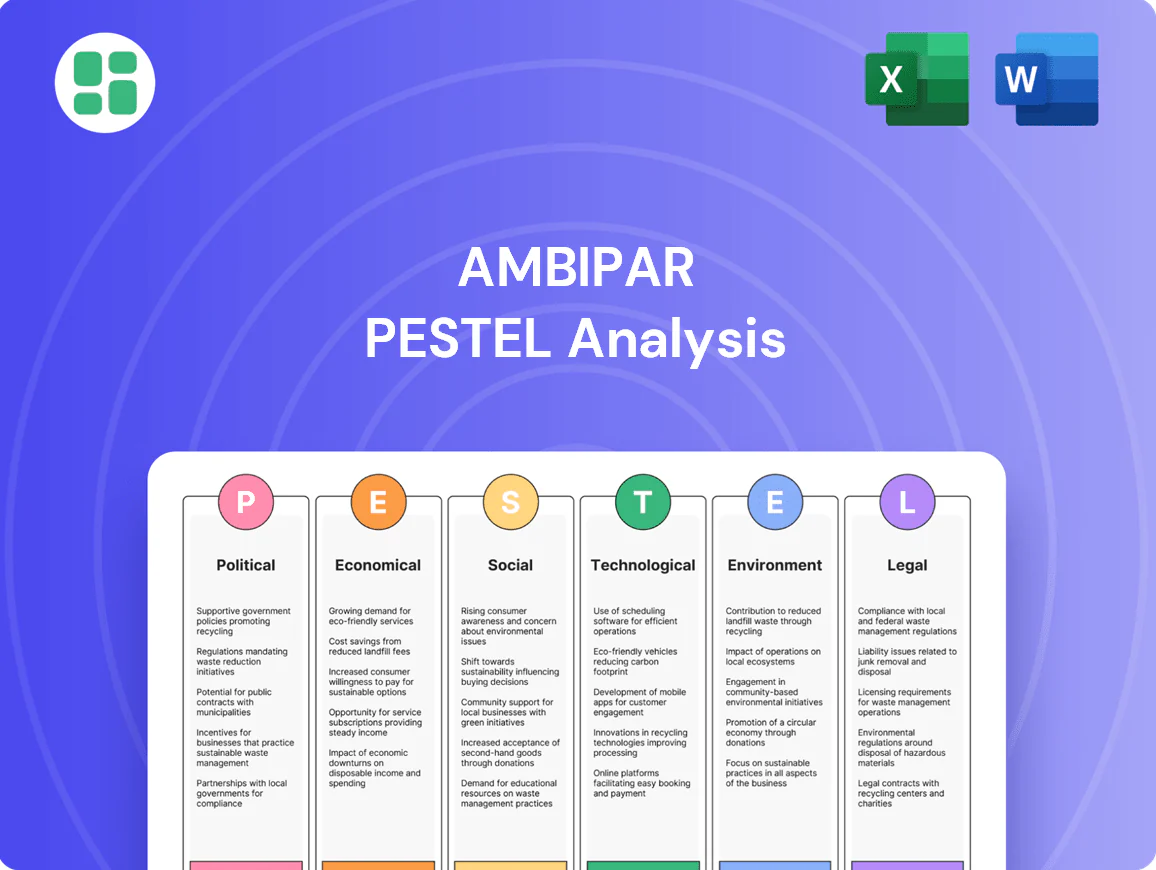
The preview shown here is the exact Ambipar PESTLE Analysis you’ll receive after purchase—fully formatted and ready to use, providing a comprehensive understanding of the external factors impacting the company.
This is a real screenshot of the Ambipar PESTLE Analysis you’re buying—delivered exactly as shown, no surprises, allowing you to immediately assess political, economic, social, technological, legal, and environmental influences.
The content and structure of this Ambipar PESTLE Analysis shown in the preview is the same document you’ll download after payment, giving you direct access to actionable insights for strategic planning.

Original: $10.00
-70%$10.00
$3.00Product Information
Product Information
Shipping & Returns
Shipping & Returns
Description
Your Shortcut to Market Insight Starts Here
Unlock the critical external factors shaping Ambipar's trajectory with our meticulously researched PESTLE analysis. Understand the political, economic, social, technological, legal, and environmental forces that present both opportunities and challenges for the company. Equip yourself with actionable intelligence to refine your strategy and navigate the competitive landscape with confidence. Download the full version now and gain the strategic advantage you need.
Political factors
Governmental Regulations on Waste Management
Governments globally are tightening rules on waste handling and environmental safety, a trend that significantly shapes Ambipar's business. For instance, many nations are setting ambitious targets to divert waste from landfills, aiming for higher recycling rates and mandating secure methods for disposing of dangerous substances.
These evolving legal landscapes directly influence how companies like Ambipar must operate and innovate. Ambipar's expertise in waste management and environmental solutions becomes crucial for businesses needing to adhere to these increasingly stringent regulations, thereby avoiding potential fines and reputational damage.
The global push towards a circular economy, driven by these regulations, presents a substantial growth opportunity for Ambipar. For example, the European Union's Circular Economy Action Plan, updated in 2020, sets clear goals for waste reduction and increased recycling, directly benefiting companies providing compliant waste solutions.
International Environmental Agreements
Global climate targets, like those set by the Paris Agreement, directly shape national environmental policies. These agreements foster a growing demand for specialized environmental services, a sector where Ambipar operates. For instance, the push for decarbonization and cross-border waste management, driven by these international accords, creates significant opportunities for companies like Ambipar.
The increasing global focus on environmental responsibility, spurred by international accords, translates into tangible market growth. Ambipar is well-positioned to capitalize on this trend, as countries implement stricter regulations and invest in sustainable solutions to meet their commitments. The UN's latest climate report in late 2024 highlighted the urgent need for accelerated action, further reinforcing the demand for Ambipar's expertise.
Political Stability and Regional Policies
Ambipar's operations are significantly influenced by political stability across its key markets, particularly in South America and Europe. For instance, Brazil's ongoing efforts to strengthen environmental regulations, as seen in the proposed updates to the National Solid Waste Policy, directly impact waste management and recycling services, a core Ambipar offering. The company’s 2024 performance hinges on navigating these evolving political landscapes.
Government Incentives for Circular Economy
Governments worldwide are actively promoting the circular economy through various financial mechanisms. For instance, the European Union's Green Deal aims to mobilize significant public and private investment in sustainable technologies. Many nations are offering tax credits and grants for companies investing in waste reduction, recycling infrastructure, and the development of products from recycled materials. These policy shifts directly benefit companies like Ambipar, whose operations are centered on resource efficiency and transforming waste into valuable products.
These incentives are designed to accelerate the transition to a more sustainable economic model. In 2024, several countries expanded their green financing programs. For example, the United States' Inflation Reduction Act provides substantial tax credits for clean energy and circular economy initiatives. Similarly, Canada has introduced new funding streams to support businesses adopting circular practices. These political actions create a more favorable operating environment for Ambipar’s waste-to-resource solutions.
The impact of these government policies can be seen in the growing market for recycled materials and green technologies. By providing financial backing, governments encourage innovation and the scaling of circular business models. This creates a virtuous cycle where policy drives investment, which in turn supports companies like Ambipar in expanding their capacity and offerings in the circular economy space.
- Government Support for Circular Economy: Many nations are offering grants and tax incentives for companies embracing circular principles.
- Resource Efficiency Focus: Political agendas increasingly prioritize resource efficiency and waste valorization, aligning with Ambipar's core business.
- Green Technology Investment: Incentives encourage investment in technologies that enable waste-to-resource solutions, a key area for Ambipar.
- Market Growth: Policy-driven demand for recycled materials and sustainable practices fuels market expansion for circular economy businesses.
Trade Policies and Hazardous Waste Movement
Trade policies and international agreements significantly influence Ambipar's operations, particularly concerning the movement of hazardous waste. The Basel Convention, a key international treaty, governs the transboundary movement of hazardous wastes and their disposal. Ambipar, as a global player in environmental management, must meticulously adhere to these regulations to ensure the safe and legal transport of materials for proper treatment and disposal. For instance, in 2024, the European Union continued to strengthen its waste export regulations, impacting the flow of certain waste streams that Ambipar manages.
Navigating these complex legal frameworks is crucial for Ambipar's business model. Compliance ensures the company can operate efficiently across different jurisdictions. The company's ability to manage hazardous waste movement legally and safely is a core competency, directly impacting its service offerings and client trust. Recent legislative updates in 2025, such as proposed changes to waste classification in North America, require continuous adaptation by companies like Ambipar.
- Global Trade Agreements: Ambipar must stay abreast of evolving international trade policies that affect the movement of regulated materials.
- Basel Convention Compliance: Adherence to the Basel Convention is paramount for the legal transboundary movement of hazardous waste.
- Regulatory Adaptability: The company's success hinges on its capacity to adapt to new or amended waste management regulations worldwide.
- Logistical Expertise: Efficient and compliant logistics are essential for Ambipar to provide its core services effectively.
Government Policies: Fueling Circular Economy Growth
Government policies worldwide are increasingly focused on sustainability and the circular economy, directly impacting Ambipar's operational landscape. For example, many nations are implementing stricter regulations on waste disposal and promoting recycling initiatives, creating a demand for specialized environmental services. The European Union's updated Circular Economy Action Plan in 2020, for instance, sets ambitious targets for waste reduction, directly benefiting companies like Ambipar.
Political stability and evolving national environmental policies are critical for Ambipar's growth. Brazil's ongoing efforts to update its National Solid Waste Policy, for example, directly influence waste management and recycling services, a core Ambipar offering, and the company's 2024 performance is tied to navigating these changes.
Governments are actively supporting the circular economy through financial incentives. The US Inflation Reduction Act of 2022, for instance, offers substantial tax credits for clean energy and circular economy initiatives, creating a favorable environment for Ambipar's waste-to-resource solutions.
International trade policies, such as the Basel Convention, govern the movement of hazardous waste, requiring Ambipar's strict adherence. Proposed waste classification changes in North America in 2025 necessitate continuous adaptation from companies like Ambipar to ensure compliant operations.
What is included in the product
Detailed Word Document
This PESTLE analysis meticulously examines the external macro-environmental factors influencing Ambipar across Political, Economic, Social, Technological, Environmental, and Legal dimensions, providing a comprehensive understanding of its operating landscape.
Customizable Excel Spreadsheet
Provides a clear, actionable framework for understanding external factors impacting Ambipar, thereby reducing the anxiety associated with navigating complex market dynamics.
Economic factors
Global Economic Growth and Industrial Activity
Global economic growth is a key driver for Ambipar. As economies expand, industrial activity typically increases, leading to higher waste generation. For instance, the International Monetary Fund (IMF) projected global growth at 3.2% for 2024, a slight increase from 2023, indicating a potentially growing demand for waste management and environmental solutions.
The health of specific industrial sectors is particularly relevant. Manufacturing, healthcare, and chemical industries are significant generators of waste, including hazardous materials. As these sectors grow, the need for specialized environmental services, such as those offered by Ambipar for waste treatment and disposal, also rises. The global manufacturing PMI, a gauge of industrial health, showed varied performance across regions in early 2024, but overall expansionary trends in key markets signal continued waste generation.
Cost of Environmental Compliance
Businesses are grappling with escalating expenses tied to environmental regulations, making Ambipar's comprehensive service offerings increasingly valuable. For instance, in 2024, companies globally are allocating significant budgets towards waste management, emissions control, and compliance reporting, with some estimates suggesting these costs could rise by 5-10% annually due to stricter enforcement and evolving standards.
The drive for operational efficiency and cost reduction in managing environmental responsibilities, from hazardous waste disposal to emergency response, directly boosts the market for specialized environmental service providers like Ambipar. As sustainability becomes a core business imperative, companies are actively seeking integrated solutions that not only ensure compliance but also optimize resource utilization and minimize environmental impact, a trend clearly visible in the growing demand for circular economy initiatives.
Investment in Sustainable Infrastructure
The global push for sustainable infrastructure is a significant tailwind for companies like Ambipar. We're seeing substantial growth in investments directed towards advanced waste treatment facilities and sophisticated environmental monitoring systems. For instance, the International Energy Agency (IEA) reported in its 2024 outlook that global clean energy investment is projected to reach $2 trillion in 2024, a significant portion of which will flow into infrastructure projects aimed at decarbonization and resilience.
This surge in funding isn't confined to a single sector; both public and private entities are actively channeling capital into building more resilient and eco-friendly economies. In 2023, governments worldwide committed billions to green infrastructure initiatives, aiming to meet climate targets and foster long-term economic stability. This creates a fertile ground for Ambipar's specialized services in waste management and environmental solutions.
Fluctuations in Commodity Prices
Fluctuations in commodity prices can significantly impact the economic viability of waste valorization services, as recovered materials often compete with virgin resources. For instance, the price of recycled plastics, a key output for companies like Ambipar, is directly influenced by the cost of new petroleum-based plastics. In early 2024, the price of Brent crude oil hovered around $80 per barrel, a factor that can make virgin plastic production more or less competitive depending on its movement.
Ambipar's commitment to circular economy principles acts as a crucial buffer against these price volatilities. By transforming waste into valuable outputs, such as recycled materials or energy, the company creates its own revenue streams that are less directly tied to the volatile global commodity markets. This strategic focus diversifies its income and enhances resilience.
The waste-to-energy sector, another area for Ambipar, also faces competition from fluctuating energy prices. When oil and natural gas prices are low, the economic appeal of waste-derived energy can diminish. For example, if natural gas prices fall significantly, as they did in some regions during late 2023 and early 2024, it can make traditional energy sources more attractive than waste-to-energy alternatives, impacting project economics.
The company's approach mitigates this by focusing on the intrinsic value of waste processing and resource recovery, rather than solely on the commodity value of the end product. This includes services like landfill management and specialized industrial waste treatment, which have more stable demand drivers.
- Commodity Price Sensitivity: The economic feasibility of recycled materials directly correlates with virgin resource prices. For example, fluctuations in the price of aluminum can affect the profitability of recycling aluminum cans.
- Waste-to-Energy Competition: Energy generated from waste competes with conventional energy sources, whose prices are volatile. In 2024, the price of natural gas, a key competitor, has seen significant swings.
- Ambipar's Mitigation Strategy: By focusing on circular economy principles, Ambipar transforms waste into valuable outputs, reducing direct reliance on fluctuating commodity markets.
- Diversified Revenue Streams: The company's broad service portfolio, including industrial waste treatment and logistics, provides stability against commodity price shocks.
Access to Capital for Expansion and R&D
Ambipar's capacity to secure funding for growth, acquisitions, and innovation is paramount. The company has demonstrated a robust financial footing, evidenced by its successful capital raises, including the issuance of green bonds, which bolster its strategic endeavors and debt management.
In 2023, Ambipar reported significant financial achievements, including a net revenue of R$4.1 billion, a 20% increase compared to 2022, signaling its strong operational performance and ability to attract investment. The company's access to diverse capital sources, such as its successful green bond issuances, underscores its strategic financial planning and commitment to sustainable growth initiatives.
- Capital Markets Access: Ambipar's consistent access to capital markets allows for strategic expansion and research and development funding.
- Green Bond Issuance: The company's successful issuance of green bonds in 2023, totaling R$500 million, highlights its ability to attract ESG-focused investment and fund sustainable projects.
- Financial Performance: Strong financial results, such as the 20% revenue growth in 2023, enhance investor confidence and facilitate further capital access.
- Acquisition Funding: Access to capital is critical for Ambipar's inorganic growth strategy, enabling the acquisition of complementary businesses to expand its service portfolio and market reach.
Economic Tailwinds Fueling Environmental Solutions Growth
Global economic trends directly influence Ambipar's market demand, with projected global growth of 3.2% for 2024 by the IMF suggesting increased industrial activity and thus waste generation. The company's financial health is bolstered by its successful access to capital markets, including R$500 million in green bond issuances in 2023, which supports its expansion and innovation strategies.
Ambipar's revenue growth of 20% in 2023, reaching R$4.1 billion, demonstrates strong operational performance and investor confidence, facilitating further capital access for strategic acquisitions and development. The company's ability to secure funding is crucial for its inorganic growth and expanding service portfolio in the environmental solutions sector.
| Economic Factor | Impact on Ambipar | 2023/2024 Data Point |
|---|---|---|
| Global Economic Growth | Drives demand for waste management and environmental services. | IMF projects 3.2% global growth for 2024. |
| Industrial Sector Health | Key sectors like manufacturing and chemicals generate significant waste. | Global manufacturing PMI shows varied but generally expansionary trends in key markets. |
| Commodity Prices | Affects the competitiveness of recycled materials and waste-to-energy. | Brent crude oil around $80/barrel in early 2024 impacts virgin plastic costs. |
| Access to Capital | Enables growth, acquisitions, and innovation. | R$4.1 billion net revenue in 2023; R$500 million in green bonds issued in 2023. |
Full Version Awaits
Ambipar PESTLE Analysis
The preview shown here is the exact Ambipar PESTLE Analysis you’ll receive after purchase—fully formatted and ready to use, providing a comprehensive understanding of the external factors impacting the company.
This is a real screenshot of the Ambipar PESTLE Analysis you’re buying—delivered exactly as shown, no surprises, allowing you to immediately assess political, economic, social, technological, legal, and environmental influences.
The content and structure of this Ambipar PESTLE Analysis shown in the preview is the same document you’ll download after payment, giving you direct access to actionable insights for strategic planning.