Boliden PESTLE Analysis

Plan Smarter. Present Sharper. Compete Stronger.
Uncover the critical political, economic, social, technological, environmental, and legal forces shaping Boliden's future. Our expert-crafted PESTLE analysis provides the deep-dive insights you need to anticipate market shifts and capitalize on opportunities. Download the full version now and gain a decisive competitive advantage.
Political factors

Government Policy and Mining Regulations
Boliden operates within politically stable Nordic countries and Ireland, yet mining is inherently subject to stringent regulations. Shifts in government policies concerning permitting, environmental standards, or taxation can significantly influence the feasibility and cost of exploration and development initiatives. For instance, any tightening of environmental regulations could increase operational expenses or delay project timelines.
The European Union's Critical Raw Materials Act, effective from May 2024, is a significant development. This act is designed to expedite mining project approvals and reduce the EU's reliance on imports for key materials. This regulatory push could create favorable conditions for Boliden's European-based projects, potentially accelerating their development and enhancing their competitive positioning within the bloc.
Trade Policies and Tariffs
Boliden's profitability is directly influenced by global trade policies and the imposition of tariffs on metals. As a significant producer of essential raw materials like copper, zinc, and nickel, the company's access to international markets and its cost structure are highly sensitive to shifts in trade relations and agreements between nations.
For instance, increased protectionist measures or the introduction of new trade barriers by major economies could lead to higher import duties on Boliden's products, thereby increasing operational costs and potentially limiting market access. This could directly impact sales volumes and overall revenue streams for the company, especially in key export markets.
In 2024, the global trade landscape continues to be shaped by geopolitical tensions and a trend towards regionalization. The World Trade Organization (WTO) reported a slowdown in global trade growth projections for the year, citing these very factors. Boliden, with its substantial export operations, must navigate these complexities, as any significant tariff increases could add millions to its cost of goods sold.

Geopolitical Stability in Operating Regions
Boliden’s primary operating regions in the Nordic countries and Ireland generally offer a high degree of political stability, which is a significant advantage. However, even in these stable environments, broader geopolitical tensions can ripple through global supply chains and impact the demand for the metals Boliden produces. For instance, increased political instability in regions crucial for mining equipment manufacturing or key consumer markets could indirectly affect Boliden's operational costs and sales volumes.
Disruptions stemming from geopolitical events elsewhere, such as trade disputes or regional conflicts, can lead to volatility in global metal prices. This volatility directly influences the profitability of Boliden's mining and smelting operations. Furthermore, such global instability might also affect the availability and cost of essential raw materials or components needed for Boliden's production processes, necessitating agile supply chain management.

Government Support for Green Transition
Governments across Europe are actively championing the green transition, a significant tailwind for Boliden. This policy drive directly boosts demand for essential metals like copper, nickel, and zinc, which are core to Boliden's product portfolio. For instance, the EU's ambitious targets for renewable energy deployment and electric vehicle adoption, supported by substantial funding initiatives, are creating a robust market for these materials.
Policies focused on expanding renewable energy infrastructure, such as wind and solar farms, and promoting electric mobility are key drivers. These sectors rely heavily on metals for components like batteries, wiring, and charging infrastructure. Boliden's strategic alignment with sustainable mining practices and its commitment to low-carbon metal production positions it favorably to capitalize on this escalating demand, as evidenced by the growing market share of green-certified metals.
- Increased Demand: European governments' green transition policies are projected to increase demand for copper by an estimated 15% and nickel by 10% by 2025, according to industry forecasts.
- Policy Alignment: Boliden's focus on producing metals with a lower carbon footprint aligns with the EU's Green Deal objectives, potentially leading to preferential market access and incentives.
- Investment in Renewables: Significant public investment in renewable energy projects across the EU, reaching hundreds of billions of euros annually, directly translates to higher consumption of key metals.
Labor Relations and Strikes
Labor relations and the potential for strikes represent a significant political risk for companies like Boliden. For instance, labor disputes in Finland during Q1 2025 directly impacted Boliden's operating profit, highlighting the sensitivity of operations to industrial action. Maintaining positive relationships with worker unions is therefore paramount for ensuring consistent operational stability and productivity.
Effective management of industrial relations is key to mitigating the financial and operational disruptions that can arise from labor disputes. Boliden's experience underscores the importance of proactive engagement with unions to secure favorable agreements.
- Labor disputes in Finland affected Boliden's Q1 2025 operating profit.
- Agreements with worker unions are critical for operational continuity.
- Strong industrial relations help prevent costly disruptions.
Boliden's Path: Shaped by Policy, Trade, and Labor Dynamics
Boliden's operational stability is closely tied to government policies regarding mining, environmental standards, and taxation, particularly within its Nordic and Irish operating bases. The EU's Critical Raw Materials Act, effective May 2024, aims to streamline mining approvals and reduce import dependency, potentially benefiting Boliden's European projects.
Global trade policies and tariffs directly impact Boliden's profitability, as its metal exports are sensitive to international trade relations. Geopolitical tensions in 2024 are influencing global trade, with the WTO projecting slower growth, which could increase Boliden's costs through tariffs.
European green transition policies are a significant driver for Boliden, increasing demand for copper, nickel, and zinc due to renewable energy and electric vehicle expansion. Industry forecasts suggest a 15% rise in copper demand and 10% for nickel by 2025, aligning with Boliden's low-carbon production focus.
Labor relations remain a key political factor, with Q1 2025 labor disputes in Finland impacting Boliden's operating profit, underscoring the need for strong industrial relations to ensure operational continuity.
What is included in the product
 Detailed Word Document
This Boliden PESTLE analysis examines the external macro-environmental factors impacting the company across Political, Economic, Social, Technological, Environmental, and Legal dimensions.
It provides actionable insights for strategic decision-making by highlighting opportunities and threats derived from current trends and market dynamics.

 Customizable Excel Spreadsheet
A clear, actionable summary of the Boliden PESTLE analysis, highlighting key external factors impacting the mining sector, thereby alleviating concerns about navigating complex market dynamics.
Economic factors

Global Metal Prices and Demand
Boliden's financial health is intrinsically linked to the volatile global markets for key metals like zinc, copper, lead, and gold. These price swings directly impact the company's revenue and profitability.
In the first quarter of 2025, Boliden saw a positive boost from elevated metal prices and a strong US dollar, which bolstered its financial results. However, the second quarter of 2025 experienced a negative impact from a weakening US dollar, highlighting the currency's influence.
The demand for these essential metals is largely dictated by robust growth in crucial sectors. Industries such as construction, the ever-expanding electronics market, and the burgeoning electric vehicle industry are significant drivers of metal consumption.
Currency Exchange Rate Fluctuations
Boliden's international operations mean currency exchange rate fluctuations, especially between the Swedish Krona (SEK) and the US Dollar (USD), are a significant factor. A weaker USD, for instance, can directly reduce the value of Boliden's USD-denominated sales when converted back to SEK, impacting both top-line revenue and profitability.
For example, if Boliden's revenue in Q2 2025 was heavily reliant on USD sales and the dollar weakened against the SEK, this would translate to lower reported earnings in krona terms. Effective currency risk management is therefore essential for Boliden's financial health and predictability.

Inflation and Energy Costs
Inflationary pressures in 2024 and early 2025 continue to impact Boliden's operating expenses, particularly for energy, labor, and raw material inputs crucial for its mining and smelting activities. While a more favorable energy price outlook contributed to the decision to restart the Tara mine, persistent elevated energy costs remain a significant factor that could affect overall profitability.

Interest Rates and Access to Capital
Fluctuations in interest rates directly impact Boliden's cost of capital, influencing decisions on major investments and potential acquisitions. For instance, the company's ability to secure favorable financing for significant operations like the expansion of the Kevitsa mine or the ongoing development at the Aitik mine is directly tied to the prevailing interest rate environment. As of early 2024, global central banks have maintained relatively stable, though watchful, interest rate policies, providing a degree of predictability for borrowing costs.
Maintaining access to long-term financing at competitive rates is crucial for Boliden's strategic expansion and for managing its financial leverage. A healthy net debt to equity ratio, which stood at approximately 0.4x at the end of 2023, demonstrates the importance of managing debt effectively. This allows the company to pursue growth opportunities, such as potential exploration projects or upgrades to existing facilities, without unduly burdening its balance sheet.
The cost of borrowing influences Boliden's profitability and its capacity for reinvestment. Higher interest rates can increase the expense of servicing existing debt and make new capital-intensive projects less attractive. Conversely, lower rates can reduce financing costs, freeing up capital for dividends, share buybacks, or further investment in exploration and production capacity, especially as the company looks to capitalize on demand for metals like copper and zinc in the coming years.
- Interest Rate Impact: Changes in benchmark interest rates, such as those set by the European Central Bank or the US Federal Reserve, directly affect Boliden's borrowing costs.
- Financing for Growth: Access to long-term, affordable capital is essential for funding significant projects, including mine development and potential acquisitions, to ensure sustained growth.
- Debt Management: Boliden's net debt to equity ratio, around 0.4x in late 2023, highlights the need for prudent debt management, which is influenced by interest rate levels.
- Investment Attractiveness: Interest rates play a key role in determining the economic viability of new capital expenditures and the overall cost of doing business for Boliden.
Economic Growth in Key Markets
The economic health of sectors that use Boliden's metals, like construction, automotive (particularly electric vehicles), and electronics, significantly impacts demand. For instance, the global automotive industry, a major consumer of copper and zinc, saw a projected 2.1% growth in 2024, according to Statista, indicating a steady demand base for Boliden.
Robust economic expansion in Boliden's key markets, especially Europe, fuels higher metal consumption and boosts the company's sales volumes. In 2024, the Eurozone's GDP was forecast to grow by 0.7%, a modest but positive indicator for industrial activity and material demand.
- Construction Sector Demand: Global construction output was expected to rise by 2.5% in 2024, driving demand for metals like copper used in wiring and plumbing.
- Automotive Industry Trends: The increasing production of electric vehicles, which use substantially more copper than internal combustion engine vehicles, presents a significant growth opportunity.
- Electronics Market Growth: The global consumer electronics market, projected for steady growth in 2024-2025, relies on metals like copper and zinc for its products.
- European Economic Outlook: A stable or growing European economy directly translates to higher industrial production and, consequently, greater demand for Boliden's metal products.
Economic Dynamics: Shaping Metal Company's Financials
Boliden's financial performance is heavily influenced by global economic conditions, particularly metal prices and currency exchange rates. Elevated prices and a strong US dollar positively impacted Boliden in early 2025, but a weakening dollar later in the quarter presented a headwind.
Inflationary pressures in 2024 and early 2025 have increased operating expenses for Boliden, especially for energy and raw materials. Interest rate fluctuations also affect the company's cost of capital, influencing investment decisions and debt management, with a net debt to equity ratio around 0.4x at the end of 2023.
Demand for Boliden's metals is tied to growth in key sectors like construction, automotive (especially EVs), and electronics. For example, global construction output was expected to rise by 2.5% in 2024, supporting demand for copper, while the automotive industry saw projected 2.1% growth in 2024.
| Economic Factor | 2024/2025 Data Point | Impact on Boliden |
|---|---|---|
| Metal Prices | Volatile, with Q1 2025 seeing elevated prices | Directly impacts revenue and profitability |
| US Dollar Strength | Strong in Q1 2025, weakened later | Affects value of USD-denominated sales |
| Inflation | Persistent pressure on operating costs | Increases expenses for energy, labor, materials |
| Interest Rates | Relatively stable as of early 2024 | Influences cost of capital and investment decisions |
| Global GDP Growth (Eurozone) | Forecasted 0.7% in 2024 | Modest growth supports industrial activity and metal demand |
| Global Construction Output | Expected 2.5% rise in 2024 | Drives demand for copper and other construction metals |
| Global Automotive Industry Growth | Projected 2.1% in 2024 | Boosts demand for copper and zinc, especially from EVs |
Full Version Awaits
Boliden PESTLE Analysis
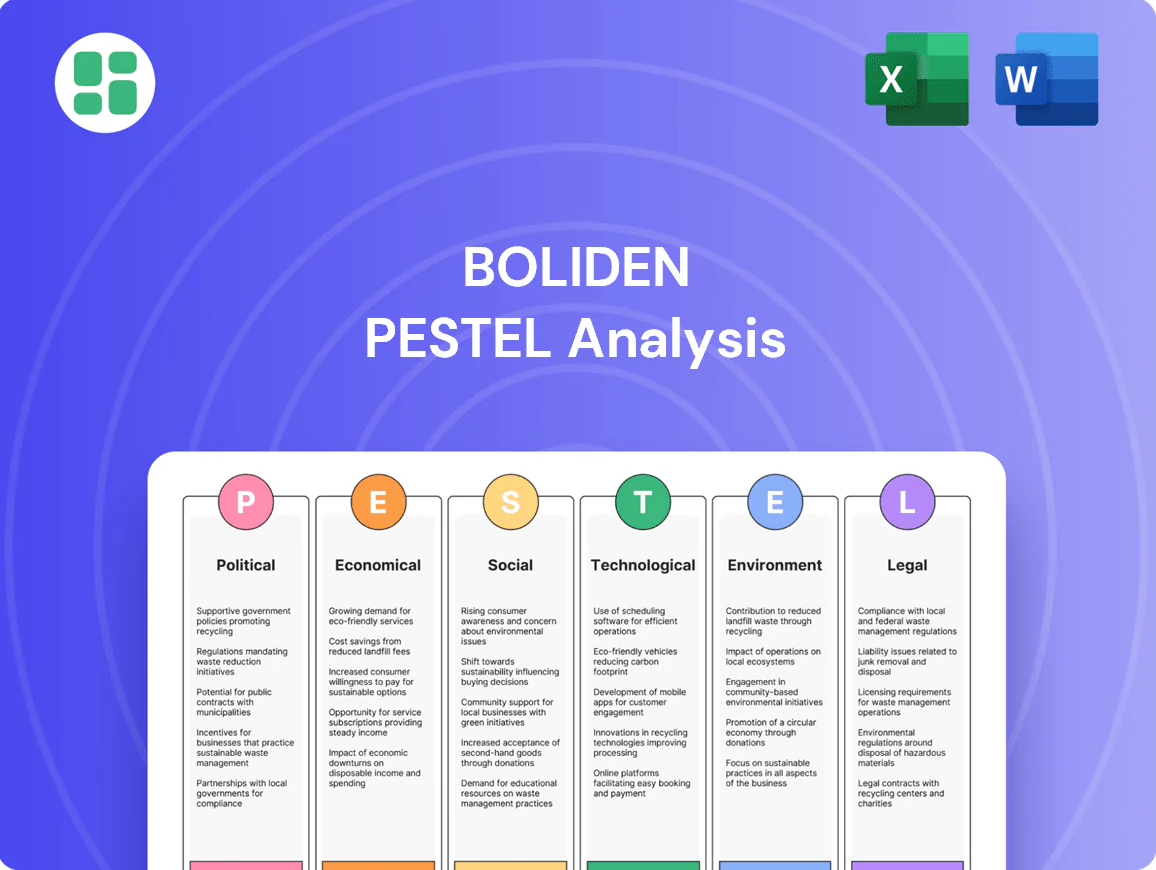
The preview shown here is the exact document you’ll receive after purchase—fully formatted and ready to use. This comprehensive Boliden PESTLE analysis details the Political, Economic, Social, Technological, Legal, and Environmental factors impacting the company's operations and strategic decisions. You'll gain a deep understanding of the external forces shaping Boliden's future.

Original: $10.00
-70%$10.00
$3.00Product Information
Product Information
Shipping & Returns
Shipping & Returns
Description
Plan Smarter. Present Sharper. Compete Stronger.
Uncover the critical political, economic, social, technological, environmental, and legal forces shaping Boliden's future. Our expert-crafted PESTLE analysis provides the deep-dive insights you need to anticipate market shifts and capitalize on opportunities. Download the full version now and gain a decisive competitive advantage.
Political factors
Government Policy and Mining Regulations
Boliden operates within politically stable Nordic countries and Ireland, yet mining is inherently subject to stringent regulations. Shifts in government policies concerning permitting, environmental standards, or taxation can significantly influence the feasibility and cost of exploration and development initiatives. For instance, any tightening of environmental regulations could increase operational expenses or delay project timelines.
The European Union's Critical Raw Materials Act, effective from May 2024, is a significant development. This act is designed to expedite mining project approvals and reduce the EU's reliance on imports for key materials. This regulatory push could create favorable conditions for Boliden's European-based projects, potentially accelerating their development and enhancing their competitive positioning within the bloc.
Trade Policies and Tariffs
Boliden's profitability is directly influenced by global trade policies and the imposition of tariffs on metals. As a significant producer of essential raw materials like copper, zinc, and nickel, the company's access to international markets and its cost structure are highly sensitive to shifts in trade relations and agreements between nations.
For instance, increased protectionist measures or the introduction of new trade barriers by major economies could lead to higher import duties on Boliden's products, thereby increasing operational costs and potentially limiting market access. This could directly impact sales volumes and overall revenue streams for the company, especially in key export markets.
In 2024, the global trade landscape continues to be shaped by geopolitical tensions and a trend towards regionalization. The World Trade Organization (WTO) reported a slowdown in global trade growth projections for the year, citing these very factors. Boliden, with its substantial export operations, must navigate these complexities, as any significant tariff increases could add millions to its cost of goods sold.
Geopolitical Stability in Operating Regions
Boliden’s primary operating regions in the Nordic countries and Ireland generally offer a high degree of political stability, which is a significant advantage. However, even in these stable environments, broader geopolitical tensions can ripple through global supply chains and impact the demand for the metals Boliden produces. For instance, increased political instability in regions crucial for mining equipment manufacturing or key consumer markets could indirectly affect Boliden's operational costs and sales volumes.
Disruptions stemming from geopolitical events elsewhere, such as trade disputes or regional conflicts, can lead to volatility in global metal prices. This volatility directly influences the profitability of Boliden's mining and smelting operations. Furthermore, such global instability might also affect the availability and cost of essential raw materials or components needed for Boliden's production processes, necessitating agile supply chain management.
Government Support for Green Transition
Governments across Europe are actively championing the green transition, a significant tailwind for Boliden. This policy drive directly boosts demand for essential metals like copper, nickel, and zinc, which are core to Boliden's product portfolio. For instance, the EU's ambitious targets for renewable energy deployment and electric vehicle adoption, supported by substantial funding initiatives, are creating a robust market for these materials.
Policies focused on expanding renewable energy infrastructure, such as wind and solar farms, and promoting electric mobility are key drivers. These sectors rely heavily on metals for components like batteries, wiring, and charging infrastructure. Boliden's strategic alignment with sustainable mining practices and its commitment to low-carbon metal production positions it favorably to capitalize on this escalating demand, as evidenced by the growing market share of green-certified metals.
- Increased Demand: European governments' green transition policies are projected to increase demand for copper by an estimated 15% and nickel by 10% by 2025, according to industry forecasts.
- Policy Alignment: Boliden's focus on producing metals with a lower carbon footprint aligns with the EU's Green Deal objectives, potentially leading to preferential market access and incentives.
- Investment in Renewables: Significant public investment in renewable energy projects across the EU, reaching hundreds of billions of euros annually, directly translates to higher consumption of key metals.
Labor Relations and Strikes
Labor relations and the potential for strikes represent a significant political risk for companies like Boliden. For instance, labor disputes in Finland during Q1 2025 directly impacted Boliden's operating profit, highlighting the sensitivity of operations to industrial action. Maintaining positive relationships with worker unions is therefore paramount for ensuring consistent operational stability and productivity.
Effective management of industrial relations is key to mitigating the financial and operational disruptions that can arise from labor disputes. Boliden's experience underscores the importance of proactive engagement with unions to secure favorable agreements.
- Labor disputes in Finland affected Boliden's Q1 2025 operating profit.
- Agreements with worker unions are critical for operational continuity.
- Strong industrial relations help prevent costly disruptions.
Boliden's Path: Shaped by Policy, Trade, and Labor Dynamics
Boliden's operational stability is closely tied to government policies regarding mining, environmental standards, and taxation, particularly within its Nordic and Irish operating bases. The EU's Critical Raw Materials Act, effective May 2024, aims to streamline mining approvals and reduce import dependency, potentially benefiting Boliden's European projects.
Global trade policies and tariffs directly impact Boliden's profitability, as its metal exports are sensitive to international trade relations. Geopolitical tensions in 2024 are influencing global trade, with the WTO projecting slower growth, which could increase Boliden's costs through tariffs.
European green transition policies are a significant driver for Boliden, increasing demand for copper, nickel, and zinc due to renewable energy and electric vehicle expansion. Industry forecasts suggest a 15% rise in copper demand and 10% for nickel by 2025, aligning with Boliden's low-carbon production focus.
Labor relations remain a key political factor, with Q1 2025 labor disputes in Finland impacting Boliden's operating profit, underscoring the need for strong industrial relations to ensure operational continuity.
What is included in the product
Detailed Word Document
This Boliden PESTLE analysis examines the external macro-environmental factors impacting the company across Political, Economic, Social, Technological, Environmental, and Legal dimensions.
It provides actionable insights for strategic decision-making by highlighting opportunities and threats derived from current trends and market dynamics.
Customizable Excel Spreadsheet
A clear, actionable summary of the Boliden PESTLE analysis, highlighting key external factors impacting the mining sector, thereby alleviating concerns about navigating complex market dynamics.
Economic factors
Global Metal Prices and Demand
Boliden's financial health is intrinsically linked to the volatile global markets for key metals like zinc, copper, lead, and gold. These price swings directly impact the company's revenue and profitability.
In the first quarter of 2025, Boliden saw a positive boost from elevated metal prices and a strong US dollar, which bolstered its financial results. However, the second quarter of 2025 experienced a negative impact from a weakening US dollar, highlighting the currency's influence.
The demand for these essential metals is largely dictated by robust growth in crucial sectors. Industries such as construction, the ever-expanding electronics market, and the burgeoning electric vehicle industry are significant drivers of metal consumption.
Currency Exchange Rate Fluctuations
Boliden's international operations mean currency exchange rate fluctuations, especially between the Swedish Krona (SEK) and the US Dollar (USD), are a significant factor. A weaker USD, for instance, can directly reduce the value of Boliden's USD-denominated sales when converted back to SEK, impacting both top-line revenue and profitability.
For example, if Boliden's revenue in Q2 2025 was heavily reliant on USD sales and the dollar weakened against the SEK, this would translate to lower reported earnings in krona terms. Effective currency risk management is therefore essential for Boliden's financial health and predictability.
Inflation and Energy Costs
Inflationary pressures in 2024 and early 2025 continue to impact Boliden's operating expenses, particularly for energy, labor, and raw material inputs crucial for its mining and smelting activities. While a more favorable energy price outlook contributed to the decision to restart the Tara mine, persistent elevated energy costs remain a significant factor that could affect overall profitability.
Interest Rates and Access to Capital
Fluctuations in interest rates directly impact Boliden's cost of capital, influencing decisions on major investments and potential acquisitions. For instance, the company's ability to secure favorable financing for significant operations like the expansion of the Kevitsa mine or the ongoing development at the Aitik mine is directly tied to the prevailing interest rate environment. As of early 2024, global central banks have maintained relatively stable, though watchful, interest rate policies, providing a degree of predictability for borrowing costs.
Maintaining access to long-term financing at competitive rates is crucial for Boliden's strategic expansion and for managing its financial leverage. A healthy net debt to equity ratio, which stood at approximately 0.4x at the end of 2023, demonstrates the importance of managing debt effectively. This allows the company to pursue growth opportunities, such as potential exploration projects or upgrades to existing facilities, without unduly burdening its balance sheet.
The cost of borrowing influences Boliden's profitability and its capacity for reinvestment. Higher interest rates can increase the expense of servicing existing debt and make new capital-intensive projects less attractive. Conversely, lower rates can reduce financing costs, freeing up capital for dividends, share buybacks, or further investment in exploration and production capacity, especially as the company looks to capitalize on demand for metals like copper and zinc in the coming years.
- Interest Rate Impact: Changes in benchmark interest rates, such as those set by the European Central Bank or the US Federal Reserve, directly affect Boliden's borrowing costs.
- Financing for Growth: Access to long-term, affordable capital is essential for funding significant projects, including mine development and potential acquisitions, to ensure sustained growth.
- Debt Management: Boliden's net debt to equity ratio, around 0.4x in late 2023, highlights the need for prudent debt management, which is influenced by interest rate levels.
- Investment Attractiveness: Interest rates play a key role in determining the economic viability of new capital expenditures and the overall cost of doing business for Boliden.
Economic Growth in Key Markets
The economic health of sectors that use Boliden's metals, like construction, automotive (particularly electric vehicles), and electronics, significantly impacts demand. For instance, the global automotive industry, a major consumer of copper and zinc, saw a projected 2.1% growth in 2024, according to Statista, indicating a steady demand base for Boliden.
Robust economic expansion in Boliden's key markets, especially Europe, fuels higher metal consumption and boosts the company's sales volumes. In 2024, the Eurozone's GDP was forecast to grow by 0.7%, a modest but positive indicator for industrial activity and material demand.
- Construction Sector Demand: Global construction output was expected to rise by 2.5% in 2024, driving demand for metals like copper used in wiring and plumbing.
- Automotive Industry Trends: The increasing production of electric vehicles, which use substantially more copper than internal combustion engine vehicles, presents a significant growth opportunity.
- Electronics Market Growth: The global consumer electronics market, projected for steady growth in 2024-2025, relies on metals like copper and zinc for its products.
- European Economic Outlook: A stable or growing European economy directly translates to higher industrial production and, consequently, greater demand for Boliden's metal products.
Economic Dynamics: Shaping Metal Company's Financials
Boliden's financial performance is heavily influenced by global economic conditions, particularly metal prices and currency exchange rates. Elevated prices and a strong US dollar positively impacted Boliden in early 2025, but a weakening dollar later in the quarter presented a headwind.
Inflationary pressures in 2024 and early 2025 have increased operating expenses for Boliden, especially for energy and raw materials. Interest rate fluctuations also affect the company's cost of capital, influencing investment decisions and debt management, with a net debt to equity ratio around 0.4x at the end of 2023.
Demand for Boliden's metals is tied to growth in key sectors like construction, automotive (especially EVs), and electronics. For example, global construction output was expected to rise by 2.5% in 2024, supporting demand for copper, while the automotive industry saw projected 2.1% growth in 2024.
| Economic Factor | 2024/2025 Data Point | Impact on Boliden |
|---|---|---|
| Metal Prices | Volatile, with Q1 2025 seeing elevated prices | Directly impacts revenue and profitability |
| US Dollar Strength | Strong in Q1 2025, weakened later | Affects value of USD-denominated sales |
| Inflation | Persistent pressure on operating costs | Increases expenses for energy, labor, materials |
| Interest Rates | Relatively stable as of early 2024 | Influences cost of capital and investment decisions |
| Global GDP Growth (Eurozone) | Forecasted 0.7% in 2024 | Modest growth supports industrial activity and metal demand |
| Global Construction Output | Expected 2.5% rise in 2024 | Drives demand for copper and other construction metals |
| Global Automotive Industry Growth | Projected 2.1% in 2024 | Boosts demand for copper and zinc, especially from EVs |
Full Version Awaits
Boliden PESTLE Analysis
The preview shown here is the exact document you’ll receive after purchase—fully formatted and ready to use. This comprehensive Boliden PESTLE analysis details the Political, Economic, Social, Technological, Legal, and Environmental factors impacting the company's operations and strategic decisions. You'll gain a deep understanding of the external forces shaping Boliden's future.