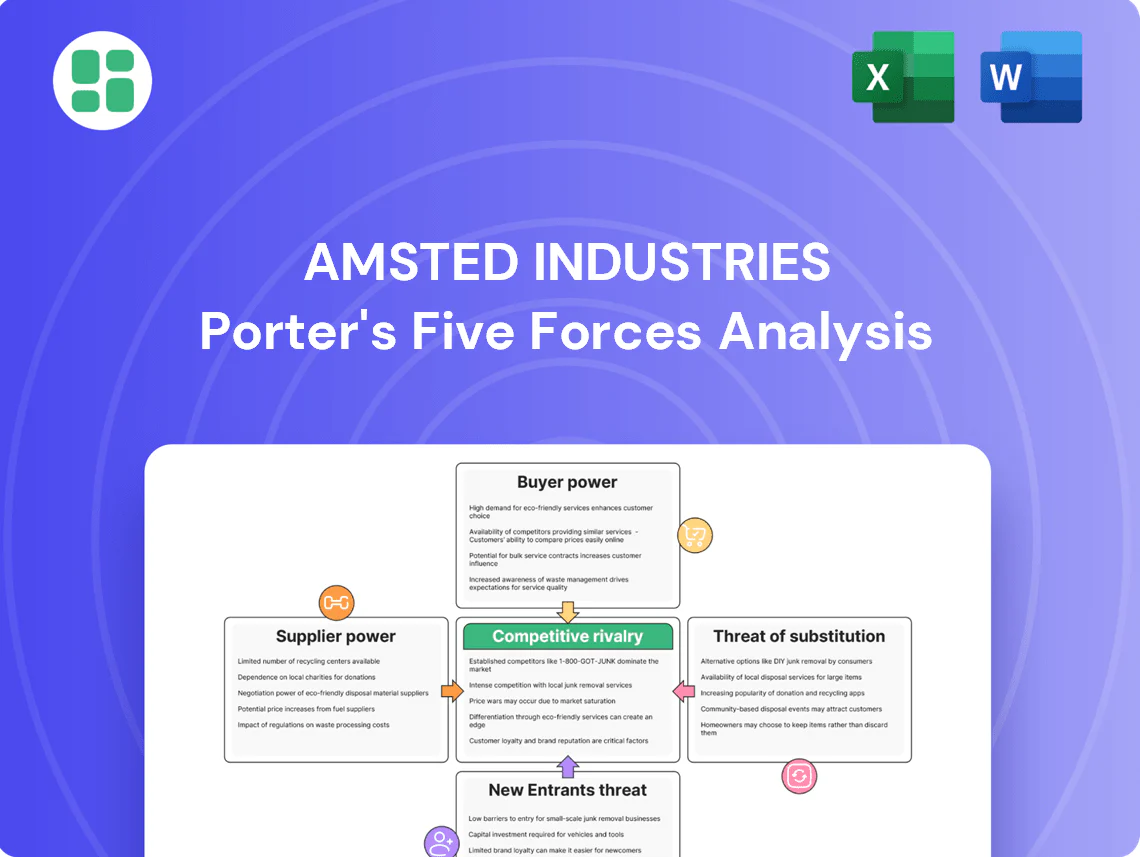
Amsted Industries Porter's Five Forces Analysis

Don't Miss the Bigger Picture
Amsted Industries navigates a landscape shaped by moderate bargaining power of buyers and suppliers, with the threat of substitutes being a significant consideration.
The intensity of rivalry within its sectors is notable, while the threat of new entrants presents a dynamic challenge to its market position.
This brief snapshot only scratches the surface. Unlock the full Porter's Five Forces Analysis to explore Amsted Industries’s competitive dynamics, market pressures, and strategic advantages in detail.
Suppliers Bargaining Power

Supplier Concentration and Specialization
Amsted Industries depends on suppliers for essential raw materials such as steel, specialized components, and sophisticated manufacturing machinery. The leverage these suppliers hold can be significant if their numbers are limited or if they provide highly specialized inputs that are indispensable for Amsted's engineered products.
Considering Amsted's emphasis on heavy-duty and precision parts, it's likely that certain raw materials or proprietary technologies originate from a concentrated group of suppliers. For instance, the global steel market, while large, can exhibit concentrated power among major producers, especially for specific grades required for demanding applications.
Switching Costs for Amsted
Amsted faces considerable switching costs when changing suppliers, particularly for specialized or integrated parts. These costs encompass retooling manufacturing equipment, the lengthy process of qualifying new materials, and the potential for significant production downtime. For instance, if Amsted relies on a supplier for a unique alloy used in its railcar components, the cost and time to find and vet an alternative supplier capable of meeting stringent quality and performance standards could be substantial.

Threat of Forward Integration by Suppliers
The threat of forward integration by suppliers is a factor Amsted Industries must consider, though it’s typically less pronounced for raw material providers. However, if specialized component manufacturers possess the capability and see a clear incentive, they could potentially move into Amsted's manufacturing or assembly stages to capture greater value. This possibility underscores the importance of nurturing robust supplier relationships and strategically diversifying the supplier pool to mitigate such risks.

Uniqueness of Inputs and Supplier Importance
The uniqueness of inputs significantly impacts supplier bargaining power. If Amsted Industries relies on specialized, patented, or proprietary components that are difficult to source elsewhere, those suppliers hold considerable sway. This is particularly true when these inputs are critical for the performance and differentiation of Amsted's industrial products.
Amsted's commitment to high-performance and durable components for demanding industrial applications underscores the importance of supplier reliability. The quality and consistency of these essential inputs directly affect Amsted's product integrity and reputation, granting suppliers a stronger negotiating position.
- Supplier Dependence: If Amsted requires highly specialized materials or components that only a few suppliers can provide, their bargaining power increases.
- Input Criticality: For products where supplier input quality directly dictates performance and safety, suppliers gain leverage.
- Lack of Substitutes: The absence of readily available substitute inputs strengthens a supplier's position.
Supplier's Share of Amsted's Costs
The bargaining power of suppliers for Amsted Industries is significantly influenced by their share of Amsted's total costs. When a supplier provides an input that constitutes a large portion of Amsted's expenses, that supplier gains considerable leverage. For instance, if steel prices, a critical raw material for Amsted's railcar components and other heavy machinery parts, experience sharp increases, suppliers of steel can exert greater influence over Amsted's purchasing decisions and profitability.
In 2024, the volatility of commodity markets, particularly for metals like steel, directly impacted manufacturers such as Amsted. Fluctuations in these input costs can dramatically shift the balance of power towards suppliers. For example, a sustained rise in global steel prices, driven by factors like increased demand or supply chain disruptions, would amplify the bargaining power of steel producers supplying Amsted.
- Supplier's Cost Share: The higher a supplier's input represents in Amsted's overall cost structure, the stronger their bargaining position.
- Raw Material Volatility: Fluctuations in the price of key inputs like steel directly affect Amsted's profitability and enhance supplier leverage.
- Impact on Profitability: Rising raw material costs can squeeze Amsted's margins, giving suppliers more power to dictate terms.
- Strategic Importance of Inputs: For critical components where Amsted has fewer alternative suppliers, supplier power is further amplified.
Amsted's Supplier Dynamics: Critical Inputs and Bargaining Power
Amsted Industries' suppliers hold significant bargaining power, particularly those providing specialized steel grades and critical components essential for its engineered products. In 2024, global steel prices saw considerable volatility, directly impacting Amsted's cost structure and empowering steel producers. For instance, a surge in the price of high-strength steel, a key input for Amsted's railcar components, would grant those suppliers greater leverage over Amsted's purchasing decisions.
The criticality of these inputs, coupled with Amsted's substantial switching costs for retooling and supplier qualification, further bolsters supplier influence. If a supplier provides a unique alloy or patented technology, its bargaining power is amplified due to the lack of readily available substitutes.
The concentration of suppliers for specialized machinery also contributes to their leverage. Amsted's reliance on these sophisticated inputs means that a limited number of manufacturers can dictate terms, especially when these machines are vital for maintaining Amsted's production quality and efficiency.
| Factor | Impact on Amsted Industries | 2024 Context/Example |
|---|---|---|
| Supplier Concentration | Limited suppliers for specialized inputs increase their power. | Few manufacturers produce highly specialized alloys or advanced machinery. |
| Switching Costs | High costs to change suppliers strengthen existing relationships. | Retooling, material qualification, and potential downtime are significant deterrents. |
| Input Criticality | Essential, high-quality inputs give suppliers leverage. | Performance and safety of railcar parts depend on specific material grades. |
| Cost Share of Input | Suppliers providing a large portion of Amsted's costs have more influence. | Steel prices, a major cost component, directly affect Amsted's margins. |
What is included in the product
 Detailed Word Document
This analysis details the competitive forces impacting Amsted Industries, examining supplier and buyer power, the threat of new entrants and substitutes, and the intensity of rivalry within its diverse industrial markets.

 Customizable Excel Spreadsheet
Amsted Industries' Porter's Five Forces analysis provides a clear, one-sheet summary of all five forces—perfect for quick decision-making and understanding competitive pressures.
Customers Bargaining Power

Customer Concentration and Purchase Volume
Amsted Industries operates in sectors like rail, automotive, and construction, meaning its customers are often large, sophisticated industrial players. For instance, major railroad operators and vehicle manufacturers are key buyers, and their substantial purchase volumes grant them considerable leverage. This means they can often negotiate favorable pricing and contract terms, directly impacting Amsted's profitability.
Customer Switching Costs
Customer switching costs for Amsted Industries' engineered solutions are a mixed bag, impacting their bargaining power. For highly specialized or custom-designed components, like those integrated into critical aerospace or automotive systems, the effort and expense involved in re-engineering and re-qualifying new suppliers can be substantial, creating high switching costs for customers. This limits their ability to easily switch away from Amsted.
However, for more standardized or commoditized parts within Amsted's portfolio, customers likely face lower switching costs. In these instances, if pricing or service levels become less competitive, customers may find it relatively straightforward to source similar components from alternative manufacturers, thereby increasing their bargaining power.

Threat of Backward Integration by Customers
Large customers, especially those with substantial manufacturing expertise, can exert pressure by considering backward integration. This means they might start producing components in-house if Amsted's pricing or contract terms become unfavorable. For instance, a major automotive manufacturer, a significant customer for many industrial suppliers, could potentially develop its own capabilities for certain components if the cost-benefit analysis favors it.

Product Differentiation and Importance to Customers
Amsted Industries' product differentiation, particularly through superior engineering and quality, directly impacts customer bargaining power. When Amsted's offerings are perceived as unique and essential, customers have fewer viable alternatives, thereby diminishing their leverage.
The criticality of Amsted's components to a customer's end product's safety, efficiency, or distinctiveness further insulates the company from price pressures. For instance, if Amsted supplies specialized castings for high-performance railcars, the customer's reliance on that specific quality and reliability reduces their ability to negotiate lower prices.
- Superior Engineering: Amsted's commitment to advanced engineering reduces the availability of direct substitutes.
- Quality and Performance: High-quality components build customer loyalty and reduce price sensitivity.
- Criticality to End Products: When Amsted's parts are vital for safety or performance, customers are less likely to switch based on price alone.
- Reduced Price Sensitivity: This reliance on Amsted's specialized products limits customers' bargaining power.
Customer Price Sensitivity
Customer price sensitivity is a significant factor for Amsted Industries, especially in its industrial markets. When customers themselves face intense competition, they tend to scrutinize costs more closely. This means Amsted’s pricing strategy needs to be carefully considered, as customers might switch suppliers if they find a lower-cost alternative, particularly if the perceived difference between suppliers is minimal.
This sensitivity is amplified when Amsted’s components constitute a substantial percentage of a customer's total production expenses. For instance, if a key component from Amsted makes up 15% or more of a customer’s final product cost, even small price changes can have a noticeable impact on the customer's profitability. This was evident in the automotive sector in late 2023 and early 2024, where rising input costs for manufacturers led to increased pressure on their component suppliers.
- High Price Sensitivity in Industrial Markets: Customers in industrial sectors are often driven by cost efficiency due to their own competitive landscapes.
- Impact of Component Cost Share: If Amsted's products represent a large portion of a customer's overall cost, price becomes a more critical decision factor.
- Supplier Differentiation Matters: Low perceived differentiation among suppliers intensifies customer focus on price.
- Market Trends: The automotive industry, a key market for many industrial suppliers, experienced significant cost pressures in late 2023 and early 2024, highlighting customer price sensitivity.
Industrial Buyers: Shaping Amsted's Profitability
The bargaining power of customers for Amsted Industries is significant, particularly with large, industrial clients in sectors like rail and automotive. These buyers, such as major railroad operators and vehicle manufacturers, leverage their substantial purchase volumes to negotiate favorable pricing and contract terms, directly impacting Amsted's profitability. For example, in 2024, the automotive sector continued to face inflationary pressures, leading manufacturers to exert stronger cost controls on their suppliers.
Switching costs for Amsted's customers vary; highly specialized, custom-engineered components create high switching costs due to re-engineering and re-qualification needs, limiting customer leverage. Conversely, for more standardized parts, lower switching costs allow customers to more readily switch suppliers if Amsted's pricing or service becomes less competitive. This dynamic was observed in the rail sector where some component sourcing saw increased competition in early 2024.
Customers' ability to consider backward integration, producing components in-house, also serves as a pressure point, especially for large automotive manufacturers. Amsted's product differentiation through superior engineering and quality is crucial in mitigating this power. When Amsted's offerings are perceived as unique and essential, customers have fewer alternatives, reducing their ability to negotiate aggressively on price. For instance, Amsted's specialized rail components, critical for safety, limit customer price concessions.
| Customer Segment | Key Influence Factor | Impact on Amsted | Example Scenario (2024) |
|---|---|---|---|
| Major Railroad Operators | High Purchase Volume | Stronger Price Negotiation Power | Negotiating bulk discounts on specialized castings for new rolling stock orders. |
| Automotive Manufacturers | Price Sensitivity & Input Cost Pressure | Increased scrutiny on supplier pricing | Pressuring suppliers for cost reductions amidst rising raw material costs impacting vehicle production. |
| Customers of Standardized Parts | Low Switching Costs | Potential for supplier switching based on price | Easily sourcing generic fasteners from alternative suppliers if Amsted's pricing is not competitive. |
| Customers of Critical Components | High Switching Costs & Product Criticality | Reduced Price Sensitivity | Reliance on Amsted's high-performance, safety-critical components for aerospace applications, limiting price negotiation. |
What You See Is What You Get
Amsted Industries Porter's Five Forces Analysis
This preview shows the exact document you'll receive immediately after purchase—no surprises, no placeholders. You'll gain a comprehensive understanding of Amsted Industries' competitive landscape through a detailed Porter's Five Forces analysis, examining the bargaining power of buyers and suppliers, the threat of new entrants and substitutes, and the intensity of rivalry within its industries.

Original: $10.00
-70%$10.00
$3.00Product Information
Product Information
Shipping & Returns
Shipping & Returns
Description
Don't Miss the Bigger Picture
Amsted Industries navigates a landscape shaped by moderate bargaining power of buyers and suppliers, with the threat of substitutes being a significant consideration.
The intensity of rivalry within its sectors is notable, while the threat of new entrants presents a dynamic challenge to its market position.
This brief snapshot only scratches the surface. Unlock the full Porter's Five Forces Analysis to explore Amsted Industries’s competitive dynamics, market pressures, and strategic advantages in detail.
Suppliers Bargaining Power
Supplier Concentration and Specialization
Amsted Industries depends on suppliers for essential raw materials such as steel, specialized components, and sophisticated manufacturing machinery. The leverage these suppliers hold can be significant if their numbers are limited or if they provide highly specialized inputs that are indispensable for Amsted's engineered products.
Considering Amsted's emphasis on heavy-duty and precision parts, it's likely that certain raw materials or proprietary technologies originate from a concentrated group of suppliers. For instance, the global steel market, while large, can exhibit concentrated power among major producers, especially for specific grades required for demanding applications.
Switching Costs for Amsted
Amsted faces considerable switching costs when changing suppliers, particularly for specialized or integrated parts. These costs encompass retooling manufacturing equipment, the lengthy process of qualifying new materials, and the potential for significant production downtime. For instance, if Amsted relies on a supplier for a unique alloy used in its railcar components, the cost and time to find and vet an alternative supplier capable of meeting stringent quality and performance standards could be substantial.
Threat of Forward Integration by Suppliers
The threat of forward integration by suppliers is a factor Amsted Industries must consider, though it’s typically less pronounced for raw material providers. However, if specialized component manufacturers possess the capability and see a clear incentive, they could potentially move into Amsted's manufacturing or assembly stages to capture greater value. This possibility underscores the importance of nurturing robust supplier relationships and strategically diversifying the supplier pool to mitigate such risks.
Uniqueness of Inputs and Supplier Importance
The uniqueness of inputs significantly impacts supplier bargaining power. If Amsted Industries relies on specialized, patented, or proprietary components that are difficult to source elsewhere, those suppliers hold considerable sway. This is particularly true when these inputs are critical for the performance and differentiation of Amsted's industrial products.
Amsted's commitment to high-performance and durable components for demanding industrial applications underscores the importance of supplier reliability. The quality and consistency of these essential inputs directly affect Amsted's product integrity and reputation, granting suppliers a stronger negotiating position.
- Supplier Dependence: If Amsted requires highly specialized materials or components that only a few suppliers can provide, their bargaining power increases.
- Input Criticality: For products where supplier input quality directly dictates performance and safety, suppliers gain leverage.
- Lack of Substitutes: The absence of readily available substitute inputs strengthens a supplier's position.
Supplier's Share of Amsted's Costs
The bargaining power of suppliers for Amsted Industries is significantly influenced by their share of Amsted's total costs. When a supplier provides an input that constitutes a large portion of Amsted's expenses, that supplier gains considerable leverage. For instance, if steel prices, a critical raw material for Amsted's railcar components and other heavy machinery parts, experience sharp increases, suppliers of steel can exert greater influence over Amsted's purchasing decisions and profitability.
In 2024, the volatility of commodity markets, particularly for metals like steel, directly impacted manufacturers such as Amsted. Fluctuations in these input costs can dramatically shift the balance of power towards suppliers. For example, a sustained rise in global steel prices, driven by factors like increased demand or supply chain disruptions, would amplify the bargaining power of steel producers supplying Amsted.
- Supplier's Cost Share: The higher a supplier's input represents in Amsted's overall cost structure, the stronger their bargaining position.
- Raw Material Volatility: Fluctuations in the price of key inputs like steel directly affect Amsted's profitability and enhance supplier leverage.
- Impact on Profitability: Rising raw material costs can squeeze Amsted's margins, giving suppliers more power to dictate terms.
- Strategic Importance of Inputs: For critical components where Amsted has fewer alternative suppliers, supplier power is further amplified.
Amsted's Supplier Dynamics: Critical Inputs and Bargaining Power
Amsted Industries' suppliers hold significant bargaining power, particularly those providing specialized steel grades and critical components essential for its engineered products. In 2024, global steel prices saw considerable volatility, directly impacting Amsted's cost structure and empowering steel producers. For instance, a surge in the price of high-strength steel, a key input for Amsted's railcar components, would grant those suppliers greater leverage over Amsted's purchasing decisions.
The criticality of these inputs, coupled with Amsted's substantial switching costs for retooling and supplier qualification, further bolsters supplier influence. If a supplier provides a unique alloy or patented technology, its bargaining power is amplified due to the lack of readily available substitutes.
The concentration of suppliers for specialized machinery also contributes to their leverage. Amsted's reliance on these sophisticated inputs means that a limited number of manufacturers can dictate terms, especially when these machines are vital for maintaining Amsted's production quality and efficiency.
| Factor | Impact on Amsted Industries | 2024 Context/Example |
|---|---|---|
| Supplier Concentration | Limited suppliers for specialized inputs increase their power. | Few manufacturers produce highly specialized alloys or advanced machinery. |
| Switching Costs | High costs to change suppliers strengthen existing relationships. | Retooling, material qualification, and potential downtime are significant deterrents. |
| Input Criticality | Essential, high-quality inputs give suppliers leverage. | Performance and safety of railcar parts depend on specific material grades. |
| Cost Share of Input | Suppliers providing a large portion of Amsted's costs have more influence. | Steel prices, a major cost component, directly affect Amsted's margins. |
What is included in the product
Detailed Word Document
This analysis details the competitive forces impacting Amsted Industries, examining supplier and buyer power, the threat of new entrants and substitutes, and the intensity of rivalry within its diverse industrial markets.
Customizable Excel Spreadsheet
Amsted Industries' Porter's Five Forces analysis provides a clear, one-sheet summary of all five forces—perfect for quick decision-making and understanding competitive pressures.
Customers Bargaining Power
Customer Concentration and Purchase Volume
Amsted Industries operates in sectors like rail, automotive, and construction, meaning its customers are often large, sophisticated industrial players. For instance, major railroad operators and vehicle manufacturers are key buyers, and their substantial purchase volumes grant them considerable leverage. This means they can often negotiate favorable pricing and contract terms, directly impacting Amsted's profitability.
Customer Switching Costs
Customer switching costs for Amsted Industries' engineered solutions are a mixed bag, impacting their bargaining power. For highly specialized or custom-designed components, like those integrated into critical aerospace or automotive systems, the effort and expense involved in re-engineering and re-qualifying new suppliers can be substantial, creating high switching costs for customers. This limits their ability to easily switch away from Amsted.
However, for more standardized or commoditized parts within Amsted's portfolio, customers likely face lower switching costs. In these instances, if pricing or service levels become less competitive, customers may find it relatively straightforward to source similar components from alternative manufacturers, thereby increasing their bargaining power.
Threat of Backward Integration by Customers
Large customers, especially those with substantial manufacturing expertise, can exert pressure by considering backward integration. This means they might start producing components in-house if Amsted's pricing or contract terms become unfavorable. For instance, a major automotive manufacturer, a significant customer for many industrial suppliers, could potentially develop its own capabilities for certain components if the cost-benefit analysis favors it.
Product Differentiation and Importance to Customers
Amsted Industries' product differentiation, particularly through superior engineering and quality, directly impacts customer bargaining power. When Amsted's offerings are perceived as unique and essential, customers have fewer viable alternatives, thereby diminishing their leverage.
The criticality of Amsted's components to a customer's end product's safety, efficiency, or distinctiveness further insulates the company from price pressures. For instance, if Amsted supplies specialized castings for high-performance railcars, the customer's reliance on that specific quality and reliability reduces their ability to negotiate lower prices.
- Superior Engineering: Amsted's commitment to advanced engineering reduces the availability of direct substitutes.
- Quality and Performance: High-quality components build customer loyalty and reduce price sensitivity.
- Criticality to End Products: When Amsted's parts are vital for safety or performance, customers are less likely to switch based on price alone.
- Reduced Price Sensitivity: This reliance on Amsted's specialized products limits customers' bargaining power.
Customer Price Sensitivity
Customer price sensitivity is a significant factor for Amsted Industries, especially in its industrial markets. When customers themselves face intense competition, they tend to scrutinize costs more closely. This means Amsted’s pricing strategy needs to be carefully considered, as customers might switch suppliers if they find a lower-cost alternative, particularly if the perceived difference between suppliers is minimal.
This sensitivity is amplified when Amsted’s components constitute a substantial percentage of a customer's total production expenses. For instance, if a key component from Amsted makes up 15% or more of a customer’s final product cost, even small price changes can have a noticeable impact on the customer's profitability. This was evident in the automotive sector in late 2023 and early 2024, where rising input costs for manufacturers led to increased pressure on their component suppliers.
- High Price Sensitivity in Industrial Markets: Customers in industrial sectors are often driven by cost efficiency due to their own competitive landscapes.
- Impact of Component Cost Share: If Amsted's products represent a large portion of a customer's overall cost, price becomes a more critical decision factor.
- Supplier Differentiation Matters: Low perceived differentiation among suppliers intensifies customer focus on price.
- Market Trends: The automotive industry, a key market for many industrial suppliers, experienced significant cost pressures in late 2023 and early 2024, highlighting customer price sensitivity.
Industrial Buyers: Shaping Amsted's Profitability
The bargaining power of customers for Amsted Industries is significant, particularly with large, industrial clients in sectors like rail and automotive. These buyers, such as major railroad operators and vehicle manufacturers, leverage their substantial purchase volumes to negotiate favorable pricing and contract terms, directly impacting Amsted's profitability. For example, in 2024, the automotive sector continued to face inflationary pressures, leading manufacturers to exert stronger cost controls on their suppliers.
Switching costs for Amsted's customers vary; highly specialized, custom-engineered components create high switching costs due to re-engineering and re-qualification needs, limiting customer leverage. Conversely, for more standardized parts, lower switching costs allow customers to more readily switch suppliers if Amsted's pricing or service becomes less competitive. This dynamic was observed in the rail sector where some component sourcing saw increased competition in early 2024.
Customers' ability to consider backward integration, producing components in-house, also serves as a pressure point, especially for large automotive manufacturers. Amsted's product differentiation through superior engineering and quality is crucial in mitigating this power. When Amsted's offerings are perceived as unique and essential, customers have fewer alternatives, reducing their ability to negotiate aggressively on price. For instance, Amsted's specialized rail components, critical for safety, limit customer price concessions.
| Customer Segment | Key Influence Factor | Impact on Amsted | Example Scenario (2024) |
|---|---|---|---|
| Major Railroad Operators | High Purchase Volume | Stronger Price Negotiation Power | Negotiating bulk discounts on specialized castings for new rolling stock orders. |
| Automotive Manufacturers | Price Sensitivity & Input Cost Pressure | Increased scrutiny on supplier pricing | Pressuring suppliers for cost reductions amidst rising raw material costs impacting vehicle production. |
| Customers of Standardized Parts | Low Switching Costs | Potential for supplier switching based on price | Easily sourcing generic fasteners from alternative suppliers if Amsted's pricing is not competitive. |
| Customers of Critical Components | High Switching Costs & Product Criticality | Reduced Price Sensitivity | Reliance on Amsted's high-performance, safety-critical components for aerospace applications, limiting price negotiation. |
What You See Is What You Get
Amsted Industries Porter's Five Forces Analysis
This preview shows the exact document you'll receive immediately after purchase—no surprises, no placeholders. You'll gain a comprehensive understanding of Amsted Industries' competitive landscape through a detailed Porter's Five Forces analysis, examining the bargaining power of buyers and suppliers, the threat of new entrants and substitutes, and the intensity of rivalry within its industries.