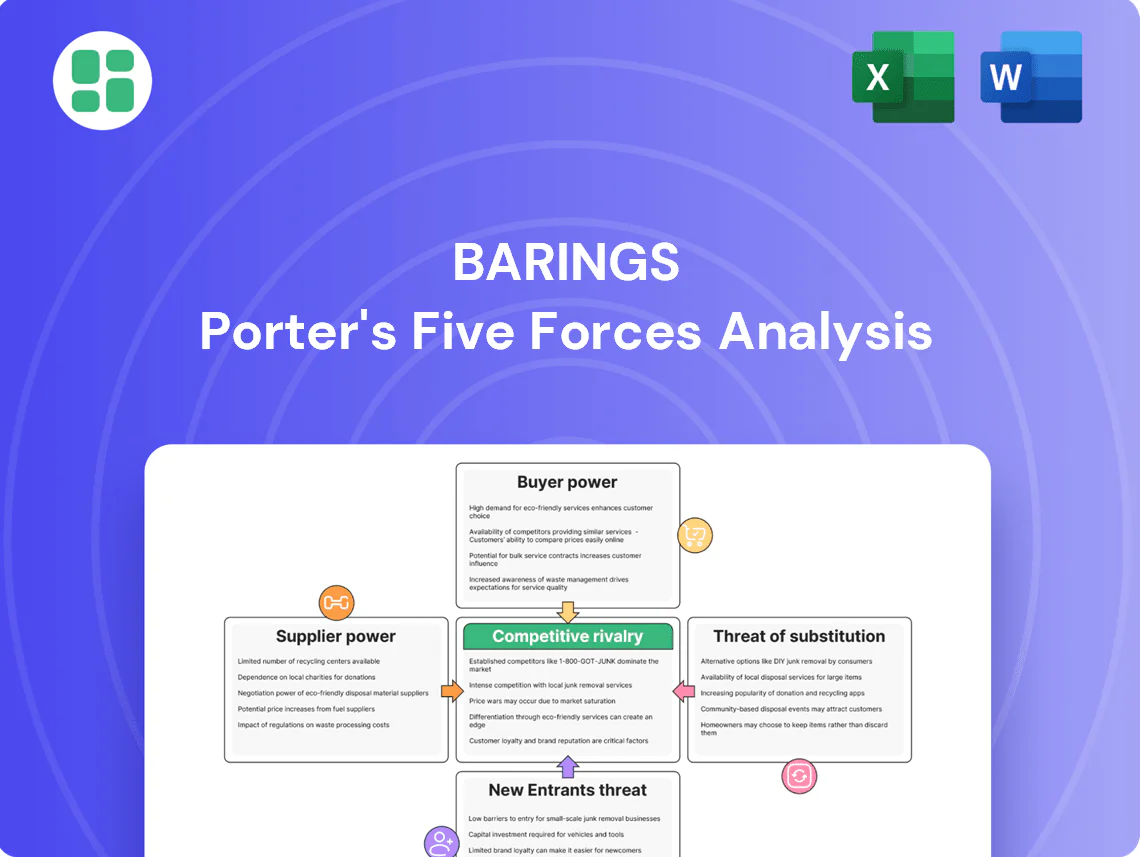
Barings Porter's Five Forces Analysis

Go Beyond the Preview—Access the Full Strategic Report
Barings's competitive landscape is shaped by the interplay of five key forces: the threat of new entrants, the bargaining power of buyers, the bargaining power of suppliers, the threat of substitute products or services, and the intensity of rivalry among existing competitors. Understanding these dynamics is crucial for any strategic decision-making.
This brief snapshot only scratches the surface. Unlock the full Porter's Five Forces Analysis to explore Barings’s competitive dynamics, market pressures, and strategic advantages in detail.
Suppliers Bargaining Power

Specialized Financial Data and Analytics Providers
Barings' reliance on specialized financial data and analytics providers means these suppliers can wield significant bargaining power. If their data is proprietary or offers a unique competitive advantage, Barings faces higher costs. For instance, a significant portion of the global financial data market is dominated by a few key players, allowing them to command premium pricing.
Highly Skilled Investment Professionals and Talent
The bargaining power of suppliers, particularly in the form of highly skilled investment professionals, is a significant factor for Barings. The asset management industry's intense competition for top talent means that experienced portfolio managers and analysts can command premium compensation packages and exert considerable influence over their working conditions. This demand for specialized expertise, especially in areas like alternative investments or quantitative analysis, directly impacts Barings' ability to attract and retain the talent essential for its active management strategies.
In 2024, the average compensation for a senior portfolio manager in the US asset management sector often exceeded $250,000 annually, with bonuses and profit-sharing further increasing total earnings. This high cost reflects the direct correlation between skilled talent and investment performance, giving these professionals substantial leverage. Barings, like its peers, must therefore offer competitive remuneration and compelling career growth to secure and keep these crucial individuals, as their departure can disrupt fund management and client relationships.

Technology and Software Vendors for Operations and Compliance
Technology and software vendors hold considerable sway over financial firms like Barings. These suppliers provide essential tools for trading platforms, risk assessment, client relationship management, and crucially, regulatory adherence. For instance, specialized software for intricate compliance reporting, like the EU's MiFID II or the US's Dodd-Frank Act, demands deep expertise, granting these vendors significant leverage. In 2024, the financial services sector continued to invest heavily in technology, with global IT spending projected to reach over $600 billion, highlighting the reliance on these specialized providers.
The bargaining power of these vendors is amplified by the substantial costs and operational disruptions associated with switching. Implementing new enterprise resource planning (ERP) systems or customer relationship management (CRM) software can take years and cost millions, making incumbent providers difficult to displace. This stickiness is particularly evident in areas like cybersecurity, where a breach could have catastrophic financial and reputational consequences, further solidifying the power of trusted, established software vendors.

Custody, Fund Administration, and Back-Office Service Providers
Custody, fund administration, and back-office service providers can wield significant bargaining power. While the market may appear to have numerous players, the specialized nature of these services, coupled with the substantial costs and risks involved in switching providers, grants existing suppliers considerable leverage. For a global investment manager like Barings, the efficiency and reliability of these outsourced operations are paramount for smooth functioning and regulatory compliance.
The bargaining power of these suppliers is amplified by several factors:
- High Switching Costs: Migrating complex operational data and processes to a new provider can be incredibly time-consuming and expensive, often running into millions of dollars for large asset managers.
- Specialized Expertise: These providers possess niche expertise in areas like regulatory reporting, trade settlement, and NAV calculation, which are critical and difficult to replicate internally or outsource to less specialized firms.
- Interdependence: Barings relies heavily on the accuracy and timeliness of these services to meet client obligations and regulatory deadlines. Any disruption can lead to significant reputational damage and financial penalties.
- Limited True Alternatives: Despite a large number of entities offering these services, the number of providers with the scale, technological infrastructure, and regulatory approvals required by a global investment manager is often more limited, concentrating power.
Research and Advisory Service Firms
Research and advisory service firms can wield significant bargaining power over entities like Barings, particularly when they offer specialized expertise or proprietary data. For instance, a boutique firm with unique insights into emerging markets or a specific alternative asset class might command higher fees, as their specialized knowledge is difficult to replicate internally. This is especially true if their research provides a distinct competitive edge, making Barings more dependent on their services.
The bargaining power of these suppliers can be seen as moderate to high. In 2024, the global market for financial research and advisory services was valued in the tens of billions of dollars, indicating a substantial industry with many players. However, the value of a specific firm's contribution is often tied to its uniqueness and the impact of its insights on investment decisions. For example, if a particular advisory service helps Barings identify a lucrative investment opportunity that generates substantial returns, the perceived value and thus the supplier's bargaining power increases.
- Unique Expertise: Firms offering specialized knowledge in niche markets or complex financial instruments hold stronger bargaining positions.
- Proprietary Data & Models: Exclusive access to unique datasets or analytical frameworks enhances a supplier's leverage.
- Competitive Advantage: Research that provides a tangible edge in investment performance increases reliance and bargaining power.
- Market Dynamics: The overall demand for specialized financial intelligence influences the pricing power of advisory firms.
Supplier Bargaining Power in Financial Services
Suppliers of specialized financial data and proprietary analytics can exert significant bargaining power over Barings. This is due to the critical nature of this data for competitive advantage and the concentrated nature of the data provider market. For example, in 2024, a few dominant firms controlled a substantial portion of global financial data, enabling premium pricing.
Highly skilled investment professionals, such as portfolio managers, represent another powerful supplier group. The intense competition for top talent in asset management, particularly in niche areas like alternative investments, allows these individuals to command high compensation and favorable terms. In 2024, senior portfolio manager compensation in the US frequently surpassed $250,000 annually, underscoring their leverage.
Technology and software vendors also hold considerable sway, providing essential tools for trading, risk management, and regulatory compliance. The high costs and operational risks associated with switching these critical systems, such as specialized compliance software, make incumbent providers difficult to replace. Global IT spending in financial services exceeded $600 billion in 2024, highlighting this reliance.
| Supplier Type | Bargaining Power Factor | Example Impact | 2024 Data Point |
|---|---|---|---|
| Data Providers | Proprietary data, market concentration | Higher subscription costs | Few key players dominate global financial data market |
| Skilled Professionals | High demand, specialized skills | Increased compensation demands | Senior portfolio manager salaries >$250k annually (US) |
| Tech Vendors | High switching costs, critical systems | Vendor lock-in, premium pricing | Financial services IT spending >$600 billion globally |
What is included in the product
 Detailed Word Document
Uncovers key drivers of competition, customer influence, and market entry risks tailored to Barings' financial services environment.

 Customizable Excel Spreadsheet
Effortlessly visualize competitive intensity with a dynamic, interactive dashboard that highlights key pressure points across all five forces.
Customers Bargaining Power

Large Institutional Clients and Negotiating Power
Barings' significant institutional clients, like pension funds and insurance companies, manage immense capital. This scale inherently grants them considerable negotiating power.
These large clients can leverage their substantial assets to demand lower management fees and highly customized investment strategies, directly impacting Barings' profitability and operational focus.
Their capacity to shift large volumes of assets provides significant leverage, allowing them to influence reporting standards and service level agreements, thereby shaping the terms of their relationship with Barings.
Availability of Numerous Alternative Investment Managers
The sheer number of investment managers available significantly empowers customers. Clients can choose from large global asset management firms, niche boutique funds, and even low-cost passive investment vehicles like ETFs. For instance, as of early 2024, the global ETF market alone held over $11 trillion in assets, showcasing the vast array of accessible investment options.
This abundance of alternatives means clients can readily switch managers if they find better performance, lower fees, or superior service elsewhere. This ease of switching directly translates into increased bargaining power for customers, forcing investment firms to compete more aggressively on these fronts.
Consequently, firms like Barings must consistently prove their value proposition. This involves demonstrating strong investment performance, competitive fee structures, and exceptional client service to retain their existing client base and attract new ones in a crowded marketplace.

Sensitivity to Fees and Performance Scrutiny
Clients today are highly attuned to both the costs associated with investment management and the actual results delivered. This heightened awareness means that firms like Barings must consistently demonstrate value to retain business.
The asset management sector has seen significant fee compression, with industry-wide average management fees for equity funds dropping to around 0.45% by the end of 2023, according to industry reports. This trend forces clients to demand competitive pricing, particularly when investment strategies fail to beat their respective benchmarks.
Barings, therefore, operates under continuous pressure to validate its fee structure by delivering robust and consistent investment performance. Any perceived underperformance against market benchmarks can quickly lead clients to seek more cost-effective alternatives.

Sophistication and Financial Literacy of Client Base
Barings' client base, comprising sophisticated institutional investors and high-net-worth individuals, demonstrates a high degree of financial literacy. This informed clientele actively scrutinizes investment strategies and demands bespoke solutions, thereby increasing their bargaining power.
Their ability to critically assess Barings' offerings means clients are less likely to accept standardized products, instead seeking highly customized and efficient services. For instance, in 2024, a significant portion of Barings' assets under management came from institutional clients who often have dedicated teams evaluating investment managers.
- Informed Decision-Making: Clients can readily compare Barings' performance and fees against competitors.
- Demand for Customization: Sophisticated clients require tailored investment strategies, increasing operational complexity and service costs for Barings.
- Performance Scrutiny: A well-informed client base actively monitors portfolio returns, pressuring managers to deliver consistent outperformance.
- Fee Sensitivity: High financial literacy often correlates with a greater awareness and negotiation of management fees.
Relatively Low Client Switching Costs for Liquid Assets
The bargaining power of customers is relatively low for Barings when it comes to liquid assets due to low client switching costs. Clients can easily move their investments, such as publicly traded stocks and bonds, from one investment manager to another. This ease of transfer, often facilitated by digital platforms and standardized processes, means clients have significant leverage.
For instance, in 2024, the global asset management industry saw continued emphasis on fee compression, driven by client demand for lower costs. This trend underscores how clients can readily seek out managers offering more competitive fee structures. The ability to reallocate capital quickly based on performance, service quality, or fees directly enhances client bargaining power.
- Low Switching Costs: Clients face minimal financial penalties or complex procedures when moving liquid assets.
- Digital Facilitation: Online platforms and streamlined processes make transferring investments straightforward.
- Fee Sensitivity: Clients are empowered to seek better fee arrangements, pressuring managers to remain competitive.
- Performance Driven: Superior returns or service from a competitor can quickly draw assets away.
Empowered Clients Reshape Asset Management Dynamics
Barings' customers possess substantial bargaining power, largely driven by the sheer volume of assets they manage and their sophisticated understanding of financial markets. This allows them to negotiate favorable terms, including lower fees and highly customized investment solutions, directly impacting the firm's profitability.
The availability of numerous alternative investment managers, from global giants to niche boutiques, empowers clients to easily switch providers if they find better performance, lower costs, or superior service. For example, the global ETF market, exceeding $11 trillion in assets by early 2024, highlights the vast array of accessible investment options available to clients.
Clients are increasingly price-sensitive, with average equity fund management fees dropping to approximately 0.45% by the end of 2023. This trend forces firms like Barings to continuously justify their fee structures through strong, consistent investment performance to retain their client base.
The bargaining power of customers is amplified by low switching costs for liquid assets, enabling clients to readily move their investments between managers. This ease of transfer, often facilitated by digital platforms, gives clients significant leverage to seek out more competitive fee arrangements and better performance, as evidenced by the ongoing fee compression trend in the asset management industry throughout 2024.
| Factor | Impact on Barings | Supporting Data (as of early 2024) |
|---|---|---|
| Client Asset Size | High leverage for fee negotiation and customization demands. | Large institutional clients manage immense capital, granting significant negotiating power. |
| Availability of Alternatives | Pressure to differentiate on performance, fees, and service. | Global ETF market exceeded $11 trillion in assets, offering vast choices. |
| Client Financial Literacy | Demand for bespoke solutions and scrutiny of performance/fees. | Sophisticated clients actively assess strategies, often with dedicated evaluation teams. |
| Switching Costs (Liquid Assets) | Low costs empower clients to move assets easily. | Digital platforms and standardized processes facilitate quick asset reallocation. |
Preview the Actual Deliverable
Barings Porter's Five Forces Analysis
This preview showcases the complete Barings Porter's Five Forces analysis, providing a thorough examination of the competitive landscape. You're looking at the actual document; once purchased, you'll receive instant access to this exact, professionally formatted file, ready for immediate use.

Original: $10.00
-70%$10.00
$3.00Product Information
Product Information
Shipping & Returns
Shipping & Returns
Description
Go Beyond the Preview—Access the Full Strategic Report
Barings's competitive landscape is shaped by the interplay of five key forces: the threat of new entrants, the bargaining power of buyers, the bargaining power of suppliers, the threat of substitute products or services, and the intensity of rivalry among existing competitors. Understanding these dynamics is crucial for any strategic decision-making.
This brief snapshot only scratches the surface. Unlock the full Porter's Five Forces Analysis to explore Barings’s competitive dynamics, market pressures, and strategic advantages in detail.
Suppliers Bargaining Power
Specialized Financial Data and Analytics Providers
Barings' reliance on specialized financial data and analytics providers means these suppliers can wield significant bargaining power. If their data is proprietary or offers a unique competitive advantage, Barings faces higher costs. For instance, a significant portion of the global financial data market is dominated by a few key players, allowing them to command premium pricing.
Highly Skilled Investment Professionals and Talent
The bargaining power of suppliers, particularly in the form of highly skilled investment professionals, is a significant factor for Barings. The asset management industry's intense competition for top talent means that experienced portfolio managers and analysts can command premium compensation packages and exert considerable influence over their working conditions. This demand for specialized expertise, especially in areas like alternative investments or quantitative analysis, directly impacts Barings' ability to attract and retain the talent essential for its active management strategies.
In 2024, the average compensation for a senior portfolio manager in the US asset management sector often exceeded $250,000 annually, with bonuses and profit-sharing further increasing total earnings. This high cost reflects the direct correlation between skilled talent and investment performance, giving these professionals substantial leverage. Barings, like its peers, must therefore offer competitive remuneration and compelling career growth to secure and keep these crucial individuals, as their departure can disrupt fund management and client relationships.
Technology and Software Vendors for Operations and Compliance
Technology and software vendors hold considerable sway over financial firms like Barings. These suppliers provide essential tools for trading platforms, risk assessment, client relationship management, and crucially, regulatory adherence. For instance, specialized software for intricate compliance reporting, like the EU's MiFID II or the US's Dodd-Frank Act, demands deep expertise, granting these vendors significant leverage. In 2024, the financial services sector continued to invest heavily in technology, with global IT spending projected to reach over $600 billion, highlighting the reliance on these specialized providers.
The bargaining power of these vendors is amplified by the substantial costs and operational disruptions associated with switching. Implementing new enterprise resource planning (ERP) systems or customer relationship management (CRM) software can take years and cost millions, making incumbent providers difficult to displace. This stickiness is particularly evident in areas like cybersecurity, where a breach could have catastrophic financial and reputational consequences, further solidifying the power of trusted, established software vendors.
Custody, Fund Administration, and Back-Office Service Providers
Custody, fund administration, and back-office service providers can wield significant bargaining power. While the market may appear to have numerous players, the specialized nature of these services, coupled with the substantial costs and risks involved in switching providers, grants existing suppliers considerable leverage. For a global investment manager like Barings, the efficiency and reliability of these outsourced operations are paramount for smooth functioning and regulatory compliance.
The bargaining power of these suppliers is amplified by several factors:
- High Switching Costs: Migrating complex operational data and processes to a new provider can be incredibly time-consuming and expensive, often running into millions of dollars for large asset managers.
- Specialized Expertise: These providers possess niche expertise in areas like regulatory reporting, trade settlement, and NAV calculation, which are critical and difficult to replicate internally or outsource to less specialized firms.
- Interdependence: Barings relies heavily on the accuracy and timeliness of these services to meet client obligations and regulatory deadlines. Any disruption can lead to significant reputational damage and financial penalties.
- Limited True Alternatives: Despite a large number of entities offering these services, the number of providers with the scale, technological infrastructure, and regulatory approvals required by a global investment manager is often more limited, concentrating power.
Research and Advisory Service Firms
Research and advisory service firms can wield significant bargaining power over entities like Barings, particularly when they offer specialized expertise or proprietary data. For instance, a boutique firm with unique insights into emerging markets or a specific alternative asset class might command higher fees, as their specialized knowledge is difficult to replicate internally. This is especially true if their research provides a distinct competitive edge, making Barings more dependent on their services.
The bargaining power of these suppliers can be seen as moderate to high. In 2024, the global market for financial research and advisory services was valued in the tens of billions of dollars, indicating a substantial industry with many players. However, the value of a specific firm's contribution is often tied to its uniqueness and the impact of its insights on investment decisions. For example, if a particular advisory service helps Barings identify a lucrative investment opportunity that generates substantial returns, the perceived value and thus the supplier's bargaining power increases.
- Unique Expertise: Firms offering specialized knowledge in niche markets or complex financial instruments hold stronger bargaining positions.
- Proprietary Data & Models: Exclusive access to unique datasets or analytical frameworks enhances a supplier's leverage.
- Competitive Advantage: Research that provides a tangible edge in investment performance increases reliance and bargaining power.
- Market Dynamics: The overall demand for specialized financial intelligence influences the pricing power of advisory firms.
Supplier Bargaining Power in Financial Services
Suppliers of specialized financial data and proprietary analytics can exert significant bargaining power over Barings. This is due to the critical nature of this data for competitive advantage and the concentrated nature of the data provider market. For example, in 2024, a few dominant firms controlled a substantial portion of global financial data, enabling premium pricing.
Highly skilled investment professionals, such as portfolio managers, represent another powerful supplier group. The intense competition for top talent in asset management, particularly in niche areas like alternative investments, allows these individuals to command high compensation and favorable terms. In 2024, senior portfolio manager compensation in the US frequently surpassed $250,000 annually, underscoring their leverage.
Technology and software vendors also hold considerable sway, providing essential tools for trading, risk management, and regulatory compliance. The high costs and operational risks associated with switching these critical systems, such as specialized compliance software, make incumbent providers difficult to replace. Global IT spending in financial services exceeded $600 billion in 2024, highlighting this reliance.
| Supplier Type | Bargaining Power Factor | Example Impact | 2024 Data Point |
|---|---|---|---|
| Data Providers | Proprietary data, market concentration | Higher subscription costs | Few key players dominate global financial data market |
| Skilled Professionals | High demand, specialized skills | Increased compensation demands | Senior portfolio manager salaries >$250k annually (US) |
| Tech Vendors | High switching costs, critical systems | Vendor lock-in, premium pricing | Financial services IT spending >$600 billion globally |
What is included in the product
Detailed Word Document
Uncovers key drivers of competition, customer influence, and market entry risks tailored to Barings' financial services environment.
Customizable Excel Spreadsheet
Effortlessly visualize competitive intensity with a dynamic, interactive dashboard that highlights key pressure points across all five forces.
Customers Bargaining Power
Large Institutional Clients and Negotiating Power
Barings' significant institutional clients, like pension funds and insurance companies, manage immense capital. This scale inherently grants them considerable negotiating power.
These large clients can leverage their substantial assets to demand lower management fees and highly customized investment strategies, directly impacting Barings' profitability and operational focus.
Their capacity to shift large volumes of assets provides significant leverage, allowing them to influence reporting standards and service level agreements, thereby shaping the terms of their relationship with Barings.
Availability of Numerous Alternative Investment Managers
The sheer number of investment managers available significantly empowers customers. Clients can choose from large global asset management firms, niche boutique funds, and even low-cost passive investment vehicles like ETFs. For instance, as of early 2024, the global ETF market alone held over $11 trillion in assets, showcasing the vast array of accessible investment options.
This abundance of alternatives means clients can readily switch managers if they find better performance, lower fees, or superior service elsewhere. This ease of switching directly translates into increased bargaining power for customers, forcing investment firms to compete more aggressively on these fronts.
Consequently, firms like Barings must consistently prove their value proposition. This involves demonstrating strong investment performance, competitive fee structures, and exceptional client service to retain their existing client base and attract new ones in a crowded marketplace.
Sensitivity to Fees and Performance Scrutiny
Clients today are highly attuned to both the costs associated with investment management and the actual results delivered. This heightened awareness means that firms like Barings must consistently demonstrate value to retain business.
The asset management sector has seen significant fee compression, with industry-wide average management fees for equity funds dropping to around 0.45% by the end of 2023, according to industry reports. This trend forces clients to demand competitive pricing, particularly when investment strategies fail to beat their respective benchmarks.
Barings, therefore, operates under continuous pressure to validate its fee structure by delivering robust and consistent investment performance. Any perceived underperformance against market benchmarks can quickly lead clients to seek more cost-effective alternatives.
Sophistication and Financial Literacy of Client Base
Barings' client base, comprising sophisticated institutional investors and high-net-worth individuals, demonstrates a high degree of financial literacy. This informed clientele actively scrutinizes investment strategies and demands bespoke solutions, thereby increasing their bargaining power.
Their ability to critically assess Barings' offerings means clients are less likely to accept standardized products, instead seeking highly customized and efficient services. For instance, in 2024, a significant portion of Barings' assets under management came from institutional clients who often have dedicated teams evaluating investment managers.
- Informed Decision-Making: Clients can readily compare Barings' performance and fees against competitors.
- Demand for Customization: Sophisticated clients require tailored investment strategies, increasing operational complexity and service costs for Barings.
- Performance Scrutiny: A well-informed client base actively monitors portfolio returns, pressuring managers to deliver consistent outperformance.
- Fee Sensitivity: High financial literacy often correlates with a greater awareness and negotiation of management fees.
Relatively Low Client Switching Costs for Liquid Assets
The bargaining power of customers is relatively low for Barings when it comes to liquid assets due to low client switching costs. Clients can easily move their investments, such as publicly traded stocks and bonds, from one investment manager to another. This ease of transfer, often facilitated by digital platforms and standardized processes, means clients have significant leverage.
For instance, in 2024, the global asset management industry saw continued emphasis on fee compression, driven by client demand for lower costs. This trend underscores how clients can readily seek out managers offering more competitive fee structures. The ability to reallocate capital quickly based on performance, service quality, or fees directly enhances client bargaining power.
- Low Switching Costs: Clients face minimal financial penalties or complex procedures when moving liquid assets.
- Digital Facilitation: Online platforms and streamlined processes make transferring investments straightforward.
- Fee Sensitivity: Clients are empowered to seek better fee arrangements, pressuring managers to remain competitive.
- Performance Driven: Superior returns or service from a competitor can quickly draw assets away.
Empowered Clients Reshape Asset Management Dynamics
Barings' customers possess substantial bargaining power, largely driven by the sheer volume of assets they manage and their sophisticated understanding of financial markets. This allows them to negotiate favorable terms, including lower fees and highly customized investment solutions, directly impacting the firm's profitability.
The availability of numerous alternative investment managers, from global giants to niche boutiques, empowers clients to easily switch providers if they find better performance, lower costs, or superior service. For example, the global ETF market, exceeding $11 trillion in assets by early 2024, highlights the vast array of accessible investment options available to clients.
Clients are increasingly price-sensitive, with average equity fund management fees dropping to approximately 0.45% by the end of 2023. This trend forces firms like Barings to continuously justify their fee structures through strong, consistent investment performance to retain their client base.
The bargaining power of customers is amplified by low switching costs for liquid assets, enabling clients to readily move their investments between managers. This ease of transfer, often facilitated by digital platforms, gives clients significant leverage to seek out more competitive fee arrangements and better performance, as evidenced by the ongoing fee compression trend in the asset management industry throughout 2024.
| Factor | Impact on Barings | Supporting Data (as of early 2024) |
|---|---|---|
| Client Asset Size | High leverage for fee negotiation and customization demands. | Large institutional clients manage immense capital, granting significant negotiating power. |
| Availability of Alternatives | Pressure to differentiate on performance, fees, and service. | Global ETF market exceeded $11 trillion in assets, offering vast choices. |
| Client Financial Literacy | Demand for bespoke solutions and scrutiny of performance/fees. | Sophisticated clients actively assess strategies, often with dedicated evaluation teams. |
| Switching Costs (Liquid Assets) | Low costs empower clients to move assets easily. | Digital platforms and standardized processes facilitate quick asset reallocation. |
Preview the Actual Deliverable
Barings Porter's Five Forces Analysis
This preview showcases the complete Barings Porter's Five Forces analysis, providing a thorough examination of the competitive landscape. You're looking at the actual document; once purchased, you'll receive instant access to this exact, professionally formatted file, ready for immediate use.