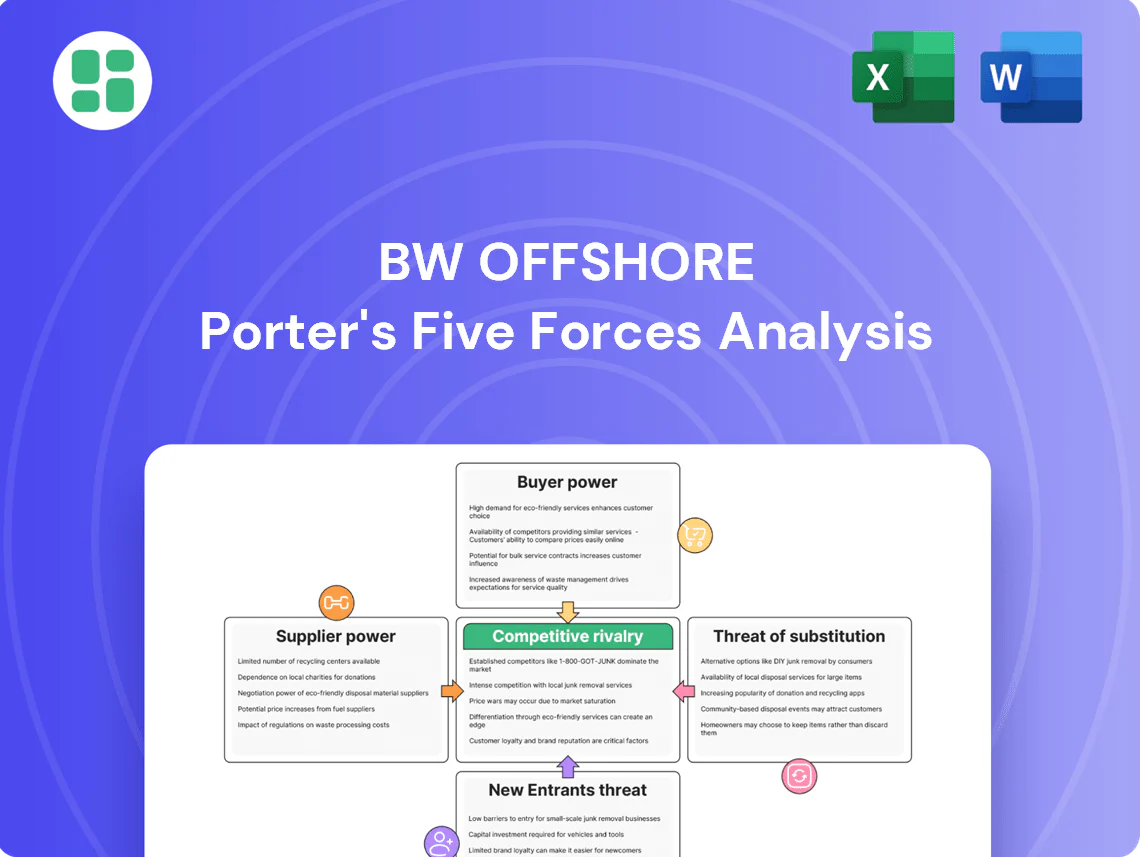
BW Offshore Porter's Five Forces Analysis

From Overview to Strategy Blueprint
BW Offshore operates in a dynamic offshore energy sector, facing significant pressures from intense rivalry and the substantial bargaining power of its clients. Understanding these forces is crucial for navigating the competitive landscape.
The complete report reveals the real forces shaping BW Offshore’s industry—from supplier influence to threat of new entrants. Gain actionable insights to drive smarter decision-making.
Suppliers Bargaining Power

Specialized Equipment and Technology Providers
Suppliers of highly specialized Floating Production Storage and Offloading (FPSO) components, like turrets and advanced processing modules, exert considerable bargaining power. This is due to the unique, tailor-made nature and essential role these parts play in BW Offshore's operations. For instance, in 2024, the development of next-generation FPSOs often requires proprietary technologies where only a handful of vendors possess the necessary expertise and manufacturing capabilities.
The limited pool of qualified suppliers for these complex systems translates into higher pricing and less favorable contractual terms for BW Offshore. The significant investment and extended lead times required to procure these bespoke components further consolidate supplier leverage. This situation is common in the offshore oil and gas sector, where innovation drives demand for highly specific, often patented, equipment.
Shipyards and Fabrication Facilities
The bargaining power of shipyards and fabrication facilities is significant for BW Offshore due to the concentrated global capacity for constructing and converting FPSO vessels. This concentration means a limited number of specialized yards can handle these complex projects, giving them leverage in negotiations.
Cost overruns and delays at these shipyards can directly impact BW Offshore's profitability and project schedules. For instance, the Barossa FPSO project experienced significant delays and cost increases, highlighting the financial risks associated with shipyard performance.
The demand for new FPSO builds, particularly for larger capacity units, further strengthens the negotiating position of these key fabrication facilities. As of early 2024, the offshore energy sector continues to see demand for FPSOs, especially for projects in emerging deepwater regions, which keeps shipyard order books robust.

Skilled Labor and Expertise
BW Offshore's success hinges on its access to a highly skilled workforce, encompassing specialized engineers, experienced project managers, and proficient offshore technicians. These professionals are essential for the complex operations of Floating Production Storage and Offloading (FPSO) units and the development of new projects.
A scarcity of this specialized talent, a trend observed across the offshore energy sector, can significantly escalate labor costs. For instance, in 2024, the demand for experienced offshore engineers remained robust, leading to competitive salary packages and increased reliance on specialized recruitment firms. This situation grants these labor suppliers greater bargaining power.
BW Offshore's dependence on this critical human capital directly influences its ability to execute projects on time and maintain operational uptime. When specialized skills are in short supply, the cost and availability of these resources can impact project timelines and overall operational efficiency, demonstrating the significant bargaining power of skilled labor suppliers.

Financial Institutions and Capital Providers
Financial institutions and capital providers wield significant influence over BW Offshore due to the immense capital requirements of Floating Production Storage and Offloading (FPSO) projects. The terms and availability of financing, including loans and other capital solutions, directly dictate BW Offshore's capacity to initiate and grow its fleet. For instance, in 2024, the cost of capital remains a critical factor, influenced by global interest rate trends and overall market liquidity, which can substantially alter project economics.
The bargaining power of these financial entities is amplified by the inherent risks associated with large-scale offshore projects. BW Offshore relies heavily on securing favorable financing terms to maintain competitive project bids and ensure profitability. Any tightening of credit markets or an increase in benchmark interest rates, such as the Federal Reserve's policy rates which remained elevated through much of 2024, directly translates to higher borrowing costs for BW Offshore, thereby increasing the suppliers' leverage.
- Capital Intensity: FPSO projects often exceed billions of dollars, making access to finance paramount.
- Financing Terms: Interest rates, loan covenants, and repayment schedules are key negotiation points.
- Market Liquidity: The general availability of funds in the financial markets affects competition among lenders and thus BW Offshore's negotiating position.
- Risk Perception: Lenders' assessment of project and BW Offshore's risk directly impacts the cost and availability of capital.
Raw Material and Energy Input Suppliers
While not as critical as specialized FPSO suppliers, BW Offshore's reliance on raw materials like steel and energy inputs for its fleet and construction projects means these suppliers can influence costs. Price swings in global commodity markets, often driven by geopolitical factors, directly impact BW Offshore's operational expenses and capital expenditure for new builds. For instance, steel prices saw significant fluctuations in 2023 and early 2024, with benchmarks like the S&P Global Platts average for hot-rolled coil in Northern Europe experiencing periods of upward pressure.
The bargaining power of these suppliers is amplified by potential supply chain disruptions. Events affecting global energy markets or major steel-producing regions can lead to shortages or increased lead times.
- Steel Price Volatility: Global steel benchmarks have shown considerable price swings in 2023-2024, directly impacting BW Offshore's material costs for vessel construction and maintenance.
- Energy Input Costs: Fluctuations in oil and gas prices affect BW Offshore's operational expenses, as energy is a key input for vessel operations.
- Supply Chain Risks: Geopolitical events and logistical challenges can disrupt the supply of essential raw materials and energy, potentially delaying projects and increasing costs.
Supplier Power: Driving Offshore Project Costs and Delays
The bargaining power of suppliers for BW Offshore is significant, particularly for specialized FPSO components where only a few vendors possess the necessary expertise and proprietary technology. This limited supplier base, coupled with the high cost and long lead times for these bespoke parts, grants suppliers considerable leverage in pricing and contract terms. For example, in 2024, the demand for advanced turret systems, critical for FPSO operations, was met by a concentrated group of manufacturers, allowing them to command premium prices.
Shipyards and fabrication facilities also hold substantial bargaining power due to the limited global capacity for constructing and converting complex FPSO vessels. This scarcity of specialized yards means BW Offshore faces challenges in securing favorable terms, with project delays and cost overruns being significant risks, as evidenced by industry-wide issues impacting major offshore projects throughout 2023 and into 2024.
Furthermore, the scarcity of highly skilled labor, such as specialized offshore engineers and technicians, empowers these professionals and their employers. In 2024, competitive salary demands and increased reliance on recruitment firms for these in-demand roles directly translated to higher labor costs for BW Offshore, impacting project execution timelines and operational efficiency.
What is included in the product
 Detailed Word Document
Analyzes the competitive intensity, buyer and supplier power, threat of new entrants, and substitute products impacting BW Offshore's strategic decisions.

 Customizable Excel Spreadsheet
Instantly identify and mitigate competitive threats with a dynamic, visual representation of BW Offshore's market landscape.
Customers Bargaining Power

Major Oil and Gas Companies
BW Offshore's customers, primarily major international and national oil and gas companies, wield considerable bargaining power. These clients, such as ExxonMobil and Saudi Aramco, often have substantial financial clout and numerous development projects, allowing them to negotiate favorable terms on the long-term charters of BW Offshore's Floating Production Storage and Offloading (FPSO) units.
Long-term Contractual Relationships
BW Offshore's long-term FPSO contracts, often spanning 5 to 15 years, create a degree of customer power. While these agreements offer revenue predictability, they lock BW Offshore into fixed terms, potentially limiting its ability to adapt to evolving market conditions or technological advancements. This can empower clients to negotiate favorable terms, particularly when BW Offshore has invested heavily in a bespoke FPSO for a specific field.

High Switching Costs for Customers
Once a Floating Production Storage and Offloading (FPSO) unit is deployed and fully integrated into an offshore oil or gas field, the customer faces exceptionally high costs if they decide to switch providers or alternative production solutions. This inherent stickiness significantly limits the customer's ability to easily change suppliers mid-project, fostering a reliance on BW Offshore's ongoing operational performance and dependability.

Customer's Project Portfolio and Financial Health
BW Offshore's customers, particularly major oil and gas companies, wield significant bargaining power, influenced by their own project portfolios and financial standing. A customer undertaking numerous large-scale projects, like Equinor or Shell, can leverage their substantial capital expenditure plans to negotiate more favorable day rates and contract terms for Floating Production Storage and Offloading (FPSO) units. For instance, in 2024, major oil producers continued to manage vast project pipelines, with global upstream capital expenditure projected to reach approximately $565 billion, according to Rystad Energy. This scale allows them to shop around for the best value.
The financial health of these clients is a critical determinant. Companies with robust balance sheets and strong cash flows, such as ExxonMobil which reported a net income of $36.0 billion for 2023, are less pressured and can demand premium services at competitive prices. Conversely, a customer experiencing financial headwinds or re-evaluating investment strategies might seek more flexible payment structures or shorter contract durations, increasing pressure on BW Offshore to adapt its offerings.
- Customer Project Scale: Major oil companies often manage portfolios of multiple offshore projects, increasing their leverage in FPSO contract negotiations.
- Financial Strength: A client's strong balance sheet and consistent profitability, exemplified by the significant earnings of supermajors in 2023, enhance their ability to negotiate better terms.
- Market Conditions Impact: Fluctuations in oil prices and overall industry investment strategies directly affect customer financial health and their bargaining power with FPSO providers like BW Offshore.
- Contract Flexibility Demands: Financially constrained customers may push for more adaptable contract terms, creating negotiation challenges for BW Offshore.
Demand for Integrated Production Solutions
Customers are increasingly demanding integrated production solutions, encompassing everything from initial design and engineering to construction, installation, and ongoing operation. This shift means clients aren't just looking for individual services but a complete, seamless package. For BW Offshore, being able to offer this end-to-end capability significantly enhances its appeal.
However, this integrated approach also creates a leverage point for customers. By consolidating their needs with a single provider like BW Offshore, they can exert greater pressure during negotiations, expecting competitive pricing and consistently high performance across all service segments. This demand for comprehensive solutions means BW Offshore must excel in every phase of the project lifecycle to maintain its competitive edge.
- Customer Integration Demand: Clients prefer a single point of contact for design, engineering, construction, installation, and operation.
- BW Offshore's Value Proposition: Offering integrated solutions strengthens BW Offshore's market position and client appeal.
- Customer Bargaining Power: The ability to bundle services allows customers to negotiate more effectively on price and performance.
Oil & Gas Giants: Dominant Force in FPSO Charters
BW Offshore's customers, predominantly large oil and gas corporations, possess significant bargaining power due to their substantial project scale and financial muscle. These entities, such as Shell and Equinor, often manage multiple offshore developments, enabling them to negotiate favorable terms for FPSO charters. For example, global upstream capital expenditure was anticipated to be around $565 billion in 2024, highlighting the immense financial capacity of these clients.
| Customer Type | Financial Strength Indicator (2023) | Bargaining Power Driver |
|---|---|---|
| Major Oil & Gas Companies (e.g., ExxonMobil, Shell) | ExxonMobil Net Income: $36.0 billion | Large project portfolios, significant capital availability |
| National Oil Companies (e.g., Saudi Aramco) | (Specific 2023 data varies, but generally strong state backing) | Government support, long-term development plans |
Preview Before You Purchase
BW Offshore Porter's Five Forces Analysis
This preview displays the complete BW Offshore Porter's Five Forces Analysis, offering a thorough examination of competitive forces within the offshore oil and gas sector. You're looking at the actual document; once you complete your purchase, you’ll get instant access to this exact, professionally formatted file, ready for your strategic planning needs.

Original: $10.00
-70%$10.00
$3.00Product Information
Product Information
Shipping & Returns
Shipping & Returns
Description
From Overview to Strategy Blueprint
BW Offshore operates in a dynamic offshore energy sector, facing significant pressures from intense rivalry and the substantial bargaining power of its clients. Understanding these forces is crucial for navigating the competitive landscape.
The complete report reveals the real forces shaping BW Offshore’s industry—from supplier influence to threat of new entrants. Gain actionable insights to drive smarter decision-making.
Suppliers Bargaining Power
Specialized Equipment and Technology Providers
Suppliers of highly specialized Floating Production Storage and Offloading (FPSO) components, like turrets and advanced processing modules, exert considerable bargaining power. This is due to the unique, tailor-made nature and essential role these parts play in BW Offshore's operations. For instance, in 2024, the development of next-generation FPSOs often requires proprietary technologies where only a handful of vendors possess the necessary expertise and manufacturing capabilities.
The limited pool of qualified suppliers for these complex systems translates into higher pricing and less favorable contractual terms for BW Offshore. The significant investment and extended lead times required to procure these bespoke components further consolidate supplier leverage. This situation is common in the offshore oil and gas sector, where innovation drives demand for highly specific, often patented, equipment.
Shipyards and Fabrication Facilities
The bargaining power of shipyards and fabrication facilities is significant for BW Offshore due to the concentrated global capacity for constructing and converting FPSO vessels. This concentration means a limited number of specialized yards can handle these complex projects, giving them leverage in negotiations.
Cost overruns and delays at these shipyards can directly impact BW Offshore's profitability and project schedules. For instance, the Barossa FPSO project experienced significant delays and cost increases, highlighting the financial risks associated with shipyard performance.
The demand for new FPSO builds, particularly for larger capacity units, further strengthens the negotiating position of these key fabrication facilities. As of early 2024, the offshore energy sector continues to see demand for FPSOs, especially for projects in emerging deepwater regions, which keeps shipyard order books robust.
Skilled Labor and Expertise
BW Offshore's success hinges on its access to a highly skilled workforce, encompassing specialized engineers, experienced project managers, and proficient offshore technicians. These professionals are essential for the complex operations of Floating Production Storage and Offloading (FPSO) units and the development of new projects.
A scarcity of this specialized talent, a trend observed across the offshore energy sector, can significantly escalate labor costs. For instance, in 2024, the demand for experienced offshore engineers remained robust, leading to competitive salary packages and increased reliance on specialized recruitment firms. This situation grants these labor suppliers greater bargaining power.
BW Offshore's dependence on this critical human capital directly influences its ability to execute projects on time and maintain operational uptime. When specialized skills are in short supply, the cost and availability of these resources can impact project timelines and overall operational efficiency, demonstrating the significant bargaining power of skilled labor suppliers.
Financial Institutions and Capital Providers
Financial institutions and capital providers wield significant influence over BW Offshore due to the immense capital requirements of Floating Production Storage and Offloading (FPSO) projects. The terms and availability of financing, including loans and other capital solutions, directly dictate BW Offshore's capacity to initiate and grow its fleet. For instance, in 2024, the cost of capital remains a critical factor, influenced by global interest rate trends and overall market liquidity, which can substantially alter project economics.
The bargaining power of these financial entities is amplified by the inherent risks associated with large-scale offshore projects. BW Offshore relies heavily on securing favorable financing terms to maintain competitive project bids and ensure profitability. Any tightening of credit markets or an increase in benchmark interest rates, such as the Federal Reserve's policy rates which remained elevated through much of 2024, directly translates to higher borrowing costs for BW Offshore, thereby increasing the suppliers' leverage.
- Capital Intensity: FPSO projects often exceed billions of dollars, making access to finance paramount.
- Financing Terms: Interest rates, loan covenants, and repayment schedules are key negotiation points.
- Market Liquidity: The general availability of funds in the financial markets affects competition among lenders and thus BW Offshore's negotiating position.
- Risk Perception: Lenders' assessment of project and BW Offshore's risk directly impacts the cost and availability of capital.
Raw Material and Energy Input Suppliers
While not as critical as specialized FPSO suppliers, BW Offshore's reliance on raw materials like steel and energy inputs for its fleet and construction projects means these suppliers can influence costs. Price swings in global commodity markets, often driven by geopolitical factors, directly impact BW Offshore's operational expenses and capital expenditure for new builds. For instance, steel prices saw significant fluctuations in 2023 and early 2024, with benchmarks like the S&P Global Platts average for hot-rolled coil in Northern Europe experiencing periods of upward pressure.
The bargaining power of these suppliers is amplified by potential supply chain disruptions. Events affecting global energy markets or major steel-producing regions can lead to shortages or increased lead times.
- Steel Price Volatility: Global steel benchmarks have shown considerable price swings in 2023-2024, directly impacting BW Offshore's material costs for vessel construction and maintenance.
- Energy Input Costs: Fluctuations in oil and gas prices affect BW Offshore's operational expenses, as energy is a key input for vessel operations.
- Supply Chain Risks: Geopolitical events and logistical challenges can disrupt the supply of essential raw materials and energy, potentially delaying projects and increasing costs.
Supplier Power: Driving Offshore Project Costs and Delays
The bargaining power of suppliers for BW Offshore is significant, particularly for specialized FPSO components where only a few vendors possess the necessary expertise and proprietary technology. This limited supplier base, coupled with the high cost and long lead times for these bespoke parts, grants suppliers considerable leverage in pricing and contract terms. For example, in 2024, the demand for advanced turret systems, critical for FPSO operations, was met by a concentrated group of manufacturers, allowing them to command premium prices.
Shipyards and fabrication facilities also hold substantial bargaining power due to the limited global capacity for constructing and converting complex FPSO vessels. This scarcity of specialized yards means BW Offshore faces challenges in securing favorable terms, with project delays and cost overruns being significant risks, as evidenced by industry-wide issues impacting major offshore projects throughout 2023 and into 2024.
Furthermore, the scarcity of highly skilled labor, such as specialized offshore engineers and technicians, empowers these professionals and their employers. In 2024, competitive salary demands and increased reliance on recruitment firms for these in-demand roles directly translated to higher labor costs for BW Offshore, impacting project execution timelines and operational efficiency.
What is included in the product
Detailed Word Document
Analyzes the competitive intensity, buyer and supplier power, threat of new entrants, and substitute products impacting BW Offshore's strategic decisions.
Customizable Excel Spreadsheet
Instantly identify and mitigate competitive threats with a dynamic, visual representation of BW Offshore's market landscape.
Customers Bargaining Power
Major Oil and Gas Companies
BW Offshore's customers, primarily major international and national oil and gas companies, wield considerable bargaining power. These clients, such as ExxonMobil and Saudi Aramco, often have substantial financial clout and numerous development projects, allowing them to negotiate favorable terms on the long-term charters of BW Offshore's Floating Production Storage and Offloading (FPSO) units.
Long-term Contractual Relationships
BW Offshore's long-term FPSO contracts, often spanning 5 to 15 years, create a degree of customer power. While these agreements offer revenue predictability, they lock BW Offshore into fixed terms, potentially limiting its ability to adapt to evolving market conditions or technological advancements. This can empower clients to negotiate favorable terms, particularly when BW Offshore has invested heavily in a bespoke FPSO for a specific field.
High Switching Costs for Customers
Once a Floating Production Storage and Offloading (FPSO) unit is deployed and fully integrated into an offshore oil or gas field, the customer faces exceptionally high costs if they decide to switch providers or alternative production solutions. This inherent stickiness significantly limits the customer's ability to easily change suppliers mid-project, fostering a reliance on BW Offshore's ongoing operational performance and dependability.
Customer's Project Portfolio and Financial Health
BW Offshore's customers, particularly major oil and gas companies, wield significant bargaining power, influenced by their own project portfolios and financial standing. A customer undertaking numerous large-scale projects, like Equinor or Shell, can leverage their substantial capital expenditure plans to negotiate more favorable day rates and contract terms for Floating Production Storage and Offloading (FPSO) units. For instance, in 2024, major oil producers continued to manage vast project pipelines, with global upstream capital expenditure projected to reach approximately $565 billion, according to Rystad Energy. This scale allows them to shop around for the best value.
The financial health of these clients is a critical determinant. Companies with robust balance sheets and strong cash flows, such as ExxonMobil which reported a net income of $36.0 billion for 2023, are less pressured and can demand premium services at competitive prices. Conversely, a customer experiencing financial headwinds or re-evaluating investment strategies might seek more flexible payment structures or shorter contract durations, increasing pressure on BW Offshore to adapt its offerings.
- Customer Project Scale: Major oil companies often manage portfolios of multiple offshore projects, increasing their leverage in FPSO contract negotiations.
- Financial Strength: A client's strong balance sheet and consistent profitability, exemplified by the significant earnings of supermajors in 2023, enhance their ability to negotiate better terms.
- Market Conditions Impact: Fluctuations in oil prices and overall industry investment strategies directly affect customer financial health and their bargaining power with FPSO providers like BW Offshore.
- Contract Flexibility Demands: Financially constrained customers may push for more adaptable contract terms, creating negotiation challenges for BW Offshore.
Demand for Integrated Production Solutions
Customers are increasingly demanding integrated production solutions, encompassing everything from initial design and engineering to construction, installation, and ongoing operation. This shift means clients aren't just looking for individual services but a complete, seamless package. For BW Offshore, being able to offer this end-to-end capability significantly enhances its appeal.
However, this integrated approach also creates a leverage point for customers. By consolidating their needs with a single provider like BW Offshore, they can exert greater pressure during negotiations, expecting competitive pricing and consistently high performance across all service segments. This demand for comprehensive solutions means BW Offshore must excel in every phase of the project lifecycle to maintain its competitive edge.
- Customer Integration Demand: Clients prefer a single point of contact for design, engineering, construction, installation, and operation.
- BW Offshore's Value Proposition: Offering integrated solutions strengthens BW Offshore's market position and client appeal.
- Customer Bargaining Power: The ability to bundle services allows customers to negotiate more effectively on price and performance.
Oil & Gas Giants: Dominant Force in FPSO Charters
BW Offshore's customers, predominantly large oil and gas corporations, possess significant bargaining power due to their substantial project scale and financial muscle. These entities, such as Shell and Equinor, often manage multiple offshore developments, enabling them to negotiate favorable terms for FPSO charters. For example, global upstream capital expenditure was anticipated to be around $565 billion in 2024, highlighting the immense financial capacity of these clients.
| Customer Type | Financial Strength Indicator (2023) | Bargaining Power Driver |
|---|---|---|
| Major Oil & Gas Companies (e.g., ExxonMobil, Shell) | ExxonMobil Net Income: $36.0 billion | Large project portfolios, significant capital availability |
| National Oil Companies (e.g., Saudi Aramco) | (Specific 2023 data varies, but generally strong state backing) | Government support, long-term development plans |
Preview Before You Purchase
BW Offshore Porter's Five Forces Analysis
This preview displays the complete BW Offshore Porter's Five Forces Analysis, offering a thorough examination of competitive forces within the offshore oil and gas sector. You're looking at the actual document; once you complete your purchase, you’ll get instant access to this exact, professionally formatted file, ready for your strategic planning needs.