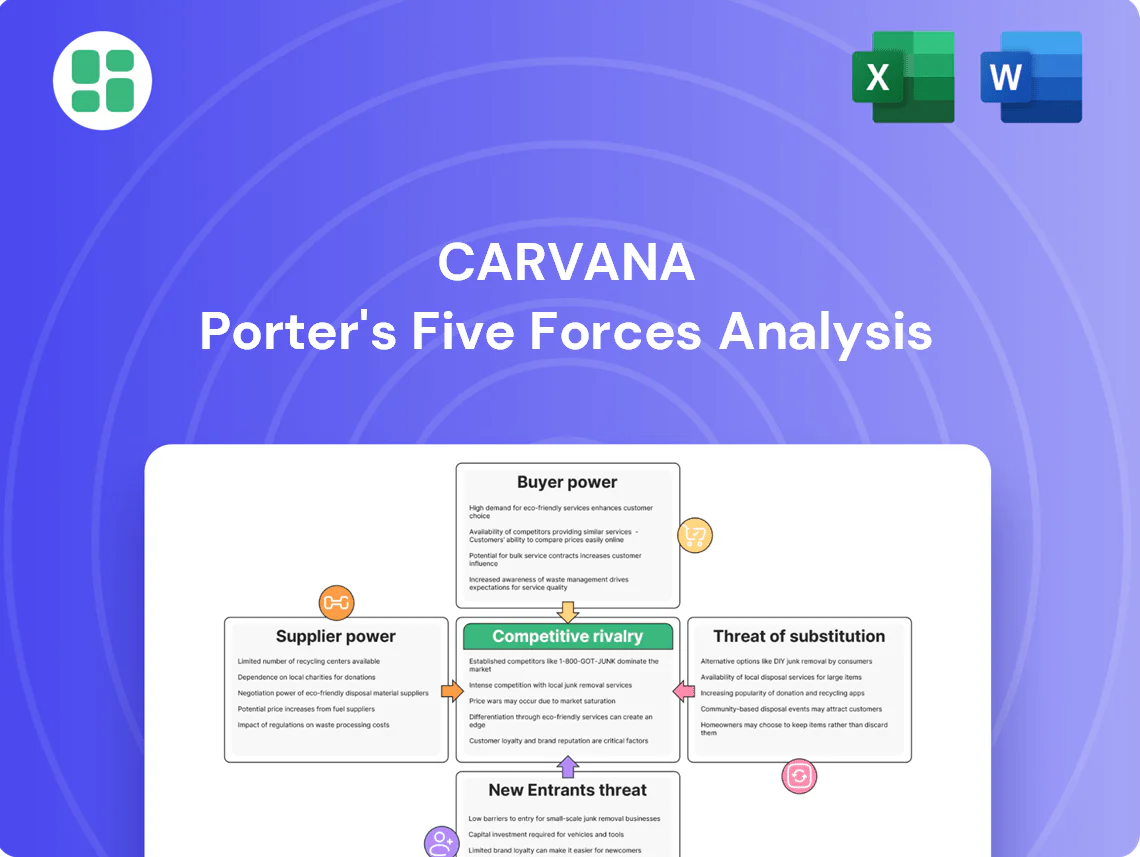
Carvana Porter's Five Forces Analysis

Don't Miss the Bigger Picture
Carvana navigates a dynamic automotive landscape, facing intense rivalry from traditional dealerships and online competitors, while also managing the bargaining power of both buyers and suppliers. The threat of new entrants is a constant consideration, as is the persistent pressure from substitute products and services. Understanding these forces is crucial for any stakeholder in the used car market.
The complete report reveals the real forces shaping Carvana’s industry—from supplier influence to threat of new entrants. Gain actionable insights to drive smarter decision-making.
Suppliers Bargaining Power

Concentrated Quality Vehicle Supply
Carvana's reliance on a concentrated pool of high-quality used vehicle suppliers, particularly for certified pre-owned inventory, grants these suppliers significant bargaining power. This limited supplier base means Carvana has fewer alternatives when sourcing desirable vehicles, allowing suppliers to dictate terms and prices more effectively.
The wholesale used car market in 2024 has experienced notable price volatility. For instance, reports indicated that average wholesale prices for used cars saw a dip of around 5-10% in early 2024 compared to the previous year, but then began to rebound, impacting Carvana's procurement costs and potentially increasing the leverage of suppliers who can offer consistent, high-quality inventory in a fluctuating market.
Impact of Supply Chain Disruptions
Ongoing supply chain disruptions, like the lingering semiconductor shortages impacting the automotive industry, directly affect Carvana by limiting vehicle availability and driving up acquisition costs. This situation significantly bolsters the bargaining power of suppliers who can reliably deliver vehicles and essential reconditioning components.
For Carvana, securing a consistent supply of vehicles is not just beneficial; it's fundamental to maintaining its inventory levels and ensuring smooth operational success in a dynamic market.

Dependence on Vehicle Condition and Pricing Terms
Suppliers who offer certified pre-owned vehicles or those with thoroughly verified history reports hold considerable sway over Carvana. They can largely set the terms for vehicle condition and pricing, which is critical for Carvana's operations.
Carvana's reliance on acquiring high-quality inventory to ensure customer satisfaction and uphold its brand reputation means these suppliers possess significant bargaining power. The used vehicle market dynamics, as seen in the Manheim Used Vehicle Value Index which experienced notable fluctuations throughout 2024, directly impact the cost and availability of this crucial inventory.

Vertical Integration Mitigates Some Power
Carvana's vertically integrated model, encompassing its own reconditioning centers and logistics network, is a strategic move to bring more repair capabilities in-house. This control over critical operational stages, including vehicle preparation, directly reduces its dependence on external third-party service providers. By insourcing these functions, Carvana can better manage costs and exert more influence over the quality and speed of its vehicle reconditioning process.
This integration helps to lessen the bargaining power of suppliers, particularly those in the automotive repair and parts sectors. For instance, by owning and operating its reconditioning facilities, Carvana can negotiate better terms for parts or even source them directly, bypassing intermediaries that might inflate prices. In 2023, Carvana continued to expand its reconditioning footprint, aiming to process a significant volume of vehicles internally to capture efficiencies.
- Vertical Integration: Carvana operates its own reconditioning centers and logistics, reducing reliance on external suppliers for vehicle preparation and transportation.
- Cost Control: Bringing repair and logistics in-house allows for greater control over costs associated with parts and services, mitigating supplier price increases.
- Operational Efficiency: Internalizing these processes can lead to improved turnaround times and quality control for vehicles entering its sales inventory.
Wholesale Market Dynamics
Carvana's acquisition of ADESA U.S. in 2022 significantly boosted its wholesale market presence, offering a captive channel for vehicle sourcing. This integration aimed to mitigate reliance on external wholesale auctions, potentially reducing supplier bargaining power. However, the broader wholesale used car market, characterized by fluctuating demand and supply, still dictates pricing and availability, thereby influencing the power of original equipment manufacturers (OEMs) and other large fleet suppliers.
The wholesale used car market in 2024 continues to be a critical factor in Carvana's inventory acquisition strategy. While Carvana's internal wholesale capabilities have grown, the overall health and competitiveness of this market remain paramount. Factors such as auction volumes, depreciation rates, and the availability of off-lease vehicles directly impact the cost of acquiring inventory, thus shaping the bargaining power of suppliers who provide these vehicles.
- Wholesale Market Integration: Carvana's 2022 acquisition of ADESA U.S. operations provided a substantial wholesale marketplace, enhancing its ability to source vehicles internally.
- Supplier Dependence: Despite internal capabilities, Carvana remains influenced by the broader wholesale market's supply dynamics, which include OEM remarketing and fleet sales.
- Pricing Influence: Wholesale pricing trends in 2024, driven by factors like auction demand and vehicle depreciation, continue to exert pressure on Carvana's inventory costs, reflecting ongoing supplier leverage.
Shifting Supplier Power in Used Vehicle Acquisition
Carvana's access to a consistent supply of high-quality used vehicles is crucial, and suppliers who can reliably provide certified pre-owned inventory or vehicles with verified histories hold significant leverage. The fluctuating wholesale used car market in 2024, with price volatility impacting acquisition costs, further strengthens the bargaining power of suppliers offering stable, desirable inventory.
Carvana's strategic move towards vertical integration, including its own reconditioning centers, aims to reduce its dependence on external repair and parts suppliers. By insourcing these functions, Carvana gains more control over costs and quality, thereby diminishing the bargaining power of third-party service providers and parts vendors.
Carvana's acquisition of ADESA U.S. in 2022 bolstered its internal wholesale sourcing capabilities, reducing reliance on external auctions. However, the broader wholesale market dynamics in 2024, influenced by OEM remarketing and fleet sales, continue to shape vehicle availability and pricing, maintaining a degree of supplier influence.
| Factor | Impact on Carvana | Supplier Bargaining Power |
|---|---|---|
| Concentrated Supplier Pool | Limited sourcing options for desirable inventory. | High |
| Wholesale Market Volatility (2024) | Fluctuating acquisition costs and availability. | Moderate to High |
| Vertical Integration (Reconditioning) | Reduced dependence on external repair and parts suppliers. | Decreasing |
| ADESA Acquisition (2022) | Enhanced internal wholesale sourcing. | Moderate |
What is included in the product
 Detailed Word Document
Carvana's Porter's Five Forces analysis reveals the intense competitive rivalry in the online used car market, the significant bargaining power of buyers, and the moderate threat of new entrants due to high capital requirements.

 Customizable Excel Spreadsheet
Effortlessly navigate the competitive landscape by visualizing Carvana's Porter's Five Forces with an intuitive, interactive dashboard.
Gain immediate clarity on competitive pressures, allowing for swift, data-driven strategic adjustments to mitigate market threats.
Customers Bargaining Power

High Price Sensitivity and Online Transparency
Customers in the used car market are incredibly sensitive to price, and the internet has made it easier than ever to shop around. They can quickly compare prices from different sellers online, putting pressure on dealerships to offer competitive deals. This transparency means companies need to be very strategic about their pricing to attract and retain buyers.
Carvana's business model is built around leveraging cost efficiencies to offer lower prices, directly addressing this customer price sensitivity. For instance, in February 2025, Carvana's average car selling price was reported to be approximately 3% lower than that of CarMax and around 5% lower than Lithia Motors, demonstrating their commitment to this strategy.
Low Switching Costs for Buyers
Customers can easily compare prices and features across various online car retailers, including Carvana, CarMax, and Vroom, due to minimal switching costs. This accessibility allows buyers to shift their business with little friction, enhancing their leverage in price negotiations.

Availability of Alternative Channels
Consumers today have a wealth of options when it comes to buying used cars, far beyond just the local dealership. They can easily explore other online marketplaces, compare prices with private sellers, or even visit different brick-and-mortar stores. This abundance of choices significantly boosts the bargaining power of customers, as they can always find a better deal or a more convenient way to purchase.
The rise of online platforms has fundamentally altered the landscape for traditional used car dealerships. For instance, in 2023, online used car sales continued to grow, with platforms like Carvana and Vroom capturing a notable share of the market, forcing traditional dealers to adapt their strategies and pricing to remain competitive.

Customer-Centric Approach and Guarantees
Carvana actively works to diminish customer bargaining power by focusing on a distinct, customer-focused experience. This includes offerings like a seven-day return policy and CarvanaCare extended warranties, designed to foster trust and customer loyalty. By emphasizing value beyond just price, Carvana aims to secure repeat business, a strategy that saw positive traction in 2024 as consumers sought reliable online purchasing options.
These customer-centric initiatives are crucial in an industry where price comparison is easy. Carvana’s approach aims to shift the focus from pure cost to overall satisfaction and peace of mind. For instance, their transparent pricing model and the aforementioned return policy reduce the perceived risk for buyers, thereby lessening their inclination to haggle or switch based solely on minor price differences.
- Customer-Centric Experience: Carvana differentiates itself through a focus on customer satisfaction, not just price.
- Risk Reduction: Features like a 7-day return policy and extended warranties (CarvanaCare) lower the perceived risk for buyers.
- Building Loyalty: These initiatives aim to cultivate trust and encourage repeat purchases, mitigating price sensitivity.
- 2024 Impact: The emphasis on a positive customer journey contributed to customer retention and brand preference in the competitive used car market during 2024.
Financing Options and Affordability
Carvana's competitive financing options significantly bolster its bargaining power with customers by making vehicle ownership more attainable. This accessibility can sway purchasing decisions, shifting focus from the vehicle's list price to the overall affordability of the financing package.
However, the current economic climate, marked by rising interest rates, presents a challenge. For instance, as of mid-2024, average auto loan rates have seen an uptick, potentially impacting Carvana's customer base. This trend can decrease overall demand and heighten customer scrutiny of financing terms, thereby increasing customer bargaining power.
- Competitive Financing: Carvana's ability to offer attractive loan terms can reduce customer price sensitivity.
- Interest Rate Sensitivity: Rising interest rates in 2024 make financing costs a more significant factor for buyers.
- Affordability Impact: Higher rates can make car purchases less affordable, increasing customer leverage in negotiations.
- Demand Fluctuation: Economic conditions influencing interest rates directly affect consumer demand and bargaining power.
Customer Power Drives Used Car Market Shifts
Customers in the used car market wield significant power due to the ease of price comparison and the abundance of choices available. This transparency forces companies like Carvana to focus on competitive pricing and a superior customer experience to retain buyers. The ability for customers to easily switch between online retailers or even private sellers amplifies their leverage.
| Factor | Impact on Carvana | 2024/2025 Data/Trend |
|---|---|---|
| Price Sensitivity | High | Customers actively compare prices online, pressuring Carvana to maintain competitive pricing. |
| Switching Costs | Low | Minimal effort for customers to move between online platforms, increasing their bargaining power. |
| Information Availability | High | Online reviews and price comparison tools empower customers with extensive market knowledge. |
| Availability of Substitutes | High | Numerous online and offline sellers provide ample alternatives, strengthening customer leverage. |
Same Document Delivered
Carvana Porter's Five Forces Analysis
This preview shows the exact Carvana Porter's Five Forces Analysis you'll receive immediately after purchase, detailing threats from new entrants, buyer bargaining power, supplier bargaining power, the threat of substitutes, and the intensity of competitive rivalry within the online used car market.
The document displayed here is the part of the full version you’ll get—ready for download and use the moment you buy, offering a comprehensive breakdown of each force impacting Carvana's strategic positioning.
You're looking at the actual document; once you complete your purchase, you’ll get instant access to this exact file, providing actionable insights into Carvana's competitive landscape.

Original: $10.00
-70%$10.00
$3.00Product Information
Product Information
Shipping & Returns
Shipping & Returns
Description
Don't Miss the Bigger Picture
Carvana navigates a dynamic automotive landscape, facing intense rivalry from traditional dealerships and online competitors, while also managing the bargaining power of both buyers and suppliers. The threat of new entrants is a constant consideration, as is the persistent pressure from substitute products and services. Understanding these forces is crucial for any stakeholder in the used car market.
The complete report reveals the real forces shaping Carvana’s industry—from supplier influence to threat of new entrants. Gain actionable insights to drive smarter decision-making.
Suppliers Bargaining Power
Concentrated Quality Vehicle Supply
Carvana's reliance on a concentrated pool of high-quality used vehicle suppliers, particularly for certified pre-owned inventory, grants these suppliers significant bargaining power. This limited supplier base means Carvana has fewer alternatives when sourcing desirable vehicles, allowing suppliers to dictate terms and prices more effectively.
The wholesale used car market in 2024 has experienced notable price volatility. For instance, reports indicated that average wholesale prices for used cars saw a dip of around 5-10% in early 2024 compared to the previous year, but then began to rebound, impacting Carvana's procurement costs and potentially increasing the leverage of suppliers who can offer consistent, high-quality inventory in a fluctuating market.
Impact of Supply Chain Disruptions
Ongoing supply chain disruptions, like the lingering semiconductor shortages impacting the automotive industry, directly affect Carvana by limiting vehicle availability and driving up acquisition costs. This situation significantly bolsters the bargaining power of suppliers who can reliably deliver vehicles and essential reconditioning components.
For Carvana, securing a consistent supply of vehicles is not just beneficial; it's fundamental to maintaining its inventory levels and ensuring smooth operational success in a dynamic market.
Dependence on Vehicle Condition and Pricing Terms
Suppliers who offer certified pre-owned vehicles or those with thoroughly verified history reports hold considerable sway over Carvana. They can largely set the terms for vehicle condition and pricing, which is critical for Carvana's operations.
Carvana's reliance on acquiring high-quality inventory to ensure customer satisfaction and uphold its brand reputation means these suppliers possess significant bargaining power. The used vehicle market dynamics, as seen in the Manheim Used Vehicle Value Index which experienced notable fluctuations throughout 2024, directly impact the cost and availability of this crucial inventory.
Vertical Integration Mitigates Some Power
Carvana's vertically integrated model, encompassing its own reconditioning centers and logistics network, is a strategic move to bring more repair capabilities in-house. This control over critical operational stages, including vehicle preparation, directly reduces its dependence on external third-party service providers. By insourcing these functions, Carvana can better manage costs and exert more influence over the quality and speed of its vehicle reconditioning process.
This integration helps to lessen the bargaining power of suppliers, particularly those in the automotive repair and parts sectors. For instance, by owning and operating its reconditioning facilities, Carvana can negotiate better terms for parts or even source them directly, bypassing intermediaries that might inflate prices. In 2023, Carvana continued to expand its reconditioning footprint, aiming to process a significant volume of vehicles internally to capture efficiencies.
- Vertical Integration: Carvana operates its own reconditioning centers and logistics, reducing reliance on external suppliers for vehicle preparation and transportation.
- Cost Control: Bringing repair and logistics in-house allows for greater control over costs associated with parts and services, mitigating supplier price increases.
- Operational Efficiency: Internalizing these processes can lead to improved turnaround times and quality control for vehicles entering its sales inventory.
Wholesale Market Dynamics
Carvana's acquisition of ADESA U.S. in 2022 significantly boosted its wholesale market presence, offering a captive channel for vehicle sourcing. This integration aimed to mitigate reliance on external wholesale auctions, potentially reducing supplier bargaining power. However, the broader wholesale used car market, characterized by fluctuating demand and supply, still dictates pricing and availability, thereby influencing the power of original equipment manufacturers (OEMs) and other large fleet suppliers.
The wholesale used car market in 2024 continues to be a critical factor in Carvana's inventory acquisition strategy. While Carvana's internal wholesale capabilities have grown, the overall health and competitiveness of this market remain paramount. Factors such as auction volumes, depreciation rates, and the availability of off-lease vehicles directly impact the cost of acquiring inventory, thus shaping the bargaining power of suppliers who provide these vehicles.
- Wholesale Market Integration: Carvana's 2022 acquisition of ADESA U.S. operations provided a substantial wholesale marketplace, enhancing its ability to source vehicles internally.
- Supplier Dependence: Despite internal capabilities, Carvana remains influenced by the broader wholesale market's supply dynamics, which include OEM remarketing and fleet sales.
- Pricing Influence: Wholesale pricing trends in 2024, driven by factors like auction demand and vehicle depreciation, continue to exert pressure on Carvana's inventory costs, reflecting ongoing supplier leverage.
Shifting Supplier Power in Used Vehicle Acquisition
Carvana's access to a consistent supply of high-quality used vehicles is crucial, and suppliers who can reliably provide certified pre-owned inventory or vehicles with verified histories hold significant leverage. The fluctuating wholesale used car market in 2024, with price volatility impacting acquisition costs, further strengthens the bargaining power of suppliers offering stable, desirable inventory.
Carvana's strategic move towards vertical integration, including its own reconditioning centers, aims to reduce its dependence on external repair and parts suppliers. By insourcing these functions, Carvana gains more control over costs and quality, thereby diminishing the bargaining power of third-party service providers and parts vendors.
Carvana's acquisition of ADESA U.S. in 2022 bolstered its internal wholesale sourcing capabilities, reducing reliance on external auctions. However, the broader wholesale market dynamics in 2024, influenced by OEM remarketing and fleet sales, continue to shape vehicle availability and pricing, maintaining a degree of supplier influence.
| Factor | Impact on Carvana | Supplier Bargaining Power |
|---|---|---|
| Concentrated Supplier Pool | Limited sourcing options for desirable inventory. | High |
| Wholesale Market Volatility (2024) | Fluctuating acquisition costs and availability. | Moderate to High |
| Vertical Integration (Reconditioning) | Reduced dependence on external repair and parts suppliers. | Decreasing |
| ADESA Acquisition (2022) | Enhanced internal wholesale sourcing. | Moderate |
What is included in the product
Detailed Word Document
Carvana's Porter's Five Forces analysis reveals the intense competitive rivalry in the online used car market, the significant bargaining power of buyers, and the moderate threat of new entrants due to high capital requirements.
Customizable Excel Spreadsheet
Effortlessly navigate the competitive landscape by visualizing Carvana's Porter's Five Forces with an intuitive, interactive dashboard.
Gain immediate clarity on competitive pressures, allowing for swift, data-driven strategic adjustments to mitigate market threats.
Customers Bargaining Power
High Price Sensitivity and Online Transparency
Customers in the used car market are incredibly sensitive to price, and the internet has made it easier than ever to shop around. They can quickly compare prices from different sellers online, putting pressure on dealerships to offer competitive deals. This transparency means companies need to be very strategic about their pricing to attract and retain buyers.
Carvana's business model is built around leveraging cost efficiencies to offer lower prices, directly addressing this customer price sensitivity. For instance, in February 2025, Carvana's average car selling price was reported to be approximately 3% lower than that of CarMax and around 5% lower than Lithia Motors, demonstrating their commitment to this strategy.
Low Switching Costs for Buyers
Customers can easily compare prices and features across various online car retailers, including Carvana, CarMax, and Vroom, due to minimal switching costs. This accessibility allows buyers to shift their business with little friction, enhancing their leverage in price negotiations.
Availability of Alternative Channels
Consumers today have a wealth of options when it comes to buying used cars, far beyond just the local dealership. They can easily explore other online marketplaces, compare prices with private sellers, or even visit different brick-and-mortar stores. This abundance of choices significantly boosts the bargaining power of customers, as they can always find a better deal or a more convenient way to purchase.
The rise of online platforms has fundamentally altered the landscape for traditional used car dealerships. For instance, in 2023, online used car sales continued to grow, with platforms like Carvana and Vroom capturing a notable share of the market, forcing traditional dealers to adapt their strategies and pricing to remain competitive.
Customer-Centric Approach and Guarantees
Carvana actively works to diminish customer bargaining power by focusing on a distinct, customer-focused experience. This includes offerings like a seven-day return policy and CarvanaCare extended warranties, designed to foster trust and customer loyalty. By emphasizing value beyond just price, Carvana aims to secure repeat business, a strategy that saw positive traction in 2024 as consumers sought reliable online purchasing options.
These customer-centric initiatives are crucial in an industry where price comparison is easy. Carvana’s approach aims to shift the focus from pure cost to overall satisfaction and peace of mind. For instance, their transparent pricing model and the aforementioned return policy reduce the perceived risk for buyers, thereby lessening their inclination to haggle or switch based solely on minor price differences.
- Customer-Centric Experience: Carvana differentiates itself through a focus on customer satisfaction, not just price.
- Risk Reduction: Features like a 7-day return policy and extended warranties (CarvanaCare) lower the perceived risk for buyers.
- Building Loyalty: These initiatives aim to cultivate trust and encourage repeat purchases, mitigating price sensitivity.
- 2024 Impact: The emphasis on a positive customer journey contributed to customer retention and brand preference in the competitive used car market during 2024.
Financing Options and Affordability
Carvana's competitive financing options significantly bolster its bargaining power with customers by making vehicle ownership more attainable. This accessibility can sway purchasing decisions, shifting focus from the vehicle's list price to the overall affordability of the financing package.
However, the current economic climate, marked by rising interest rates, presents a challenge. For instance, as of mid-2024, average auto loan rates have seen an uptick, potentially impacting Carvana's customer base. This trend can decrease overall demand and heighten customer scrutiny of financing terms, thereby increasing customer bargaining power.
- Competitive Financing: Carvana's ability to offer attractive loan terms can reduce customer price sensitivity.
- Interest Rate Sensitivity: Rising interest rates in 2024 make financing costs a more significant factor for buyers.
- Affordability Impact: Higher rates can make car purchases less affordable, increasing customer leverage in negotiations.
- Demand Fluctuation: Economic conditions influencing interest rates directly affect consumer demand and bargaining power.
Customer Power Drives Used Car Market Shifts
Customers in the used car market wield significant power due to the ease of price comparison and the abundance of choices available. This transparency forces companies like Carvana to focus on competitive pricing and a superior customer experience to retain buyers. The ability for customers to easily switch between online retailers or even private sellers amplifies their leverage.
| Factor | Impact on Carvana | 2024/2025 Data/Trend |
|---|---|---|
| Price Sensitivity | High | Customers actively compare prices online, pressuring Carvana to maintain competitive pricing. |
| Switching Costs | Low | Minimal effort for customers to move between online platforms, increasing their bargaining power. |
| Information Availability | High | Online reviews and price comparison tools empower customers with extensive market knowledge. |
| Availability of Substitutes | High | Numerous online and offline sellers provide ample alternatives, strengthening customer leverage. |
Same Document Delivered
Carvana Porter's Five Forces Analysis
This preview shows the exact Carvana Porter's Five Forces Analysis you'll receive immediately after purchase, detailing threats from new entrants, buyer bargaining power, supplier bargaining power, the threat of substitutes, and the intensity of competitive rivalry within the online used car market.
The document displayed here is the part of the full version you’ll get—ready for download and use the moment you buy, offering a comprehensive breakdown of each force impacting Carvana's strategic positioning.
You're looking at the actual document; once you complete your purchase, you’ll get instant access to this exact file, providing actionable insights into Carvana's competitive landscape.