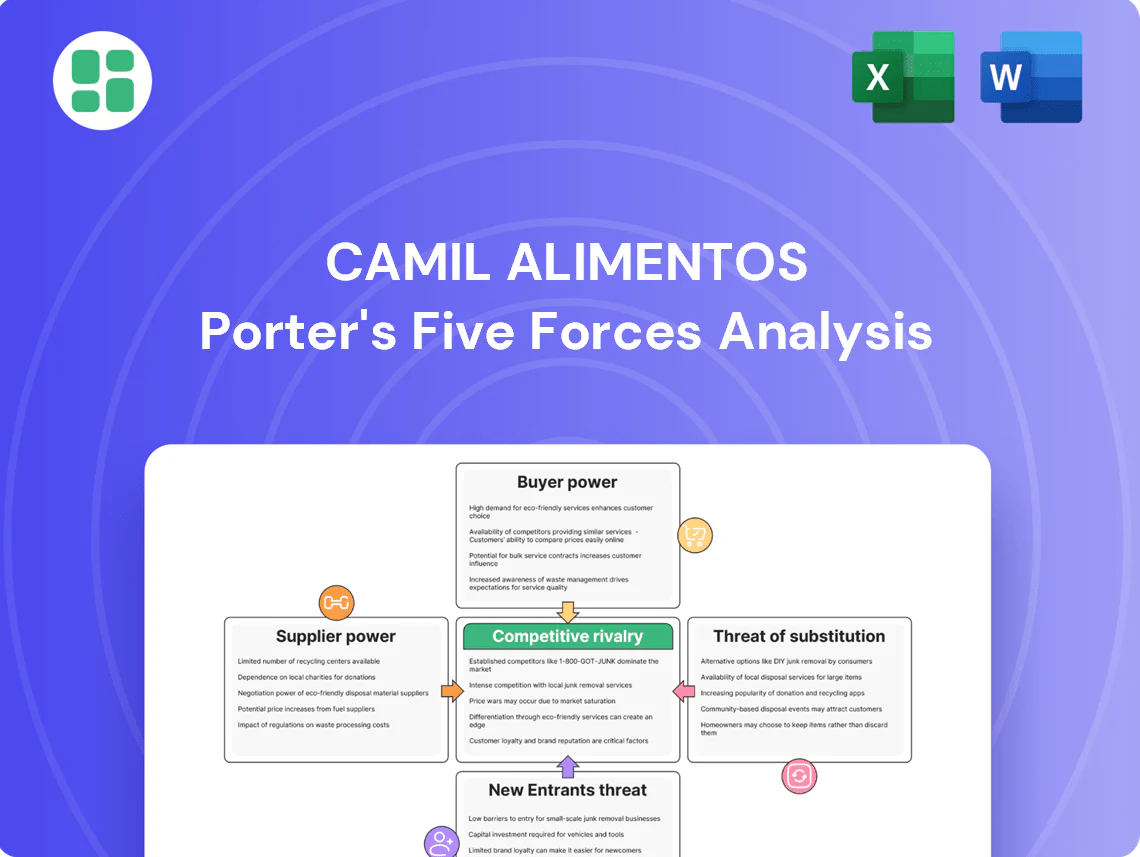
Camil Alimentos Porter's Five Forces Analysis

Elevate Your Analysis with the Complete Porter's Five Forces Analysis
Camil Alimentos faces a dynamic competitive landscape shaped by moderate buyer power and the constant threat of substitutes in the food industry. Understanding the intensity of these forces is crucial for strategic planning and identifying growth opportunities.
The complete report reveals the real forces shaping Camil Alimentos’s industry—from supplier influence to threat of new entrants. Gain actionable insights to drive smarter decision-making.
Suppliers Bargaining Power

Commodity Dependence
Camil Alimentos' significant reliance on agricultural commodities such as rice, beans, sugar, and coffee places them in a vulnerable position regarding supplier bargaining power. The prices of these essential raw materials are inherently volatile, influenced by a complex interplay of global supply and demand dynamics, unpredictable weather patterns, and geopolitical instability. These external factors can directly and substantially affect Camil's cost of goods sold, impacting profitability.
For example, the fiscal year ending February 2025 saw a notable increase in coffee costs, which directly translated into higher expenses for Camil Alimentos. This dependence on a few key commodities means that suppliers, or even broader market forces affecting these commodities, can exert considerable leverage over Camil's operational costs and pricing strategies.
Fragmented Supplier Base
The agricultural sector, a cornerstone for companies like Camil Alimentos, often features a fragmented supplier base, especially for key commodities like grains. This fragmentation means numerous small and medium-sized local producers contribute to the supply chain.
Camil Alimentos' strategy of engaging with a vast network of local suppliers, evidenced by its approximately 6,000 suppliers in February 2024, directly contributes to this fragmentation. A broad supplier pool generally dilutes the bargaining power of any single supplier, as the company has multiple alternatives for sourcing its raw materials.

Switching Costs
Switching suppliers for Camil Alimentos, even for standardized raw materials, can introduce complexities. These include the costs and time associated with new logistical setups, rigorous quality control recalibrations, and the effort required to build and nurture fresh supplier relationships. These factors contribute to switching costs, although their impact is likely moderate due to the commodity nature of many of Camil's inputs.

Supplier Concentration
Supplier concentration for Camil Alimentos can vary significantly. For highly specialized ingredients or unique packaging, a limited number of suppliers could wield greater influence, potentially impacting input costs.
However, the broader market for core agricultural commodities, like rice and beans, is generally less concentrated. Brazil's status as a major global agricultural exporter means Camil Alimentos can often source these essential inputs from a wide array of domestic and international suppliers, which naturally dilutes the power of any single supplier. For instance, in 2024, Brazil continued its strong performance in global food exports, with agricultural commodities forming a substantial portion of its trade balance, underscoring the availability of diverse sourcing options for many of Camil's raw materials.
- Supplier Concentration: While some specialized inputs may face concentrated supply chains, the overall agricultural market for Camil Alimentos benefits from Brazil's extensive export capabilities.
- Commodity Sourcing: The global and regional nature of agricultural supply for core products like rice and beans generally prevents individual suppliers from holding excessive power.
- Brazil's Agricultural Strength: As a leading agricultural exporter, Brazil provides Camil Alimentos with a robust and diverse base of potential suppliers for its primary raw materials.
Forward Integration Threat
The threat of agricultural commodity suppliers like those Camil Alimentos works with integrating forward into processing and distribution is generally low. This is primarily because such a move requires substantial capital for processing facilities, specialized operational knowledge, and robust distribution channels, resources that most individual farmers or small cooperatives typically do not possess.
Camil Alimentos' existing, well-developed infrastructure and strong market position further discourage potential forward integration by suppliers. The company's established processing capabilities and extensive distribution network create a significant barrier to entry for suppliers looking to move up the value chain.
- Low Forward Integration Threat: Farmers generally lack the capital, expertise, and distribution networks needed for forward integration.
- Camil's Deterrent: Camil's extensive infrastructure and market presence make it difficult for suppliers to compete if they were to integrate forward.
- Industry Norms: In the agricultural sector, the separation of farming and processing is a common and established model.
Strategic Sourcing: Mitigating Supplier Power in Commodity Markets
Camil Alimentos benefits from a largely fragmented supplier base, particularly for core commodities like rice and beans, due to Brazil's extensive agricultural export capabilities. With approximately 6,000 suppliers in February 2024, the company mitigates individual supplier power. While switching costs exist for raw materials, the commodity nature of many inputs limits their impact.
The threat of suppliers integrating forward into processing is low, as this requires significant capital and expertise that most agricultural producers lack. Camil's established infrastructure and market position further act as deterrents, reinforcing the typical industry separation between farming and processing.
| Factor | Assessment for Camil Alimentos | Supporting Data/Reasoning |
|---|---|---|
| Supplier Concentration | Generally Low for Core Commodities | Brazil's strong agricultural export performance in 2024 provides diverse sourcing options. |
| Availability of Substitutes | High for many agricultural inputs | Commodity nature of rice, beans, sugar, coffee allows for multiple sourcing alternatives. |
| Switching Costs | Moderate | Costs associated with logistics, quality control, and relationship building exist but are manageable for many inputs. |
| Supplier Power to Raise Prices | Low to Moderate | Fragmented supplier base and availability of substitutes limit individual supplier leverage, though specific commodity price spikes (e.g., coffee in FY25) can occur. |
| Threat of Forward Integration | Low | Lack of capital, expertise, and distribution networks among most agricultural suppliers; Camil's strong infrastructure acts as a barrier. |
What is included in the product
 Detailed Word Document
Tailored exclusively for Camil Alimentos, this analysis dissects the intensity of rivalry, buyer and supplier power, threat of new entrants and substitutes within the Brazilian food industry.

 Customizable Excel Spreadsheet
Instantly visualize competitive intensity across all five forces for Camil Alimentos, streamlining strategic planning.
Customers Bargaining Power

Retailer Concentration
Camil Alimentos faces significant customer bargaining power, particularly from large retail chains and supermarkets across South America. These major buyers, due to their substantial order volumes, can negotiate for more favorable pricing, extended payment terms, and demand promotional assistance, directly impacting Camil's margins.
The sheer scale of these retail partners is evident in the Brazilian supermarket sector, which generated approximately US$135 billion in revenue in 2022. This concentration of purchasing power allows these entities to exert considerable influence over their suppliers, including Camil.
Consumer Price Sensitivity
Consumer price sensitivity is a significant factor for Camil Alimentos, especially concerning staple food products like rice, beans, and sugar. In many emerging markets, consumers are acutely aware of price fluctuations, making them hesitant to absorb cost increases. This means Camil faces limitations in its ability to pass on rising input costs, particularly when pitted against lower-priced private label brands or unbranded competitors.
For instance, in 2024, inflation in Brazil, a key market for Camil, remained a concern, impacting household purchasing power. While specific data on Camil's price pass-through rates isn't publicly detailed, the general economic climate suggests that price increases would be met with strong consumer resistance, potentially leading to market share erosion if not managed carefully.

Product Differentiation
While Camil Alimentos possesses strong, established brands such as Camil, União, and Coqueiro, the core products like rice, beans, and sugar are fundamentally undifferentiated commodities. This lack of unique product features means customers have a wide array of choices from competitors.
Although brand loyalty can mitigate customer bargaining power, the inherent commodity nature of these staples means price often becomes a dominant purchasing driver. In 2024, the Brazilian rice market, for instance, saw significant price volatility influenced by supply and demand dynamics, further empowering price-sensitive consumers.

Low Switching Costs for Consumers
Consumers in the food industry, including those purchasing products similar to Camil Alimentos, often face minimal costs when switching between brands. This is particularly true for staple food items where brand loyalty can be less entrenched compared to more specialized goods. For instance, a shopper might easily opt for a different brand of rice or beans if it's on sale or more readily available.
This low barrier to switching directly translates into increased bargaining power for customers. They understand that if one supplier or brand doesn't meet their expectations regarding price, quality, or availability, another is readily accessible. This dynamic forces producers to remain competitive to retain their customer base.
Consider the Brazilian market, a key area for Camil Alimentos. In 2024, the food sector experienced fluctuating prices, with inflation impacting consumer purchasing power. This environment amplifies the effect of low switching costs, as consumers actively seek out the best value. For example, reports from late 2023 and early 2024 indicated that promotional activities by major retailers significantly influenced purchasing decisions for essential food items, highlighting consumers' sensitivity to price and their willingness to switch.
- Low Switching Costs: Consumers can easily change brands for staple food products like rice and beans without incurring significant expenses or effort.
- Price Sensitivity: The ease of switching makes consumers highly responsive to price differences and promotional offers from competing brands.
- Increased Competition: This empowers customers, compelling food manufacturers to maintain competitive pricing and product availability to retain market share.
- Impact on Margins: For companies like Camil Alimentos, this means constant pressure to manage costs and innovate to justify pricing and prevent customer attrition.
Information Availability
Information availability significantly boosts customer bargaining power. In 2024, widespread internet access means consumers and retailers can easily compare prices and product details for food items. This transparency allows them to identify the best deals, putting pressure on companies like Camil Alimentos to remain competitive on pricing.
This enhanced access to information fuels informed purchasing decisions. Consumers can research ingredients, nutritional content, and even ethical sourcing, demanding more from food producers. For instance, a significant portion of consumers in Brazil, Camil Alimentos' primary market, actively seek out product reviews and price comparisons online before making a purchase.
- Increased Price Sensitivity: Consumers can readily find lower-priced alternatives, making them less loyal to brands solely on habit.
- Demand for Transparency: Buyers expect detailed product information, influencing purchasing choices and potentially driving up costs for compliance.
- Retailer Leverage: Large retailers can use aggregated customer data and price comparison tools to negotiate better terms with suppliers like Camil Alimentos.
Customer Power Squeezes Food Staple Profitability
Camil Alimentos faces substantial customer bargaining power, primarily from large retail chains that dominate the South American grocery landscape. These powerful buyers leverage their significant order volumes to negotiate favorable pricing and terms, directly impacting Camil's profitability. The sheer scale of the Brazilian retail sector, which saw revenues around US$135 billion in 2022, underscores the leverage these entities possess over suppliers.
Consumer price sensitivity, especially for staple goods like rice and beans, further amplifies this power. In 2024, persistent inflation in key markets like Brazil constrained household budgets, making consumers highly resistant to price hikes. This dynamic limits Camil's ability to pass on increased input costs, particularly when competing with lower-priced private label or unbranded alternatives.
The commodity nature of Camil's core products, such as rice and sugar, means differentiation is minimal, leading customers to prioritize price. Low switching costs for these staples allow consumers to readily move between brands, compelling companies like Camil to maintain competitive pricing. In 2024, price volatility in the Brazilian rice market, influenced by supply and demand, further empowered price-conscious buyers.
| Factor | Impact on Camil Alimentos | 2024 Context/Data |
|---|---|---|
| Retailer Concentration | High bargaining power due to large order volumes | Brazilian supermarket sector revenue ~US$135 billion (2022) |
| Price Sensitivity | Limits ability to pass on cost increases | Inflation in Brazil impacting consumer purchasing power |
| Product Commoditization | Low differentiation leads to price-based competition | Price volatility in Brazilian rice market |
| Switching Costs | Low costs empower consumers to switch brands easily | Consumers actively seeking best value amidst economic pressures |
Full Version Awaits
Camil Alimentos Porter's Five Forces Analysis
This preview showcases the comprehensive Porter's Five Forces Analysis for Camil Alimentos, detailing the competitive landscape and strategic implications. The document you see here is the exact, fully formatted analysis you will receive immediately after purchase, ensuring complete transparency and readiness for your business insights.

Original: $10.00
-70%$10.00
$3.00Product Information
Product Information
Shipping & Returns
Shipping & Returns
Description
Elevate Your Analysis with the Complete Porter's Five Forces Analysis
Camil Alimentos faces a dynamic competitive landscape shaped by moderate buyer power and the constant threat of substitutes in the food industry. Understanding the intensity of these forces is crucial for strategic planning and identifying growth opportunities.
The complete report reveals the real forces shaping Camil Alimentos’s industry—from supplier influence to threat of new entrants. Gain actionable insights to drive smarter decision-making.
Suppliers Bargaining Power
Commodity Dependence
Camil Alimentos' significant reliance on agricultural commodities such as rice, beans, sugar, and coffee places them in a vulnerable position regarding supplier bargaining power. The prices of these essential raw materials are inherently volatile, influenced by a complex interplay of global supply and demand dynamics, unpredictable weather patterns, and geopolitical instability. These external factors can directly and substantially affect Camil's cost of goods sold, impacting profitability.
For example, the fiscal year ending February 2025 saw a notable increase in coffee costs, which directly translated into higher expenses for Camil Alimentos. This dependence on a few key commodities means that suppliers, or even broader market forces affecting these commodities, can exert considerable leverage over Camil's operational costs and pricing strategies.
Fragmented Supplier Base
The agricultural sector, a cornerstone for companies like Camil Alimentos, often features a fragmented supplier base, especially for key commodities like grains. This fragmentation means numerous small and medium-sized local producers contribute to the supply chain.
Camil Alimentos' strategy of engaging with a vast network of local suppliers, evidenced by its approximately 6,000 suppliers in February 2024, directly contributes to this fragmentation. A broad supplier pool generally dilutes the bargaining power of any single supplier, as the company has multiple alternatives for sourcing its raw materials.
Switching Costs
Switching suppliers for Camil Alimentos, even for standardized raw materials, can introduce complexities. These include the costs and time associated with new logistical setups, rigorous quality control recalibrations, and the effort required to build and nurture fresh supplier relationships. These factors contribute to switching costs, although their impact is likely moderate due to the commodity nature of many of Camil's inputs.
Supplier Concentration
Supplier concentration for Camil Alimentos can vary significantly. For highly specialized ingredients or unique packaging, a limited number of suppliers could wield greater influence, potentially impacting input costs.
However, the broader market for core agricultural commodities, like rice and beans, is generally less concentrated. Brazil's status as a major global agricultural exporter means Camil Alimentos can often source these essential inputs from a wide array of domestic and international suppliers, which naturally dilutes the power of any single supplier. For instance, in 2024, Brazil continued its strong performance in global food exports, with agricultural commodities forming a substantial portion of its trade balance, underscoring the availability of diverse sourcing options for many of Camil's raw materials.
- Supplier Concentration: While some specialized inputs may face concentrated supply chains, the overall agricultural market for Camil Alimentos benefits from Brazil's extensive export capabilities.
- Commodity Sourcing: The global and regional nature of agricultural supply for core products like rice and beans generally prevents individual suppliers from holding excessive power.
- Brazil's Agricultural Strength: As a leading agricultural exporter, Brazil provides Camil Alimentos with a robust and diverse base of potential suppliers for its primary raw materials.
Forward Integration Threat
The threat of agricultural commodity suppliers like those Camil Alimentos works with integrating forward into processing and distribution is generally low. This is primarily because such a move requires substantial capital for processing facilities, specialized operational knowledge, and robust distribution channels, resources that most individual farmers or small cooperatives typically do not possess.
Camil Alimentos' existing, well-developed infrastructure and strong market position further discourage potential forward integration by suppliers. The company's established processing capabilities and extensive distribution network create a significant barrier to entry for suppliers looking to move up the value chain.
- Low Forward Integration Threat: Farmers generally lack the capital, expertise, and distribution networks needed for forward integration.
- Camil's Deterrent: Camil's extensive infrastructure and market presence make it difficult for suppliers to compete if they were to integrate forward.
- Industry Norms: In the agricultural sector, the separation of farming and processing is a common and established model.
Strategic Sourcing: Mitigating Supplier Power in Commodity Markets
Camil Alimentos benefits from a largely fragmented supplier base, particularly for core commodities like rice and beans, due to Brazil's extensive agricultural export capabilities. With approximately 6,000 suppliers in February 2024, the company mitigates individual supplier power. While switching costs exist for raw materials, the commodity nature of many inputs limits their impact.
The threat of suppliers integrating forward into processing is low, as this requires significant capital and expertise that most agricultural producers lack. Camil's established infrastructure and market position further act as deterrents, reinforcing the typical industry separation between farming and processing.
| Factor | Assessment for Camil Alimentos | Supporting Data/Reasoning |
|---|---|---|
| Supplier Concentration | Generally Low for Core Commodities | Brazil's strong agricultural export performance in 2024 provides diverse sourcing options. |
| Availability of Substitutes | High for many agricultural inputs | Commodity nature of rice, beans, sugar, coffee allows for multiple sourcing alternatives. |
| Switching Costs | Moderate | Costs associated with logistics, quality control, and relationship building exist but are manageable for many inputs. |
| Supplier Power to Raise Prices | Low to Moderate | Fragmented supplier base and availability of substitutes limit individual supplier leverage, though specific commodity price spikes (e.g., coffee in FY25) can occur. |
| Threat of Forward Integration | Low | Lack of capital, expertise, and distribution networks among most agricultural suppliers; Camil's strong infrastructure acts as a barrier. |
What is included in the product
Detailed Word Document
Tailored exclusively for Camil Alimentos, this analysis dissects the intensity of rivalry, buyer and supplier power, threat of new entrants and substitutes within the Brazilian food industry.
Customizable Excel Spreadsheet
Instantly visualize competitive intensity across all five forces for Camil Alimentos, streamlining strategic planning.
Customers Bargaining Power
Retailer Concentration
Camil Alimentos faces significant customer bargaining power, particularly from large retail chains and supermarkets across South America. These major buyers, due to their substantial order volumes, can negotiate for more favorable pricing, extended payment terms, and demand promotional assistance, directly impacting Camil's margins.
The sheer scale of these retail partners is evident in the Brazilian supermarket sector, which generated approximately US$135 billion in revenue in 2022. This concentration of purchasing power allows these entities to exert considerable influence over their suppliers, including Camil.
Consumer Price Sensitivity
Consumer price sensitivity is a significant factor for Camil Alimentos, especially concerning staple food products like rice, beans, and sugar. In many emerging markets, consumers are acutely aware of price fluctuations, making them hesitant to absorb cost increases. This means Camil faces limitations in its ability to pass on rising input costs, particularly when pitted against lower-priced private label brands or unbranded competitors.
For instance, in 2024, inflation in Brazil, a key market for Camil, remained a concern, impacting household purchasing power. While specific data on Camil's price pass-through rates isn't publicly detailed, the general economic climate suggests that price increases would be met with strong consumer resistance, potentially leading to market share erosion if not managed carefully.
Product Differentiation
While Camil Alimentos possesses strong, established brands such as Camil, União, and Coqueiro, the core products like rice, beans, and sugar are fundamentally undifferentiated commodities. This lack of unique product features means customers have a wide array of choices from competitors.
Although brand loyalty can mitigate customer bargaining power, the inherent commodity nature of these staples means price often becomes a dominant purchasing driver. In 2024, the Brazilian rice market, for instance, saw significant price volatility influenced by supply and demand dynamics, further empowering price-sensitive consumers.
Low Switching Costs for Consumers
Consumers in the food industry, including those purchasing products similar to Camil Alimentos, often face minimal costs when switching between brands. This is particularly true for staple food items where brand loyalty can be less entrenched compared to more specialized goods. For instance, a shopper might easily opt for a different brand of rice or beans if it's on sale or more readily available.
This low barrier to switching directly translates into increased bargaining power for customers. They understand that if one supplier or brand doesn't meet their expectations regarding price, quality, or availability, another is readily accessible. This dynamic forces producers to remain competitive to retain their customer base.
Consider the Brazilian market, a key area for Camil Alimentos. In 2024, the food sector experienced fluctuating prices, with inflation impacting consumer purchasing power. This environment amplifies the effect of low switching costs, as consumers actively seek out the best value. For example, reports from late 2023 and early 2024 indicated that promotional activities by major retailers significantly influenced purchasing decisions for essential food items, highlighting consumers' sensitivity to price and their willingness to switch.
- Low Switching Costs: Consumers can easily change brands for staple food products like rice and beans without incurring significant expenses or effort.
- Price Sensitivity: The ease of switching makes consumers highly responsive to price differences and promotional offers from competing brands.
- Increased Competition: This empowers customers, compelling food manufacturers to maintain competitive pricing and product availability to retain market share.
- Impact on Margins: For companies like Camil Alimentos, this means constant pressure to manage costs and innovate to justify pricing and prevent customer attrition.
Information Availability
Information availability significantly boosts customer bargaining power. In 2024, widespread internet access means consumers and retailers can easily compare prices and product details for food items. This transparency allows them to identify the best deals, putting pressure on companies like Camil Alimentos to remain competitive on pricing.
This enhanced access to information fuels informed purchasing decisions. Consumers can research ingredients, nutritional content, and even ethical sourcing, demanding more from food producers. For instance, a significant portion of consumers in Brazil, Camil Alimentos' primary market, actively seek out product reviews and price comparisons online before making a purchase.
- Increased Price Sensitivity: Consumers can readily find lower-priced alternatives, making them less loyal to brands solely on habit.
- Demand for Transparency: Buyers expect detailed product information, influencing purchasing choices and potentially driving up costs for compliance.
- Retailer Leverage: Large retailers can use aggregated customer data and price comparison tools to negotiate better terms with suppliers like Camil Alimentos.
Customer Power Squeezes Food Staple Profitability
Camil Alimentos faces substantial customer bargaining power, primarily from large retail chains that dominate the South American grocery landscape. These powerful buyers leverage their significant order volumes to negotiate favorable pricing and terms, directly impacting Camil's profitability. The sheer scale of the Brazilian retail sector, which saw revenues around US$135 billion in 2022, underscores the leverage these entities possess over suppliers.
Consumer price sensitivity, especially for staple goods like rice and beans, further amplifies this power. In 2024, persistent inflation in key markets like Brazil constrained household budgets, making consumers highly resistant to price hikes. This dynamic limits Camil's ability to pass on increased input costs, particularly when competing with lower-priced private label or unbranded alternatives.
The commodity nature of Camil's core products, such as rice and sugar, means differentiation is minimal, leading customers to prioritize price. Low switching costs for these staples allow consumers to readily move between brands, compelling companies like Camil to maintain competitive pricing. In 2024, price volatility in the Brazilian rice market, influenced by supply and demand, further empowered price-conscious buyers.
| Factor | Impact on Camil Alimentos | 2024 Context/Data |
|---|---|---|
| Retailer Concentration | High bargaining power due to large order volumes | Brazilian supermarket sector revenue ~US$135 billion (2022) |
| Price Sensitivity | Limits ability to pass on cost increases | Inflation in Brazil impacting consumer purchasing power |
| Product Commoditization | Low differentiation leads to price-based competition | Price volatility in Brazilian rice market |
| Switching Costs | Low costs empower consumers to switch brands easily | Consumers actively seeking best value amidst economic pressures |
Full Version Awaits
Camil Alimentos Porter's Five Forces Analysis
This preview showcases the comprehensive Porter's Five Forces Analysis for Camil Alimentos, detailing the competitive landscape and strategic implications. The document you see here is the exact, fully formatted analysis you will receive immediately after purchase, ensuring complete transparency and readiness for your business insights.