Apollo Porter's Five Forces Analysis

Elevate Your Analysis with the Complete Porter's Five Forces Analysis
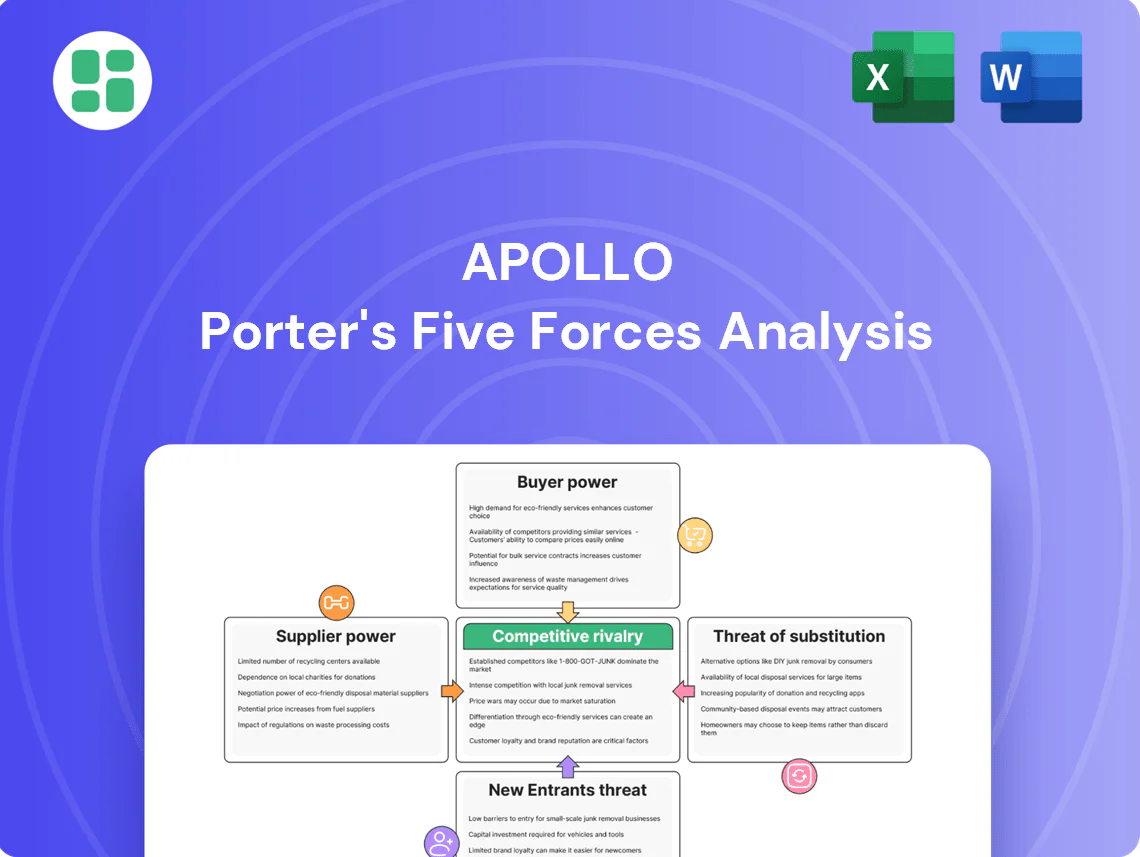
The Apollo Porter's Five Forces Analysis reveals the intricate web of competitive pressures shaping its market. Understanding the intensity of rivalry, the power of buyers and suppliers, and the threats of new entrants and substitutes is crucial for strategic planning.
This brief snapshot only scratches the surface. Unlock the full Porter's Five Forces Analysis to explore Apollo’s competitive dynamics, market pressures, and strategic advantages in detail.
Suppliers Bargaining Power

Talent Acquisition and Retention
In the realm of alternative investments, the bargaining power of suppliers, particularly in talent acquisition and retention, is a significant factor. The specialized knowledge required for deal origination and portfolio management in areas like private equity or venture capital means that experienced professionals are in high demand. This scarcity directly translates to their ability to negotiate favorable terms, impacting compensation and firm profitability.
As of early 2024, the competition for top talent in alternative asset management remains intense. For instance, average compensation packages for private equity professionals with 5-10 years of experience can easily exceed $300,000 annually, including base salary, bonus, and carried interest. This high cost of talent, driven by the specialized skills and proven track records of these individuals, underscores their substantial bargaining power.
Proprietary Data and Analytics Providers
Proprietary data and analytics providers hold significant sway, particularly when their offerings are crucial for uncovering alpha in alternative investments. Firms like Apollo rely on unique market data and advanced analytics, making it difficult to substitute these specialized research platforms. This dependence allows these providers to exert considerable bargaining power, directly impacting operational costs and a firm's competitive advantage.

Technology and Software Vendors
Technology and software vendors hold significant bargaining power over Apollo, especially those offering proprietary trading platforms or specialized risk management systems. In 2024, the increasing reliance on AI-driven analytics and cloud infrastructure means Apollo is dependent on a select group of providers for its core operations. These vendors can dictate terms, as switching costs for mission-critical software are substantial, potentially impacting Apollo's operational efficiency and profitability.

Legal, Regulatory, and Compliance Services
The financial sector's heavy regulation means top-tier legal, compliance, and auditing services are essential. This necessity, combined with specialized knowledge and strict rules, gives firms in these areas considerable leverage, directly affecting companies' operating costs.
For instance, in 2024, the global legal services market was valued at over $700 billion, with a significant portion dedicated to financial compliance and regulatory advisory. The complexity of regulations like MiFID II or Dodd-Frank necessitates deep expertise, making it difficult for financial institutions to switch providers without substantial disruption and cost.
Key aspects influencing this bargaining power include:
- High Switching Costs: Transitioning between legal and compliance providers involves extensive knowledge transfer and potential regulatory re-approval processes, making it costly and time-consuming.
- Specialized Expertise: The intricate and ever-evolving nature of financial regulations requires highly specialized knowledge that is not easily replicated.
- Risk Mitigation: Engaging reputable legal and compliance firms is crucial for avoiding hefty fines and reputational damage, reinforcing their indispensable role.
Financial Intermediaries and Placement Agents
Financial intermediaries and placement agents, while not traditional suppliers, can wield significant bargaining power over Apollo. Their expertise in connecting Apollo with specific limited partners (LPs) or sourcing lucrative deal opportunities is crucial for capital raising and investment success.
These agents' extensive networks and proven ability to facilitate capital flows grant them leverage in negotiating fees. For instance, in 2024, placement agent fees for private equity funds typically ranged from 1% to 2% of committed capital, with top-tier agents commanding the higher end due to their access to institutional investors.
- Network Access: Placement agents provide access to a curated list of LPs, saving Apollo significant time and resources in investor outreach.
- Deal Sourcing: Consultants can identify proprietary deal flow, giving Apollo a competitive edge in acquisitions.
- Fee Negotiation: The value of these services translates into bargaining power for agents during fee discussions.
- Market Intelligence: Agents often possess deep insights into LP sentiment and market trends, which can influence deal terms.
Specialized Suppliers Wield Significant Power Over Investment Firms
The bargaining power of suppliers for Apollo is substantial, particularly concerning specialized talent and proprietary data crucial for alternative investments. High demand for experienced professionals in private equity, with compensation packages in early 2024 often exceeding $300,000 annually, highlights this leverage.
Furthermore, exclusive data analytics providers and critical technology vendors, essential for competitive edge and operational efficiency, can dictate terms due to high switching costs. This dependence allows these suppliers to exert significant influence on Apollo's operational expenses and strategic execution.
| Supplier Type | Key Influence Factor | 2024 Impact Example |
|---|---|---|
| Talent (PE Professionals) | Scarcity and specialized skills | Annual compensation > $300k |
| Data Providers | Proprietary market data | Crucial for alpha generation |
| Technology Vendors | Mission-critical software/AI | High switching costs |
| Legal/Compliance Firms | Regulatory expertise | Global legal services market > $700B |
| Placement Agents | LP networks and deal sourcing | Fees of 1-2% of committed capital |
What is included in the product
 Detailed Word Document
Uncovers key drivers of competition, customer influence, and market entry risks tailored to Apollo's specific industry context.

 Customizable Excel Spreadsheet
Quickly identify and address competitive threats with a visual breakdown of all five forces, simplifying complex market dynamics.
Customers Bargaining Power

Large Institutional Investors
Large institutional investors, including pension funds, sovereign wealth funds, and endowments, represent a significant portion of Apollo's client base. These sophisticated entities manage vast sums of capital, granting them substantial leverage in negotiations. Their ability to allocate or withdraw large amounts of money means they can often dictate terms related to management fees, performance fees, and other fund-specific conditions, influencing Apollo's revenue streams.
Access to Alternative Investment Options
Clients today have a vast selection of alternative investment managers, not just direct rivals but also large, diversified financial firms. This wide availability empowers them to scrutinize performance metrics, fee schedules, and unique investment approaches. For instance, as of early 2024, the global alternative investment market was valued at an estimated $14.5 trillion, with significant growth projected, offering clients more leverage than ever before.
This extensive choice directly translates into increased bargaining power for customers. They can readily compare offerings and demand better terms, such as reduced management fees or performance-based incentives. The ability to switch providers easily if expectations aren't met means Apollo must continuously demonstrate value and competitive pricing to retain and attract clients in this dynamic landscape.

Performance-Driven Relationships
Client relationships at Apollo are intrinsically tied to investment performance. If returns fall short of expectations, clients can withdraw capital or withhold new investments, a clear demonstration of their leverage.
This dynamic compels Apollo to prioritize generating strong returns and consistently maintaining an impressive track record to retain and attract capital. For instance, in 2024, many alternative asset managers faced pressure as public market volatility impacted private market valuations, highlighting the critical nature of performance in maintaining client trust and capital commitments.

Transparency and Reporting Demands
Sophisticated institutional investors, a key customer segment for asset managers like Apollo, are increasingly vocal about their reporting needs. These investors, including large pension funds and endowments, demand granular detail on portfolio performance, risk exposures, and adherence to specific Environmental, Social, and Governance (ESG) mandates. Their capacity to shift assets to managers who provide this level of transparency directly enhances their bargaining power.
This trend is evident in the growing emphasis on ESG integration within investment portfolios. For instance, by mid-2024, a significant portion of institutional capital was being allocated with ESG considerations, forcing asset managers to adapt their reporting frameworks to meet these evolving client expectations. Apollo, like its peers, must demonstrate robust ESG data and reporting capabilities to retain and attract these influential clients.
- Increased Demand for ESG Reporting: Institutional investors are prioritizing ESG factors, influencing manager selection and demanding detailed reporting on these metrics.
- Transparency as a Differentiator: High levels of operational and reporting transparency are becoming a competitive advantage, empowering clients to choose providers that meet their standards.
- Data-Driven Investment Decisions: Sophisticated investors leverage detailed data to scrutinize managers, thereby increasing their leverage in fee negotiations and service level agreements.
Long-Term Capital Commitments
Clients' long-term capital commitments, while substantial, offer a critical bargaining chip. The decision to renew or allocate new capital to Apollo's subsequent funds hinges on demonstrated past performance and a positive client experience. For instance, as of Q1 2024, Apollo reported $675 billion in assets under management (AUM), a significant portion of which represents these long-term commitments.
This ongoing reliance on client satisfaction directly influences Apollo's future AUM growth trajectory. Clients evaluate not only financial returns but also the alignment of interests and the overall service provided. A strong client retention rate, crucial for sustained growth, means Apollo must consistently deliver value and maintain trust.
- Client Leverage: The ability to re-up or allocate new capital provides clients with significant leverage.
- Performance Dependency: Future capital allocation is directly tied to satisfaction with past performance.
- AUM Growth Impact: Client retention and new allocations are vital for Apollo's ongoing AUM expansion.
- Client Experience Matters: Beyond returns, the overall client experience and alignment of interests are key decision factors.
Capital's Clout: Clients Command Investment Terms
Customers, particularly large institutional investors, wield considerable power due to their substantial capital allocations and the wide array of alternative investment managers available. This extensive choice, coupled with a growing demand for transparency and ESG reporting, allows clients to negotiate favorable terms and exert pressure on Apollo to consistently deliver strong performance and superior service. The ability for clients to easily switch providers if their expectations are not met underscores their significant bargaining power.
| Customer Segment | Leverage Factors | Impact on Apollo |
|---|---|---|
| Institutional Investors (Pension Funds, Endowments) | Large capital commitments, ability to allocate/withdraw significant sums | Dictate terms on fees, demand detailed ESG and performance reporting |
| Sophisticated Investors | Access to vast market data, ability to compare managers | Increased scrutiny of performance metrics and fee structures, driving fee pressure |
| Clients with Long-Term Commitments | Decision to renew or allocate new capital to future funds | Directly influences Apollo's AUM growth and retention rates; requires consistent value delivery |
Same Document Delivered
Apollo Porter's Five Forces Analysis
This preview showcases the complete Apollo Porter's Five Forces Analysis, offering a detailed examination of competitive pressures within its industry. The document you see here is the exact, professionally formatted report you will receive immediately after purchase, ensuring no surprises or placeholders. You can confidently expect to download this comprehensive analysis, ready for immediate application to your strategic decision-making.

Original: $10.00
-70%$10.00
$3.00Product Information
Product Information
Shipping & Returns
Shipping & Returns
Description
Elevate Your Analysis with the Complete Porter's Five Forces Analysis
The Apollo Porter's Five Forces Analysis reveals the intricate web of competitive pressures shaping its market. Understanding the intensity of rivalry, the power of buyers and suppliers, and the threats of new entrants and substitutes is crucial for strategic planning.
This brief snapshot only scratches the surface. Unlock the full Porter's Five Forces Analysis to explore Apollo’s competitive dynamics, market pressures, and strategic advantages in detail.
Suppliers Bargaining Power
Talent Acquisition and Retention
In the realm of alternative investments, the bargaining power of suppliers, particularly in talent acquisition and retention, is a significant factor. The specialized knowledge required for deal origination and portfolio management in areas like private equity or venture capital means that experienced professionals are in high demand. This scarcity directly translates to their ability to negotiate favorable terms, impacting compensation and firm profitability.
As of early 2024, the competition for top talent in alternative asset management remains intense. For instance, average compensation packages for private equity professionals with 5-10 years of experience can easily exceed $300,000 annually, including base salary, bonus, and carried interest. This high cost of talent, driven by the specialized skills and proven track records of these individuals, underscores their substantial bargaining power.
Proprietary Data and Analytics Providers
Proprietary data and analytics providers hold significant sway, particularly when their offerings are crucial for uncovering alpha in alternative investments. Firms like Apollo rely on unique market data and advanced analytics, making it difficult to substitute these specialized research platforms. This dependence allows these providers to exert considerable bargaining power, directly impacting operational costs and a firm's competitive advantage.
Technology and Software Vendors
Technology and software vendors hold significant bargaining power over Apollo, especially those offering proprietary trading platforms or specialized risk management systems. In 2024, the increasing reliance on AI-driven analytics and cloud infrastructure means Apollo is dependent on a select group of providers for its core operations. These vendors can dictate terms, as switching costs for mission-critical software are substantial, potentially impacting Apollo's operational efficiency and profitability.
Legal, Regulatory, and Compliance Services
The financial sector's heavy regulation means top-tier legal, compliance, and auditing services are essential. This necessity, combined with specialized knowledge and strict rules, gives firms in these areas considerable leverage, directly affecting companies' operating costs.
For instance, in 2024, the global legal services market was valued at over $700 billion, with a significant portion dedicated to financial compliance and regulatory advisory. The complexity of regulations like MiFID II or Dodd-Frank necessitates deep expertise, making it difficult for financial institutions to switch providers without substantial disruption and cost.
Key aspects influencing this bargaining power include:
- High Switching Costs: Transitioning between legal and compliance providers involves extensive knowledge transfer and potential regulatory re-approval processes, making it costly and time-consuming.
- Specialized Expertise: The intricate and ever-evolving nature of financial regulations requires highly specialized knowledge that is not easily replicated.
- Risk Mitigation: Engaging reputable legal and compliance firms is crucial for avoiding hefty fines and reputational damage, reinforcing their indispensable role.
Financial Intermediaries and Placement Agents
Financial intermediaries and placement agents, while not traditional suppliers, can wield significant bargaining power over Apollo. Their expertise in connecting Apollo with specific limited partners (LPs) or sourcing lucrative deal opportunities is crucial for capital raising and investment success.
These agents' extensive networks and proven ability to facilitate capital flows grant them leverage in negotiating fees. For instance, in 2024, placement agent fees for private equity funds typically ranged from 1% to 2% of committed capital, with top-tier agents commanding the higher end due to their access to institutional investors.
- Network Access: Placement agents provide access to a curated list of LPs, saving Apollo significant time and resources in investor outreach.
- Deal Sourcing: Consultants can identify proprietary deal flow, giving Apollo a competitive edge in acquisitions.
- Fee Negotiation: The value of these services translates into bargaining power for agents during fee discussions.
- Market Intelligence: Agents often possess deep insights into LP sentiment and market trends, which can influence deal terms.
Specialized Suppliers Wield Significant Power Over Investment Firms
The bargaining power of suppliers for Apollo is substantial, particularly concerning specialized talent and proprietary data crucial for alternative investments. High demand for experienced professionals in private equity, with compensation packages in early 2024 often exceeding $300,000 annually, highlights this leverage.
Furthermore, exclusive data analytics providers and critical technology vendors, essential for competitive edge and operational efficiency, can dictate terms due to high switching costs. This dependence allows these suppliers to exert significant influence on Apollo's operational expenses and strategic execution.
| Supplier Type | Key Influence Factor | 2024 Impact Example |
|---|---|---|
| Talent (PE Professionals) | Scarcity and specialized skills | Annual compensation > $300k |
| Data Providers | Proprietary market data | Crucial for alpha generation |
| Technology Vendors | Mission-critical software/AI | High switching costs |
| Legal/Compliance Firms | Regulatory expertise | Global legal services market > $700B |
| Placement Agents | LP networks and deal sourcing | Fees of 1-2% of committed capital |
What is included in the product
Detailed Word Document
Uncovers key drivers of competition, customer influence, and market entry risks tailored to Apollo's specific industry context.
Customizable Excel Spreadsheet
Quickly identify and address competitive threats with a visual breakdown of all five forces, simplifying complex market dynamics.
Customers Bargaining Power
Large Institutional Investors
Large institutional investors, including pension funds, sovereign wealth funds, and endowments, represent a significant portion of Apollo's client base. These sophisticated entities manage vast sums of capital, granting them substantial leverage in negotiations. Their ability to allocate or withdraw large amounts of money means they can often dictate terms related to management fees, performance fees, and other fund-specific conditions, influencing Apollo's revenue streams.
Access to Alternative Investment Options
Clients today have a vast selection of alternative investment managers, not just direct rivals but also large, diversified financial firms. This wide availability empowers them to scrutinize performance metrics, fee schedules, and unique investment approaches. For instance, as of early 2024, the global alternative investment market was valued at an estimated $14.5 trillion, with significant growth projected, offering clients more leverage than ever before.
This extensive choice directly translates into increased bargaining power for customers. They can readily compare offerings and demand better terms, such as reduced management fees or performance-based incentives. The ability to switch providers easily if expectations aren't met means Apollo must continuously demonstrate value and competitive pricing to retain and attract clients in this dynamic landscape.
Performance-Driven Relationships
Client relationships at Apollo are intrinsically tied to investment performance. If returns fall short of expectations, clients can withdraw capital or withhold new investments, a clear demonstration of their leverage.
This dynamic compels Apollo to prioritize generating strong returns and consistently maintaining an impressive track record to retain and attract capital. For instance, in 2024, many alternative asset managers faced pressure as public market volatility impacted private market valuations, highlighting the critical nature of performance in maintaining client trust and capital commitments.
Transparency and Reporting Demands
Sophisticated institutional investors, a key customer segment for asset managers like Apollo, are increasingly vocal about their reporting needs. These investors, including large pension funds and endowments, demand granular detail on portfolio performance, risk exposures, and adherence to specific Environmental, Social, and Governance (ESG) mandates. Their capacity to shift assets to managers who provide this level of transparency directly enhances their bargaining power.
This trend is evident in the growing emphasis on ESG integration within investment portfolios. For instance, by mid-2024, a significant portion of institutional capital was being allocated with ESG considerations, forcing asset managers to adapt their reporting frameworks to meet these evolving client expectations. Apollo, like its peers, must demonstrate robust ESG data and reporting capabilities to retain and attract these influential clients.
- Increased Demand for ESG Reporting: Institutional investors are prioritizing ESG factors, influencing manager selection and demanding detailed reporting on these metrics.
- Transparency as a Differentiator: High levels of operational and reporting transparency are becoming a competitive advantage, empowering clients to choose providers that meet their standards.
- Data-Driven Investment Decisions: Sophisticated investors leverage detailed data to scrutinize managers, thereby increasing their leverage in fee negotiations and service level agreements.
Long-Term Capital Commitments
Clients' long-term capital commitments, while substantial, offer a critical bargaining chip. The decision to renew or allocate new capital to Apollo's subsequent funds hinges on demonstrated past performance and a positive client experience. For instance, as of Q1 2024, Apollo reported $675 billion in assets under management (AUM), a significant portion of which represents these long-term commitments.
This ongoing reliance on client satisfaction directly influences Apollo's future AUM growth trajectory. Clients evaluate not only financial returns but also the alignment of interests and the overall service provided. A strong client retention rate, crucial for sustained growth, means Apollo must consistently deliver value and maintain trust.
- Client Leverage: The ability to re-up or allocate new capital provides clients with significant leverage.
- Performance Dependency: Future capital allocation is directly tied to satisfaction with past performance.
- AUM Growth Impact: Client retention and new allocations are vital for Apollo's ongoing AUM expansion.
- Client Experience Matters: Beyond returns, the overall client experience and alignment of interests are key decision factors.
Capital's Clout: Clients Command Investment Terms
Customers, particularly large institutional investors, wield considerable power due to their substantial capital allocations and the wide array of alternative investment managers available. This extensive choice, coupled with a growing demand for transparency and ESG reporting, allows clients to negotiate favorable terms and exert pressure on Apollo to consistently deliver strong performance and superior service. The ability for clients to easily switch providers if their expectations are not met underscores their significant bargaining power.
| Customer Segment | Leverage Factors | Impact on Apollo |
|---|---|---|
| Institutional Investors (Pension Funds, Endowments) | Large capital commitments, ability to allocate/withdraw significant sums | Dictate terms on fees, demand detailed ESG and performance reporting |
| Sophisticated Investors | Access to vast market data, ability to compare managers | Increased scrutiny of performance metrics and fee structures, driving fee pressure |
| Clients with Long-Term Commitments | Decision to renew or allocate new capital to future funds | Directly influences Apollo's AUM growth and retention rates; requires consistent value delivery |
Same Document Delivered
Apollo Porter's Five Forces Analysis
This preview showcases the complete Apollo Porter's Five Forces Analysis, offering a detailed examination of competitive pressures within its industry. The document you see here is the exact, professionally formatted report you will receive immediately after purchase, ensuring no surprises or placeholders. You can confidently expect to download this comprehensive analysis, ready for immediate application to your strategic decision-making.