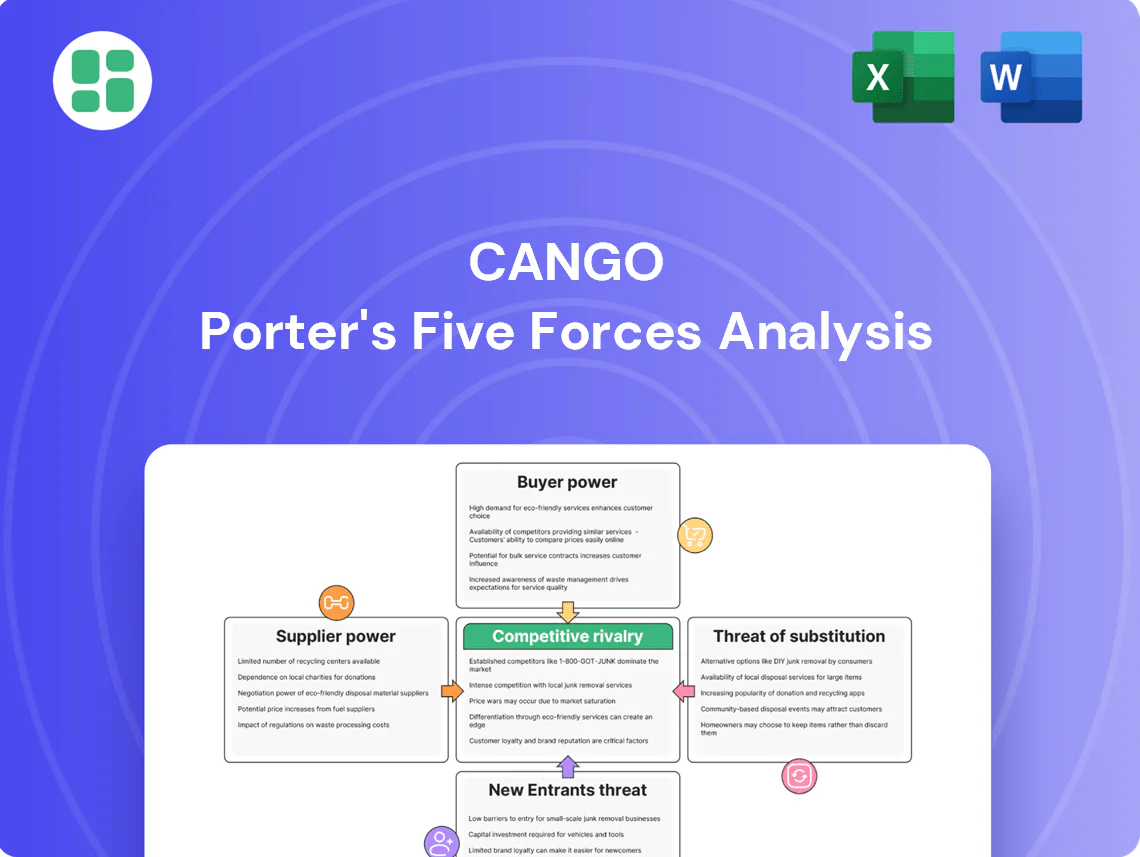
Cango Porter's Five Forces Analysis

Elevate Your Analysis with the Complete Porter's Five Forces Analysis
Our Porter's Five Forces Analysis of Cango reveals critical insights into the competitive landscape, including the bargaining power of buyers and suppliers, the threat of new entrants, and the intensity of rivalry. Understanding these forces is crucial for navigating Cango's market effectively.
This brief snapshot only scratches the surface. Unlock the full Porter's Five Forces Analysis to explore Cango’s competitive dynamics, market pressures, and strategic advantages in detail.
Suppliers Bargaining Power

Financial Institutions
The bargaining power of financial institutions supplying capital for auto financing to Cango Inc. is a significant factor, generally considered moderate to high. Cango depends on these institutions to provide the necessary financing options for its customers, directly impacting the platform's competitiveness and profitability. For instance, in 2024, the automotive financing sector saw continued consolidation, with larger banks and specialized lenders holding substantial market share.
Major financial players, due to their scale, established regulatory compliance, and deep pockets, often have the leverage to dictate terms. This can translate to higher interest rates or stricter collateral requirements for Cango. However, Cango's extensive network of dealerships and its substantial customer transaction volume can serve as a counter-leveraging point, offering these financial institutions access to a large and active market. The ability of Cango to attract and retain a broad base of car buyers and sellers provides a valuable pipeline of business for lenders.
Automotive Dealers (as sources of inventory/customers)
Automotive dealers, especially those with high sales volumes or specialized inventory, wield a degree of bargaining power over Cango. They are essential for Cango's platform, acting as the conduit to both car buyers and the vehicles themselves. Cango's success hinges on its ability to cultivate and maintain a robust network of these dealers, as they are the gatekeepers to its financing and transaction services.
While dealers are critical, their power is tempered by the competitive landscape. The sheer number of dealers vying for business, coupled with the benefits Cango's platform offers—like simplified financing processes and access to a wider customer base—can reduce individual dealer leverage. For instance, in 2023, Cango reported facilitating transactions for a significant number of vehicles, demonstrating its value proposition to dealers seeking to expand their reach and streamline sales.

Technology and Data Providers
Suppliers of technology infrastructure, software, and big data analytics tools for Cango generally possess moderate bargaining power. Cango's operations, risk management, and user experience heavily depend on these advanced technologies and data insights.
Specialized providers, particularly those offering proprietary AI-driven analytics or critical cloud infrastructure, can exert greater influence. For instance, a significant portion of the global cloud computing market, estimated to reach over $1 trillion by 2024, is dominated by a few key players, giving them leverage.

Marketing and Advertising Platforms
Online automotive advertising platforms and other marketing channels that Cango utilizes to reach users and dealers possess a degree of bargaining power. The cost and efficacy of these platforms are crucial to Cango's approach to acquiring new customers.
Dominant digital marketing channels in China, such as Tencent's WeChat and Alibaba's platforms, can significantly influence pricing and terms. This directly impacts Cango's sales and marketing expenditures, as seen in the competitive landscape for user and dealer acquisition.
- Increased Marketing Costs: In 2023, digital advertising spending in China continued to rise, with automotive sectors often facing higher customer acquisition costs due to intense competition.
- Platform Dependency: Cango's reliance on a few major platforms means these providers can exert pressure on pricing and service terms.
- Effectiveness Measurement: The ability of these platforms to deliver measurable results for Cango influences their negotiation leverage; if a platform is less effective, Cango has more power.
Regulatory Bodies (Indirect Supplier)
Government and regulatory bodies in China function as significant indirect suppliers for Cango, shaping the operational landscape. Their directives on auto finance, data privacy, and market access directly impact Cango's strategic decisions and cost structures. For instance, in 2023, China's cybersecurity review measures, including those for network data security, imposed stricter compliance burdens on companies handling user data, potentially increasing operational expenses for Cango.
These entities wield substantial bargaining power by setting the rules of engagement. Cango's ability to operate and grow is contingent on adhering to these regulations. Failure to comply can result in penalties or restrictions, underscoring the indirect suppliers' influence. The evolving regulatory environment means Cango must remain agile, investing in compliance to mitigate risks and maintain its license to operate.
- Regulatory Framework: Chinese government bodies establish the legal and operational guidelines for the automotive finance sector.
- Data Security Mandates: Regulations concerning network data security, such as those enforced in 2023, necessitate significant investment in compliance for companies like Cango.
- Market Access and Operations: Policies on market entry and operational conduct directly influence Cango's business model and risk exposure.
- Compliance Costs: Adherence to evolving regulations represents a mandatory and often substantial cost for Cango.
Supplier Bargaining Power Shapes Cango's Business
Suppliers of technology and data analytics tools generally hold moderate bargaining power over Cango. Cango's reliance on specialized software and cloud services means these providers can influence pricing. For instance, the dominance of a few major cloud providers in 2024 gives them leverage, potentially increasing Cango's infrastructure costs.
Online advertising platforms, crucial for customer acquisition, also exhibit bargaining power. Dominant Chinese digital marketing channels can dictate terms, impacting Cango's marketing expenditures. In 2023, rising digital ad costs in China meant higher customer acquisition expenses for automotive firms.
Government and regulatory bodies act as indirect suppliers, wielding significant power through setting operational rules. Cango's compliance with directives on data privacy and auto finance, like those tightened in 2023, incurs costs and shapes its strategy.
| Supplier Type | Bargaining Power Level | Key Factors Influencing Power | Impact on Cango |
|---|---|---|---|
| Financial Institutions | Moderate to High | Market share, scale, Cango's transaction volume | Terms of financing, interest rates |
| Automotive Dealers | Moderate | Sales volume, Cango's network value, dealer competition | Platform adoption, service level agreements |
| Technology & Data Providers | Moderate | Proprietary technology, market concentration (e.g., cloud) | Software costs, data service fees |
| Advertising Platforms | Moderate to High | Market dominance (e.g., WeChat, Alibaba), ad cost trends | Customer acquisition costs |
| Government/Regulators | High (Indirect) | Regulatory framework, data security mandates | Compliance costs, operational restrictions |
What is included in the product
 Detailed Word Document
Analyzes the competitive forces impacting Cango, including buyer and supplier power, threat of new entrants and substitutes, and existing rivalry, to understand its market position and profitability.

 Customizable Excel Spreadsheet
Instantly identify and mitigate competitive threats with a dynamic, visual representation of all five forces, enabling proactive strategy adjustments.
Customers Bargaining Power

Car Buyers
Car buyers in China wield considerable bargaining power, a key factor for Cango. The Chinese auto market is incredibly competitive, offering buyers many choices for both vehicles and financing. In 2024, with the ongoing expansion of the new energy vehicle (NEV) market, buyers are further empowered by a wide array of financing options, including those from traditional banks, online platforms, and direct manufacturer financing arms.
Buyers can easily compare deals across different providers, putting pressure on companies like Cango to offer competitive rates and terms. This accessibility to multiple financing solutions, coupled with government incentives for NEVs and trade-in programs, allows consumers to negotiate for the most favorable conditions, directly impacting Cango's service margins and customer acquisition costs.
Automotive Dealers (as users of Cango's services)
Automotive dealers, especially smaller independent ones, possess moderate bargaining power with Cango. They can opt for alternative transaction service providers or establish their own in-house financing, limiting Cango's leverage. The ease with which dealers can switch platforms and the tangible value Cango provides in sales and customer acquisition directly influence their negotiating strength.

Financial Institutions (as Cango's partners)
Financial institutions partnering with Cango to originate loans wield significant bargaining power. They are both suppliers, providing the capital for loans, and customers, utilizing Cango's platform to connect with car buyers. In 2024, the competitive landscape for auto financing means these institutions can negotiate terms, impacting Cango's fee structure and profitability.
These institutions can leverage alternative channels to originate auto loans, reducing their reliance on Cango. This gives them leverage to push for more favorable interest rates and risk-sharing agreements, directly affecting Cango's revenue streams from its financing facilitation services.

Used Car Exporters/International Buyers
Used car exporters and international buyers wield significant bargaining power when dealing with platforms like Cango. Their ability to negotiate stems from their need for a complete export solution, encompassing vehicle inspection, complex logistics, and customs procedures. These buyers can easily switch between different export facilitators, making Cango's value proposition crucial.
The effectiveness of Cango's platform in managing cross-border transactions directly influences these buyers' willingness to engage. Factors like service transparency, operational efficiency, and overall cost-competitiveness are paramount. For instance, in 2023, the global used car market saw continued growth, with export markets playing an increasingly vital role, underscoring the importance of competitive pricing and streamlined processes for international buyers.
- Demand for Comprehensive Services: International buyers require end-to-end solutions, including quality inspections, shipping arrangements, and customs brokerage.
- Availability of Alternatives: The presence of numerous other export facilitators means buyers can readily compare and select the most advantageous option.
- Price Sensitivity: Cross-border transactions are often cost-sensitive, making competitive pricing a key determinant for these buyers.
- Transparency and Efficiency: Buyers prioritize clear communication and efficient processing to minimize delays and unexpected costs in international trade.
Evolving Consumer Preferences
The rapid shift in consumer preferences towards New Energy Vehicles (NEVs) and smart vehicle features in China significantly bolsters buyer leverage. For instance, in 2023, NEV sales in China surpassed 9 million units, representing a substantial portion of the total automotive market and indicating a strong consumer demand for these technologies.
This evolving landscape necessitates that Cango, as a platform, must proactively adapt its service offerings and forge strategic partnerships. This includes developing specialized NEV financing solutions and ensuring seamless integration with advanced in-car technology to meet these growing demands.
Failure to cater to these evolving consumer preferences could result in a considerable loss of Cango's customer base, as buyers increasingly seek out platforms that align with the latest automotive trends and technological advancements.
- NEV sales in China: Over 9 million units in 2023.
- Consumer demand: Growing preference for NEVs and smart vehicle features.
- Cango's adaptation: Need for specialized NEV financing and tech integration.
- Risk of non-compliance: Potential loss of customer base.
Shifting Power: China's Car Buyers & Dealers Influence Cango's Profitability
Car buyers in China, especially those interested in New Energy Vehicles (NEVs), possess significant bargaining power due to the highly competitive market and diverse financing options available in 2024. This allows them to easily compare offers and negotiate favorable terms, directly impacting Cango's profitability.
The growing demand for NEVs, with over 9 million units sold in China in 2023, further empowers consumers. Cango must adapt by offering specialized NEV financing and integrating smart vehicle technologies to retain its customer base.
Automotive dealers and financial institutions also exert considerable bargaining power, as they can utilize alternative platforms or in-house solutions, forcing Cango to offer competitive fee structures and risk-sharing agreements.
| Customer Segment | Bargaining Power Factors | Impact on Cango |
|---|---|---|
| General Car Buyers | Numerous vehicle choices, competitive financing rates, government incentives (e.g., NEV subsidies) | Pressure on service margins, increased customer acquisition costs |
| NEV Buyers | Rapid NEV market growth (9M+ units in 2023), advanced technology features, diverse financing for NEVs | Need for specialized financing solutions, risk of losing customers to tech-aligned platforms |
| Automotive Dealers | Ability to switch providers, establish in-house financing, reliance on Cango for sales support | Negotiation leverage on fees, potential for reduced platform usage |
| Financial Institutions | Alternative origination channels, ability to negotiate rates and risk-sharing | Direct impact on Cango's revenue from financing facilitation |
| Used Car Exporters/International Buyers | Need for end-to-end export solutions, price sensitivity, availability of alternative facilitators | Emphasis on competitive pricing, operational efficiency, and transparent processes |
What You See Is What You Get
Cango Porter's Five Forces Analysis
This preview showcases the complete Cango Porter's Five Forces Analysis, offering a detailed examination of competitive forces within the automotive industry. The document you see here is precisely what you will receive immediately after purchase, ensuring full transparency and immediate usability for your strategic planning needs.

Original: $10.00
-70%$10.00
$3.00Product Information
Product Information
Shipping & Returns
Shipping & Returns
Description
Elevate Your Analysis with the Complete Porter's Five Forces Analysis
Our Porter's Five Forces Analysis of Cango reveals critical insights into the competitive landscape, including the bargaining power of buyers and suppliers, the threat of new entrants, and the intensity of rivalry. Understanding these forces is crucial for navigating Cango's market effectively.
This brief snapshot only scratches the surface. Unlock the full Porter's Five Forces Analysis to explore Cango’s competitive dynamics, market pressures, and strategic advantages in detail.
Suppliers Bargaining Power
Financial Institutions
The bargaining power of financial institutions supplying capital for auto financing to Cango Inc. is a significant factor, generally considered moderate to high. Cango depends on these institutions to provide the necessary financing options for its customers, directly impacting the platform's competitiveness and profitability. For instance, in 2024, the automotive financing sector saw continued consolidation, with larger banks and specialized lenders holding substantial market share.
Major financial players, due to their scale, established regulatory compliance, and deep pockets, often have the leverage to dictate terms. This can translate to higher interest rates or stricter collateral requirements for Cango. However, Cango's extensive network of dealerships and its substantial customer transaction volume can serve as a counter-leveraging point, offering these financial institutions access to a large and active market. The ability of Cango to attract and retain a broad base of car buyers and sellers provides a valuable pipeline of business for lenders.
Automotive Dealers (as sources of inventory/customers)
Automotive dealers, especially those with high sales volumes or specialized inventory, wield a degree of bargaining power over Cango. They are essential for Cango's platform, acting as the conduit to both car buyers and the vehicles themselves. Cango's success hinges on its ability to cultivate and maintain a robust network of these dealers, as they are the gatekeepers to its financing and transaction services.
While dealers are critical, their power is tempered by the competitive landscape. The sheer number of dealers vying for business, coupled with the benefits Cango's platform offers—like simplified financing processes and access to a wider customer base—can reduce individual dealer leverage. For instance, in 2023, Cango reported facilitating transactions for a significant number of vehicles, demonstrating its value proposition to dealers seeking to expand their reach and streamline sales.
Technology and Data Providers
Suppliers of technology infrastructure, software, and big data analytics tools for Cango generally possess moderate bargaining power. Cango's operations, risk management, and user experience heavily depend on these advanced technologies and data insights.
Specialized providers, particularly those offering proprietary AI-driven analytics or critical cloud infrastructure, can exert greater influence. For instance, a significant portion of the global cloud computing market, estimated to reach over $1 trillion by 2024, is dominated by a few key players, giving them leverage.
Marketing and Advertising Platforms
Online automotive advertising platforms and other marketing channels that Cango utilizes to reach users and dealers possess a degree of bargaining power. The cost and efficacy of these platforms are crucial to Cango's approach to acquiring new customers.
Dominant digital marketing channels in China, such as Tencent's WeChat and Alibaba's platforms, can significantly influence pricing and terms. This directly impacts Cango's sales and marketing expenditures, as seen in the competitive landscape for user and dealer acquisition.
- Increased Marketing Costs: In 2023, digital advertising spending in China continued to rise, with automotive sectors often facing higher customer acquisition costs due to intense competition.
- Platform Dependency: Cango's reliance on a few major platforms means these providers can exert pressure on pricing and service terms.
- Effectiveness Measurement: The ability of these platforms to deliver measurable results for Cango influences their negotiation leverage; if a platform is less effective, Cango has more power.
Regulatory Bodies (Indirect Supplier)
Government and regulatory bodies in China function as significant indirect suppliers for Cango, shaping the operational landscape. Their directives on auto finance, data privacy, and market access directly impact Cango's strategic decisions and cost structures. For instance, in 2023, China's cybersecurity review measures, including those for network data security, imposed stricter compliance burdens on companies handling user data, potentially increasing operational expenses for Cango.
These entities wield substantial bargaining power by setting the rules of engagement. Cango's ability to operate and grow is contingent on adhering to these regulations. Failure to comply can result in penalties or restrictions, underscoring the indirect suppliers' influence. The evolving regulatory environment means Cango must remain agile, investing in compliance to mitigate risks and maintain its license to operate.
- Regulatory Framework: Chinese government bodies establish the legal and operational guidelines for the automotive finance sector.
- Data Security Mandates: Regulations concerning network data security, such as those enforced in 2023, necessitate significant investment in compliance for companies like Cango.
- Market Access and Operations: Policies on market entry and operational conduct directly influence Cango's business model and risk exposure.
- Compliance Costs: Adherence to evolving regulations represents a mandatory and often substantial cost for Cango.
Supplier Bargaining Power Shapes Cango's Business
Suppliers of technology and data analytics tools generally hold moderate bargaining power over Cango. Cango's reliance on specialized software and cloud services means these providers can influence pricing. For instance, the dominance of a few major cloud providers in 2024 gives them leverage, potentially increasing Cango's infrastructure costs.
Online advertising platforms, crucial for customer acquisition, also exhibit bargaining power. Dominant Chinese digital marketing channels can dictate terms, impacting Cango's marketing expenditures. In 2023, rising digital ad costs in China meant higher customer acquisition expenses for automotive firms.
Government and regulatory bodies act as indirect suppliers, wielding significant power through setting operational rules. Cango's compliance with directives on data privacy and auto finance, like those tightened in 2023, incurs costs and shapes its strategy.
| Supplier Type | Bargaining Power Level | Key Factors Influencing Power | Impact on Cango |
|---|---|---|---|
| Financial Institutions | Moderate to High | Market share, scale, Cango's transaction volume | Terms of financing, interest rates |
| Automotive Dealers | Moderate | Sales volume, Cango's network value, dealer competition | Platform adoption, service level agreements |
| Technology & Data Providers | Moderate | Proprietary technology, market concentration (e.g., cloud) | Software costs, data service fees |
| Advertising Platforms | Moderate to High | Market dominance (e.g., WeChat, Alibaba), ad cost trends | Customer acquisition costs |
| Government/Regulators | High (Indirect) | Regulatory framework, data security mandates | Compliance costs, operational restrictions |
What is included in the product
Detailed Word Document
Analyzes the competitive forces impacting Cango, including buyer and supplier power, threat of new entrants and substitutes, and existing rivalry, to understand its market position and profitability.
Customizable Excel Spreadsheet
Instantly identify and mitigate competitive threats with a dynamic, visual representation of all five forces, enabling proactive strategy adjustments.
Customers Bargaining Power
Car Buyers
Car buyers in China wield considerable bargaining power, a key factor for Cango. The Chinese auto market is incredibly competitive, offering buyers many choices for both vehicles and financing. In 2024, with the ongoing expansion of the new energy vehicle (NEV) market, buyers are further empowered by a wide array of financing options, including those from traditional banks, online platforms, and direct manufacturer financing arms.
Buyers can easily compare deals across different providers, putting pressure on companies like Cango to offer competitive rates and terms. This accessibility to multiple financing solutions, coupled with government incentives for NEVs and trade-in programs, allows consumers to negotiate for the most favorable conditions, directly impacting Cango's service margins and customer acquisition costs.
Automotive Dealers (as users of Cango's services)
Automotive dealers, especially smaller independent ones, possess moderate bargaining power with Cango. They can opt for alternative transaction service providers or establish their own in-house financing, limiting Cango's leverage. The ease with which dealers can switch platforms and the tangible value Cango provides in sales and customer acquisition directly influence their negotiating strength.
Financial Institutions (as Cango's partners)
Financial institutions partnering with Cango to originate loans wield significant bargaining power. They are both suppliers, providing the capital for loans, and customers, utilizing Cango's platform to connect with car buyers. In 2024, the competitive landscape for auto financing means these institutions can negotiate terms, impacting Cango's fee structure and profitability.
These institutions can leverage alternative channels to originate auto loans, reducing their reliance on Cango. This gives them leverage to push for more favorable interest rates and risk-sharing agreements, directly affecting Cango's revenue streams from its financing facilitation services.
Used Car Exporters/International Buyers
Used car exporters and international buyers wield significant bargaining power when dealing with platforms like Cango. Their ability to negotiate stems from their need for a complete export solution, encompassing vehicle inspection, complex logistics, and customs procedures. These buyers can easily switch between different export facilitators, making Cango's value proposition crucial.
The effectiveness of Cango's platform in managing cross-border transactions directly influences these buyers' willingness to engage. Factors like service transparency, operational efficiency, and overall cost-competitiveness are paramount. For instance, in 2023, the global used car market saw continued growth, with export markets playing an increasingly vital role, underscoring the importance of competitive pricing and streamlined processes for international buyers.
- Demand for Comprehensive Services: International buyers require end-to-end solutions, including quality inspections, shipping arrangements, and customs brokerage.
- Availability of Alternatives: The presence of numerous other export facilitators means buyers can readily compare and select the most advantageous option.
- Price Sensitivity: Cross-border transactions are often cost-sensitive, making competitive pricing a key determinant for these buyers.
- Transparency and Efficiency: Buyers prioritize clear communication and efficient processing to minimize delays and unexpected costs in international trade.
Evolving Consumer Preferences
The rapid shift in consumer preferences towards New Energy Vehicles (NEVs) and smart vehicle features in China significantly bolsters buyer leverage. For instance, in 2023, NEV sales in China surpassed 9 million units, representing a substantial portion of the total automotive market and indicating a strong consumer demand for these technologies.
This evolving landscape necessitates that Cango, as a platform, must proactively adapt its service offerings and forge strategic partnerships. This includes developing specialized NEV financing solutions and ensuring seamless integration with advanced in-car technology to meet these growing demands.
Failure to cater to these evolving consumer preferences could result in a considerable loss of Cango's customer base, as buyers increasingly seek out platforms that align with the latest automotive trends and technological advancements.
- NEV sales in China: Over 9 million units in 2023.
- Consumer demand: Growing preference for NEVs and smart vehicle features.
- Cango's adaptation: Need for specialized NEV financing and tech integration.
- Risk of non-compliance: Potential loss of customer base.
Shifting Power: China's Car Buyers & Dealers Influence Cango's Profitability
Car buyers in China, especially those interested in New Energy Vehicles (NEVs), possess significant bargaining power due to the highly competitive market and diverse financing options available in 2024. This allows them to easily compare offers and negotiate favorable terms, directly impacting Cango's profitability.
The growing demand for NEVs, with over 9 million units sold in China in 2023, further empowers consumers. Cango must adapt by offering specialized NEV financing and integrating smart vehicle technologies to retain its customer base.
Automotive dealers and financial institutions also exert considerable bargaining power, as they can utilize alternative platforms or in-house solutions, forcing Cango to offer competitive fee structures and risk-sharing agreements.
| Customer Segment | Bargaining Power Factors | Impact on Cango |
|---|---|---|
| General Car Buyers | Numerous vehicle choices, competitive financing rates, government incentives (e.g., NEV subsidies) | Pressure on service margins, increased customer acquisition costs |
| NEV Buyers | Rapid NEV market growth (9M+ units in 2023), advanced technology features, diverse financing for NEVs | Need for specialized financing solutions, risk of losing customers to tech-aligned platforms |
| Automotive Dealers | Ability to switch providers, establish in-house financing, reliance on Cango for sales support | Negotiation leverage on fees, potential for reduced platform usage |
| Financial Institutions | Alternative origination channels, ability to negotiate rates and risk-sharing | Direct impact on Cango's revenue from financing facilitation |
| Used Car Exporters/International Buyers | Need for end-to-end export solutions, price sensitivity, availability of alternative facilitators | Emphasis on competitive pricing, operational efficiency, and transparent processes |
What You See Is What You Get
Cango Porter's Five Forces Analysis
This preview showcases the complete Cango Porter's Five Forces Analysis, offering a detailed examination of competitive forces within the automotive industry. The document you see here is precisely what you will receive immediately after purchase, ensuring full transparency and immediate usability for your strategic planning needs.